









The "Great Wealth Transfer" is no longer a distant demographic forecast; it is an unfolding reality. As trillions of dollars in assets—ranging from real estate and brokerage accounts to family businesses and heirlooms—begin to migrate from the Baby Boomer generation to their heirs, a silent crisis is brewing in dining rooms and living rooms across the nation. While the transfer represents a historic opportunity for wealth accumulation, it frequently serves as a catalyst for deep-seated familial conflict, legal entanglement, and profound emotional trauma.
Despite the high financial stakes, inheritance remains a pervasive taboo. Many families find it more difficult to broach the topic of end-of-life financial logistics than they do discussing dating, political affiliations, or personal health. This culture of silence carries a heavy price, often leaving heirs to navigate the "fog of grief" while simultaneously untangling complex, poorly communicated, or nonexistent estate plans. To protect your family’s legacy and maintain harmony, it is time to move beyond silence and engage in proactive, transparent, and collaborative planning.
The Chronology of Conflict: Why Now?
The urgency surrounding this transfer is driven by a unique confluence of historical and economic factors. We are currently witnessing the largest intergenerational shift of wealth in human history. As the Boomer generation—which holds a massive portion of total household wealth—approaches the end of their life cycle, the structural mechanisms for passing on that wealth are being put to the test.
Historically, this transition occurs in three distinct phases:
- The Pre-Planning Phase: The period where, ideally, parents and children discuss wishes, values, and logistical preparations.
- The Event Phase: The death of a loved one, characterized by intense grief and the sudden onset of administrative responsibilities.
- The Settlement Phase: The long, often grueling process of probate, tax filings, and the final distribution of assets—a phase that can last anywhere from 12 to 24 months.
The crisis typically manifests during the transition from the first to the second phase. When the "Pre-Planning" phase is neglected, the "Event Phase" becomes a minefield of misunderstandings. Siblings, already processing the loss of a parent, are forced to interpret vague or outdated documents, leading to "echoes from the grave"—unresolved childhood rivalries that resurface when money is on the table.

Supporting Data: The Generational Disconnect
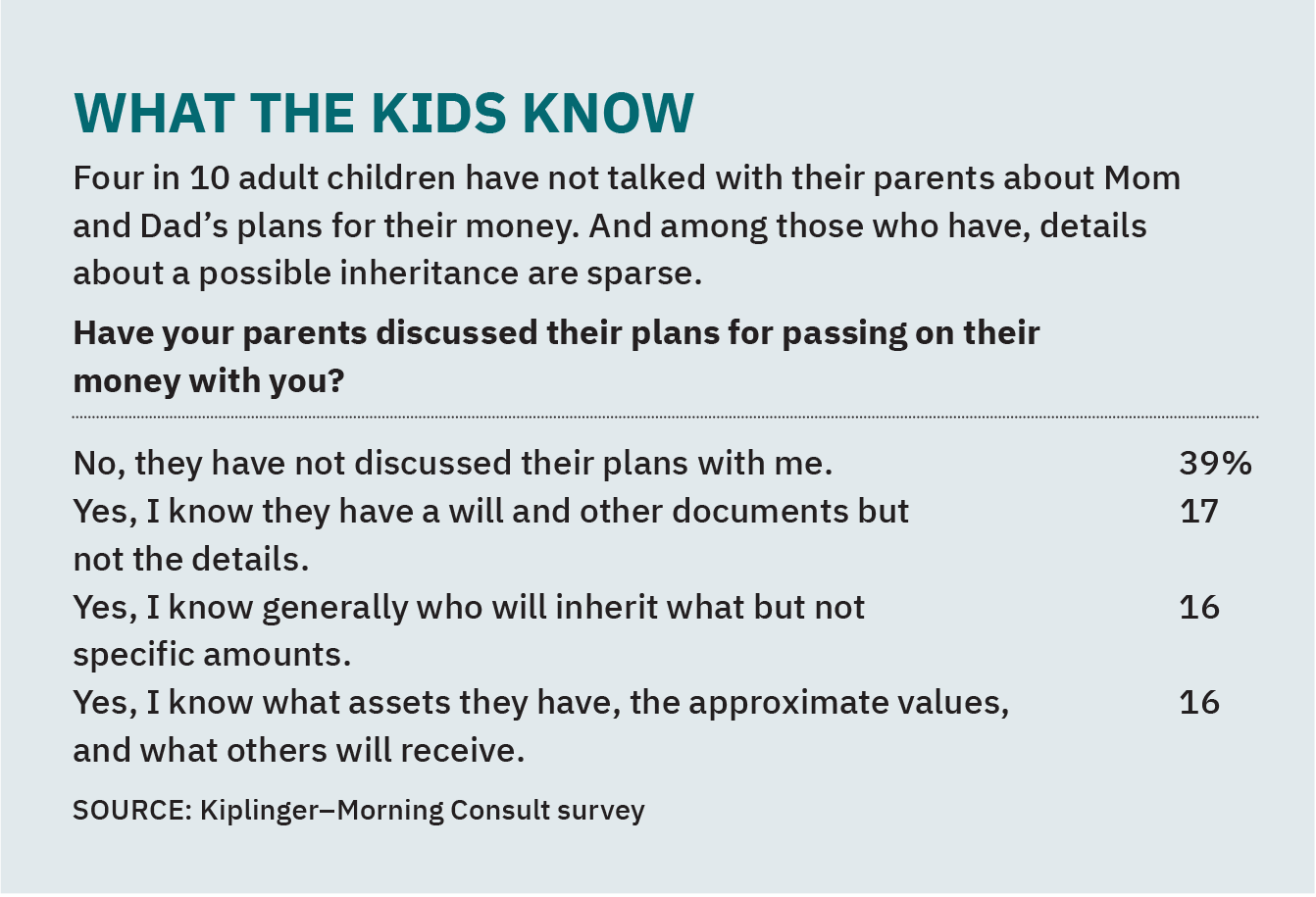
A recent survey commissioned by Kiplinger and conducted by Morning Consult as part of the "Trillion Dollar Talk" campaign sheds light on just how deep this divide goes. The findings reveal a startling reality: adult children are statistically more comfortable discussing their parents’ physical and mental health, or even their own personal romantic lives, than they are discussing inheritance.
The data also highlights a fundamental misalignment of expectations. Parents, by and large, lean toward an "equal split" of assets, believing this to be the most "fair" approach. Conversely, adult children often advocate for a more nuanced distribution, one that accounts for the varying levels of financial stability among siblings or the varying degrees of caregiving provided during the parents’ final years. This discrepancy is a primary driver of resentment; if a parent dies without having communicated the reasoning behind their estate plan, children are left to project their own insecurities and perceived slights onto the document.
Breaking the Ice: Creative Approaches to the "Talk"
Initiating a conversation about mortality and money is inherently uncomfortable. However, experts suggest that "creative entry points" can lower the emotional barrier.
Lindsay Bryan-Podvin, a financial therapist and founder of Mind Money Balance, suggests using external triggers to normalize the conversation. "Be creative when opening the door," she advises. "One jumping-off point could be a friend or colleague dealing with the loss of a parent and the logistical hurdles they faced while settling the estate."
By using a real-world example—a "what if this happened to us" scenario—you can pivot to the question of whether your own family’s documents are in order. Critically, these should not be one-off conversations. Estate planning is a living process. As life circumstances change—marriages, divorces, the birth of grandchildren, or shifts in asset value—the plan must evolve. Having these conversations periodically ensures that everyone is on the same page and that the "concrete details" are not just assumed, but understood.

The Role of the "Ethical Will"
While financial documents like wills and trusts address the what, they rarely address the why. Dr. Maggie Baker, a financial psychologist and author of Crazy About Money, emphasizes the importance of shifting the focus from mere assets to a "living legacy."
She advocates for the creation of an "ethical will." Unlike a legal will, which deals with property, an ethical will is a document that captures a person’s values, life lessons, and hopes for the next generation. By documenting these, parents can articulate the reasoning behind their financial decisions, providing context that can prevent confusion. This practice shifts the focus away from the taboo of "talking about money" and toward a celebration of shared values, which can be the bedrock of long-term family trust.
Preparing for the "Fog of Grief"
Losing a loved one is a transformative experience that impacts every facet of human existence—physical, emotional, relational, and cognitive. In this state, the "fog of grief" can make mundane tasks feel insurmountable.
A significant source of friction is the immediate cost of end-of-life services. To mitigate this, Dr. Podvin recommends that families establish a "liquidity buffer"—a savings account specifically earmarked for funeral and memorial expenses. Because estates can take over a year to settle, relying on inherited funds to cover these costs often results in financial strain for the heirs.
Furthermore, she suggests the use of a "payable-on-death" (POD) beneficiary designation for specific accounts. This allows the bank to release funds directly to a designated sibling upon the death of the account holder, bypassing the probate process entirely. This provides immediate, stress-free access to cash, preventing siblings from having to front personal money or fall into debt to cover final arrangements.
Addressing Inequality and Resentment Directly
Perhaps the most volatile element of the inheritance process is the perception of unfairness. When one sibling has served as the primary caregiver for an aging parent, and the other has been absent, an "equal split" of the estate can feel like a profound injustice to the caregiver.
Addressing this requires honesty. If you are the sibling who provided the majority of the care, it is reasonable to discuss how your time and sacrifice might be recognized. If you are the sibling who was less involved, acknowledging that effort is a necessary first step toward harmony.
"Make sure to give them a token of your appreciation," says Dr. Podvin. "This could be paying for a respite trip so they can recover, or financial compensation to offset the wages they lost while acting as a caregiver."
For those struggling with anger or feelings of being overlooked, Dr. Baker suggests seeking the guidance of a financial therapist. "Especially if you’re hearing echoes from the grave," she notes. "You can’t resolve those feelings because the person isn’t there to hear them. A therapist provides a space to process that, helping you stop the cycle of rumination."
Implications for the Future
The implication of this era of wealth transfer is clear: silence is no longer an option. Families that fail to communicate will likely see their relationships fracture under the weight of misaligned expectations. Conversely, those that embrace transparency—by discussing values, acknowledging the labor of caregivers, and preparing for the logistical realities of death—stand a much higher chance of preserving not just their wealth, but their family unit.

For parents, the message is one of empowerment: your legacy is defined not just by the assets you pass down, but by the clarity and peace of mind you leave behind. For heirs, the message is one of preparation: engage with your parents now, consult with financial professionals to understand your future role, and prioritize your relationships over the spreadsheet.
By shifting the narrative from a "transfer of money" to a "continuation of legacy," families can navigate this historic shift with grace, ensuring that when the time comes, they are united in grief rather than divided by inheritance.