









In a stunning security failure that has sent shockwaves through the federal government, the U.S. Cybersecurity & Infrastructure Security Agency (CISA)—the very entity tasked with safeguarding the nation’s digital defenses—has found itself at the center of a major data breach. Revelations emerged this week that a contractor for the agency inadvertently, yet flagrantly, exposed a vast trove of sensitive internal data, including plaintext AWS GovCloud keys and other critical administrative credentials, on a public GitHub repository.
The fallout has been immediate. Lawmakers from both chambers of Congress are now demanding a full accounting from CISA leadership, questioning how an agency that mandates rigorous security standards for the private sector could allow such a catastrophic lapse within its own ranks. As of this writing, CISA remains in a race against time to invalidate the leaked credentials and determine the full extent of the exposure.
The Anatomy of the Breach: "Private-CISA"
The breach centers on a public GitHub profile titled "Private-CISA," created by a contractor with administrative access to the agency’s internal code development platforms. According to security experts who analyzed the repository, the account was used as a digital "scratchpad," where the contractor synchronized work files and credentials between agency-managed systems and personal devices.
The severity of the incident is underscored by the deliberate nature of the exposure. Analysis of the repository’s commit logs reveals that the contractor took active steps to disable GitHub’s built-in security features, which are designed specifically to detect and block the uploading of sensitive API keys, passwords, and tokens. By bypassing these safeguards, the contractor essentially left the keys to the agency’s digital kingdom sitting in a public, searchable directory.
The repository, which remained active for months, contained dozens of plaintext credentials for internal CISA systems, including highly sensitive access tokens for AWS GovCloud. For a federal agency, such a leak is not merely an operational oversight; it is a tactical intelligence failure that provides potential adversaries with a roadmap for network infiltration.
A Chronology of the Exposure
- November 2025: Initial evidence suggests the "Private-CISA" repository was established. It functioned as an unauthorized synchronization point for the contractor’s work, allowing them to move files between protected government networks and personal cloud storage.
- April 2026: The repository was updated with its most sensitive and damaging data, including updated AWS credentials and internal configuration files.
- May 18, 2026: KrebsOnSecurity publicly reported the existence of the repository, exposing the massive security gap to the public and, by extension, to malicious actors worldwide.
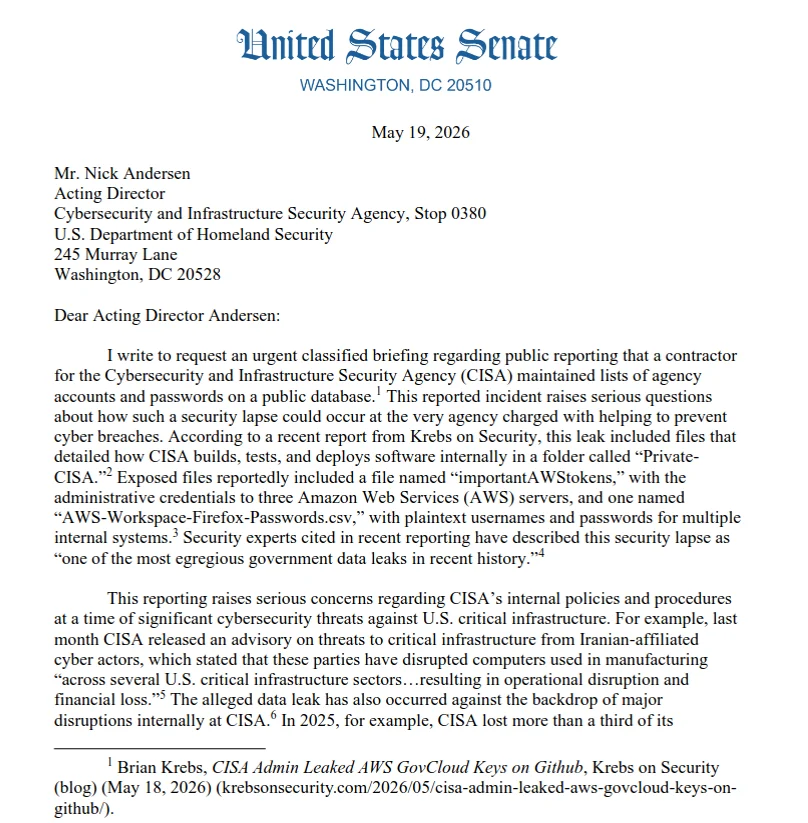
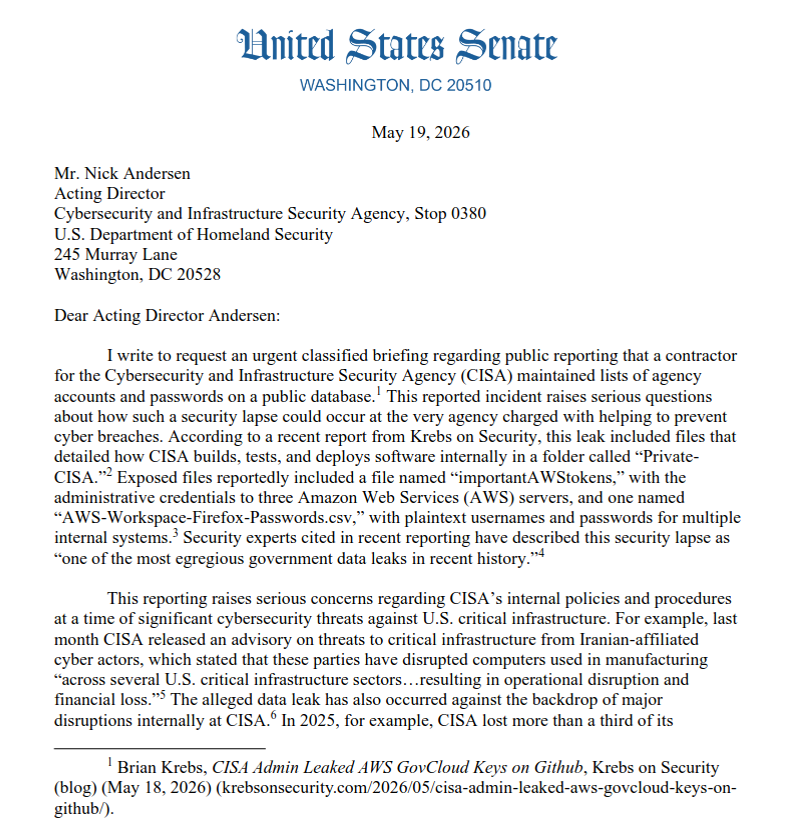
- May 19, 2026: Congressional leaders, including Sen. Maggie Hassan (D-NH) and Rep. Bennie Thompson (D-MS), issued formal letters to CISA’s acting director, Nick Andersen, demanding an immediate investigation and a list of all affected systems.
- May 20, 2026: Dylan Ayrey, founder of Truffle Security, identified a critical, still-active RSA private key within the repository that granted full administrative access to the CISA-IT GitHub organization. CISA began the process of revoking this specific key only after being notified by security researchers.
The "Firehose" Effect: Why Public Repositories are Danger Zones
The incident highlights a persistent, often ignored danger in modern software development: the "firehose" of public data. Platforms like GitHub provide a real-time feed of every commit and code change pushed to public repositories. Security researchers, including those at Truffle Security, monitor these feeds specifically to catch accidental leaks before they are exploited.
However, the reality is that sophisticated cybercriminal syndicates and state-sponsored advanced persistent threat (APT) groups monitor these same feeds. "We monitor that firehose of data for keys," said Dylan Ayrey. "We have evidence attackers monitor that firehose as well. Anyone monitoring GitHub events could be sitting on this information."

The danger is magnified by the nature of modern CI/CD (Continuous Integration and Continuous Delivery) pipelines. By gaining access to a single administrative token—like the RSA key found in the "Private-CISA" repo—an attacker can do more than just view source code. They can inject malicious code into the agency’s software updates, hijack automated deployment processes, and gain persistence across the entire CISA-IT infrastructure.
Congressional Scrutiny and Institutional Fragility
The timing of this breach could not be worse for CISA. The agency is currently grappling with the aftermath of a massive internal restructuring. Reports indicate that CISA has lost more than one-third of its workforce and nearly the entire senior leadership team following a series of forced early retirements and resignations under the current administration.
In her letter to Acting Director Nick Andersen, Senator Maggie Hassan was blunt: "This reporting raises serious concerns regarding CISA’s internal policies and procedures at a time of significant cybersecurity threats against U.S. critical infrastructure."
The sentiment was shared by Rep. Bennie Thompson and Rep. Delia Ramirez, who suggested that the breach is a symptom of a "diminished security culture." In their joint letter, the representatives warned: "It’s no secret that our adversaries—like China, Russia, and Iran—seek to gain access to and persistence on federal networks. The files contained in the ‘Private-CISA’ repository provided the information, access, and roadmap to do just that."
The Illusion of Technical Control
While Congress and the public look for technical explanations, security experts warn that the root cause may be impossible to patch with software alone.
James Wilson, editor for the Risky Business podcast, noted that while organizations can mandate policies that block key uploads, these controls are often bypassed by the "human element." When a contractor chooses to use a personal account to move work files, they are operating outside the agency’s managed environment.
"This is a human problem," said podcast co-host Adam Boileau. "You’ve hired a contractor to do this work, and they have decided of their own volition to use GitHub to synchronize content from a work machine to a home machine. I don’t know what technical controls you could put in place given that this is being done presumably outside of anything CISA managed or even had visibility on."
Official Response and the Path Forward
CISA has been largely tight-lipped regarding the duration of the exposure and the specific systems compromised. In a brief statement, the agency asserted that "there is no indication that any sensitive data was compromised as a result of the incident."
However, this assertion is being viewed with skepticism by the cybersecurity community. Given that the data was publicly available for months and the repository contained credentials to live production systems, proving a negative—that no one accessed the data—is nearly impossible.
CISA’s subsequent statement, issued after further pressure from researchers regarding the active RSA key, noted: "CISA is actively responding and coordinating with the appropriate parties and vendors to ensure any identified leaked credentials are rotated and rendered invalid and will continue to take appropriate steps to protect the security of our systems."
As the investigation continues, the agency faces a grueling cleanup. Rotating credentials is a complex task, as many of these keys are hard-coded into various automated systems and legacy infrastructure. Every day that passes without full remediation increases the risk that an adversary will successfully weaponize the leaked information.
For CISA, the "Private-CISA" incident serves as a humbling reminder that even the guardians of the digital frontier are not immune to the fundamental risks of human error and the evolving landscape of global cyber espionage. Whether this leads to a permanent change in how CISA manages its contractors and its internal security culture remains to be seen, but the pressure from Capitol Hill suggests that the status quo is no longer acceptable.