Global Report — In the contemporary business ecosystem, the humble office document has undergone a quiet yet radical evolution. No longer acting as static pages of text, modern business documents function as dynamic nodes within a broader digital nervous system—routing approvals, pulling data from disparate spreadsheets, triggering automated workflows, and capturing legally binding signatures.
Yet, for many small and medium-sized enterprises (SMEs), managing this document lifecycle has paradoxically become more complex. Organizations routinely juggle four to seven separate applications—using one tool for drafting, another for AI-assisted grammar correction, a third for formatting, a fourth for digital signatures, and cloud storage directories for final archiving.
Entering its 20th anniversary milestone this year, Zoho Writer is tackling this operational fragmentation head-on. By transforming from a traditional online word processor into a comprehensive "work processor," Zoho Writer aims to consolidate the entire document lifecycle into a single, unified platform that eliminates redundant software subscriptions and multi-application logins.
The Fragmented Document Lifecycle: A Scavenger Hunt with a Deadline
To understand the friction plaguing modern office productivity, consider a standard operational task: a marketing analyst on a five-person team needing a signed vendor agreement returned by the end of the week.
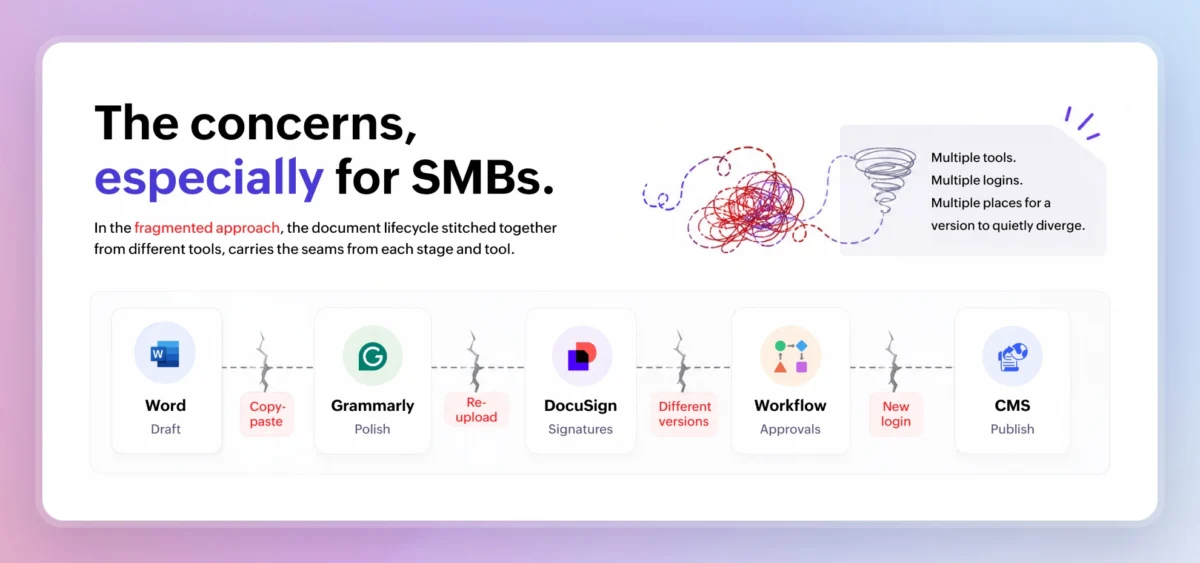
Under a traditional, decentralized approach, this seemingly straightforward task transforms into an administrative gauntlet. The analyst begins by drafting the agreement in a standalone word processor like Microsoft Word. Seeking to refine the language, she copies and pastes the text into an external writing assistant such as Grammarly.
Following this, she exports or emails the draft to multiple colleagues for review, generating a flurry of parallel email threads and isolated feedback notes. Once comments are somewhat synthesized, she converts the file format and uploads it into a specialized digital signature platform like DocuSign or AdobeSign. Finally, upon securing the signature, the document is downloaded and manually filed into a shared cloud drive.
This fragmented workflow introduces severe operational vulnerabilities, most notably version divergence.
“A client signs off on the wrong pricing, or legal reviews a clause that got fixed two versions ago,” explains Balaji V., product expert for Zoho Writer. “And by the time someone catches it, it’s not just a formatting problem anymore—it’s a compliance or financial risk.”
Furthermore, juggling numerous applications forces employees to maintain separate credentials across disparate platforms. For teams operating under tight deadlines, navigating multiple handoffs and multiple sign-ins feels less like productive work and more like a high-stakes scavenger hunt.
Chronology and Evolution: From Simple Word Processor to Work Processor
Launched two decades ago as a basic cloud-based alternative to desktop word processors, Zoho Writer’s trajectory mirrors the broader shift in enterprise software toward collaborative, cloud-first infrastructure.
The Early Years (Mid-2000s): Zoho Writer emerged as a pioneer in web-based document editing, enabling users to create and edit text documents within a web browser without installing local software.
The Collaborative Shift (2010s): As remote work and team structures expanded, the platform introduced real-time co-authoring, version history tracking, and native integrations with the broader Zoho ecosystem, including Zoho CRM.
The AI and Automation Era (Present Day): Celebrating its 20th anniversary, Zoho Writer has integrated advanced AI writing assistants (such as Zoho’s Zia), automated document merging capabilities, and native digital signature handoffs. Today, the platform functions across the web, as a native desktop application for Windows, macOS, and Linux, and via mobile apps for iOS and Android, allowing complete offline and online utility.
Supporting Data and Comparative Analysis: Zoho Writer vs. The Legacy Stack
To evaluate the tangible benefits of platform consolidation, industry analysts often point to the compounding hidden costs of managing multiple software vendors.
The Traditional Multi-Tool Stack
Drafting: Microsoft Word or Google Docs
Editing/Proofing: Grammarly or ProWritingAid
Collaboration/Review: Email attachments and cloud-comment silos
Data Population: Jotform or manual data entry tools
Formatting/Conversion: Adobe Acrobat
Execution: DocuSign or separate signature gateways
Storage: Third-party cloud drives
Resulting Liabilities:
High cumulative subscription overhead.
Fragmented user permissions and expanded cyber-security attack surfaces.
Persistent document version control errors.
Extensive IT overhead required to maintain API integrations between tools that were never natively designed to work together.
The Unified Zoho Ecosystem Approach
By contrast, Zoho Writer—integrated tightly with Zoho WorkDrive, Zoho Sheets, and internal signature gateways—handles the exact same lifecycle under one roof.
For instance, consider onboarding a new batch of employees. Instead of manually drafting individual offer letters, an HR representative can pull a standardized template from Zoho Writer, leverage Zia (Zoho’s AI assistant) to fine-tune the text, and connect a Zoho Sheets database containing candidate names, salaries, and start dates. Using merge fields, the system automatically generates customized offer and acceptance letters, routes them for internal approvals via contextual inline commenting, collects signatures, and archives the files directly into the correct shared folder—all without requiring a single secondary login.
Official Responses and Strategic Vision
Zoho executives emphasize that the driving force behind Zoho Writer’s modern feature set is the changing definition of what a business document actually is.
“What’s changed is what that document is now expected to do on its own,” explains Balaji V. “It collects information, routes its own approvals, triggers workflows, updates other systems, and collects a legally valid signature. A document today isn’t really a file anymore. It’s a complete process.”
For small and medium-sized businesses, operational bandwidth is inextricably linked to personnel constraints. Small business owners cannot afford to spend hours configuring brittle integrations between standalone applications.
“For SMBs, the main challenge is people,” adds Sathish Kumar Giddi, Product Marketer for Zoho Writer.
The strategic goal for Zoho is to alleviate these human resource bottlenecks, allowing lean teams to accomplish high-volume administrative tasks with minimal friction. Crucially, businesses do not need to abandon their historical archives; Zoho Writer features native migration tools that allow companies to seamlessly transfer legacy document libraries into the platform without losing historical templates or formatting.
Implications Across Industries
The operational efficiencies yielded by a unified work processor ripple across diverse industry verticals:
Hospitality & Tourism: A hotel and lounge managing constant vendor agreements with food suppliers, laundry services, and mainland recruitment can instantly cancel separate software subscriptions, managing all procurement contracts and staff onboarding through Zoho Writer and WorkDrive.
Digital Marketing Agencies: Agencies managing social media, blogs, and email campaigns for dozens of regional clients can compose, edit, format, gain client approval, and publish content directly to platforms like WordPress from a single dashboard.
Professional Services & Consulting: Tax experts, legal consultants, and IT integrators handling sensitive client data benefit immensely from a minimized security footprint. Fewer third-party applications mean fewer exposed credentials, bolstering compliance frameworks required by enterprise clients.
Architecture & Engineering: Firms managing complex multi-party projects—such as owner-architect agreements, scope proposals, and design revisions—can share live documents, collect feedback via inline tags, and secure signatures without relying on external IT consultants to stitch together incompatible software.
Conclusion
As businesses navigate economic pressures demanding higher output with leaner resources, the software consolidation movement is accelerating. Zoho Writer’s 20-year evolution demonstrates that the future of enterprise productivity lies not in accumulating more specialized tools, but in intelligent centralization.
By unifying drafting, AI assistance, real-time collaboration, data merging, secure signing, and cloud archiving into a single sign-on environment, Zoho Writer provides small and medium-sized businesses with a viable blueprint to cut costs, enforce compliance, eliminate version control errors, and reclaim valuable administrative time.
For organizations looking to audit their current software stack and explore unified document workflows, demonstrations and further resources are available directly through the official Zoho Writer website.