









In a sweeping operation that marks a significant escalation in the European Union’s battle against foreign-backed digital aggression, Dutch financial crime investigators have arrested two prominent figures in the Internet hosting industry. The arrests, carried out by the Tax Intelligence and Investigation Service (FIOD), target the architects of a sprawling network that allegedly served as a primary staging ground for Russian state-sponsored cyberattacks, disinformation campaigns, and hybrid warfare operations against EU targets.
The operation, which took place on May 18, saw authorities raid multiple locations, including businesses in Enschede and Almere, as well as critical data centers in Dronten and Schiphol-Rijk. The result was the physical seizure of over 800 servers, a massive cache of telecommunications equipment, and the arrest of a 57-year-old Amsterdam resident and a 39-year-old native of The Hague.
The Key Players: A Piano Prodigy and a Vanishing Consultant
The individuals detained have been identified through various reports as Andrey Nesterenko, a 39-year-old Russian native operating out of the Netherlands, and Youssef Zinad, a 57-year-old Amsterdam-based consultant.
Nesterenko, a figure with a storied past as a classical piano prodigy, founded MIRhosting’s parent company, Innovation IT Solutions Corp., in 2004. His involvement in controversial digital activities dates back nearly two decades; notably, his company was the primary host for stopgeorgia[.]ru, a hacktivist portal that coordinated cyberattacks against Georgia during the 2008 Russian military invasion. That conflict is widely regarded by cybersecurity historians as the first modern example of synchronized kinetic and digital warfare.
Zinad, by contrast, has maintained a significantly lower profile. Following initial investigative reporting in 2025 that linked him to the infrastructure in question, Zinad largely retreated from public life. Investigative efforts by de Volkskrant revealed a man in hiding: his LinkedIn profile was shuttered, his primary residence in Almere appeared abandoned, and he systematically ignored all inquiries from the press and legal authorities until his eventual arrest in Amsterdam.
A Chronology of Sanctions Evasion
The investigation centers on the technical infrastructure of "Stark Industries Solutions," a hosting provider that emerged with suspicious timing—just two weeks before the full-scale Russian invasion of Ukraine in 2022. Stark quickly gained notoriety as an "iron hammer" in the cloud, facilitating massive distributed denial-of-service (DDoS) attacks against European government institutions and supplying proxy services for Kremlin-aligned hacking collectives.
The trajectory of the investigation reveals a calculated game of shell-company musical chairs:
- May 2024: Investigative reporting highlights Stark Industries as a critical nexus for Russian cyber-mischief, exposing its reliance on Moldovan brothers Ivan and Yuri Neculiti and their company, PQHosting.
- May 2025: The European Union formally sanctions the Neculiti brothers and PQHosting for their role in facilitating Russia’s hybrid warfare efforts.
- Pre-Sanction Window: Anticipating the EU crackdown, network assets belonging to Stark were rapidly offloaded from PQHosting to a new entity, "the[.]hosting," which operated under the control of the Dutch firm WorkTitans BV.
- September 2025: Further investigation identifies that WorkTitans was effectively controlled by Nesterenko and Zinad. The network relied exclusively on connectivity provided by MIRhosting, creating a closed loop that effectively bypassed the EU sanctions.
- November 2025: During the week of Danish municipal elections, data confirms that WorkTitans and MIRhosting were the most active networks identified in cyber-aggression directed against Danish government bodies.
- May 18, 2026: FIOD executes raids and arrests, effectively severing the connection between the infrastructure and the global internet.
Supporting Data: The Anatomy of the Network
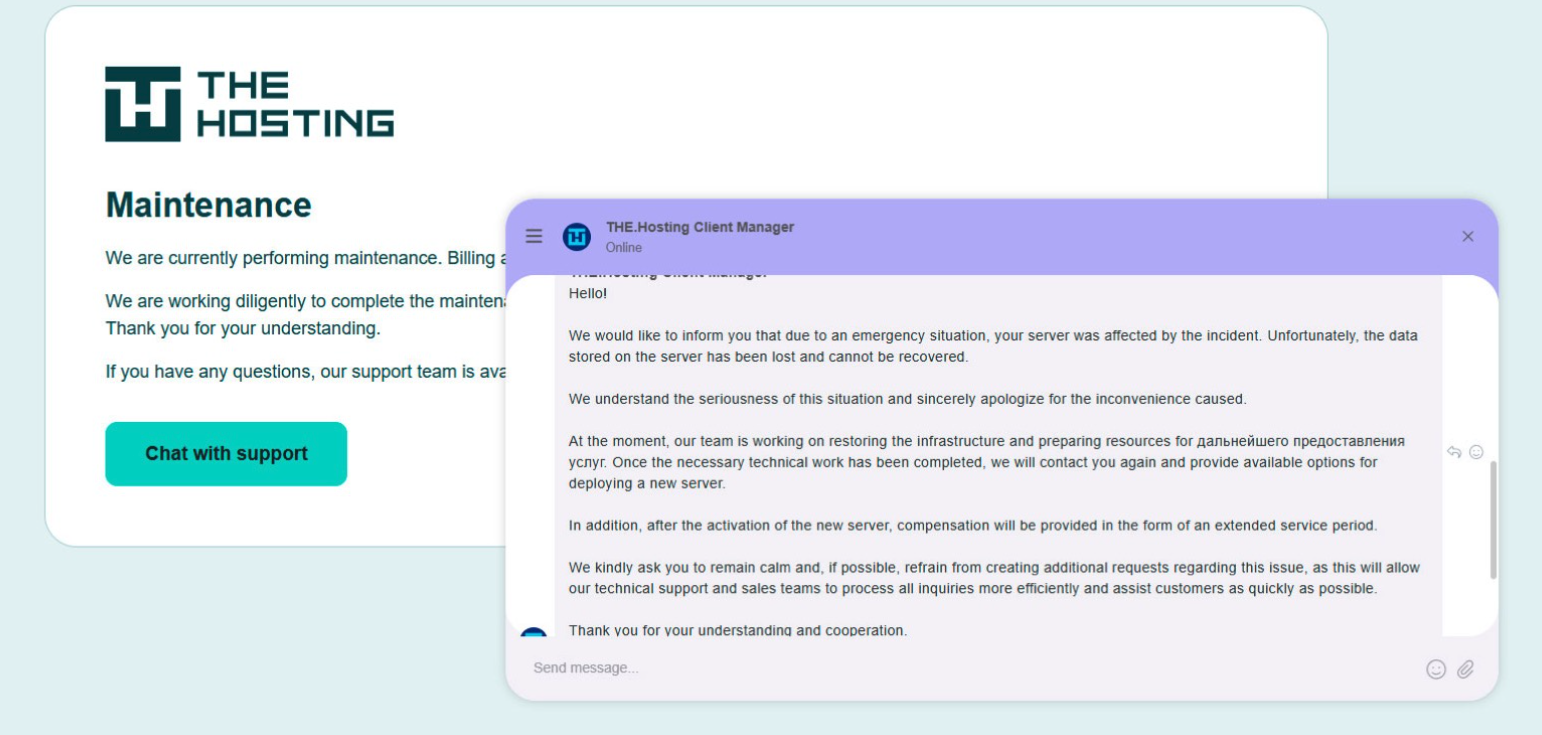
The evidence gathered by Dutch authorities suggests a high level of operational sophistication. The seizure of 800 servers at the Dronten and Schiphol-Rijk data centers resulted in an immediate and total outage for the-hosting’s client base. A message displayed to customers following the seizure confirmed the grim reality for those utilizing the platform: "Unfortunately, data stored on the server has been lost and cannot be recovered."
Data analyzed by de Volkskrant indicates that the network was not merely a passive hosting provider but an active participant in political destabilization. Throughout the mid-November 2025 Danish election period, traffic logs showed a clear correlation between the infrastructure hosted by WorkTitans and MIRhosting and the wave of digital disruptions targeting Danish democratic processes. This corroborates long-standing suspicions that such "bulletproof" hosting services are specifically tailored to provide anonymity to state-backed actors operating within the borders of the countries they intend to undermine.
Official Responses and Denials
In the wake of the arrests, the narrative from the accused remains one of innocence and claims of professional persecution.
Andrey Nesterenko has vehemently denied allegations of sanctions evasion. In email correspondence, he argued that the transfer of assets to "the[.]hosting" was a standard business consolidation rather than a strategy to circumvent EU law. "Closing or damaging a legitimate Dutch infrastructure company will not stop cybercrime, but it will harm many people who have done nothing wrong," Nesterenko stated. He maintained that he terminated all business relations with the Neculiti brothers immediately upon the imposition of EU sanctions in 2025.
MIRhosting issued a formal statement on LinkedIn asserting that its internal investigations found no evidence of misuse during the Danish election period. The company claimed that "no anomalies or spikes were observed in our network traffic" and that it had received no prior abuse reports or official requests for intervention.

However, the internal documentation tells a different story. While Nesterenko attempted to distance himself from Zinad, claiming the latter was merely a contractor, evidence surfaced of Zinad possessing a @mirhosting.com email address and being listed as an official contact for the company’s Almere office on public vocational portals. These discrepancies cast significant doubt on the "B2B arrangement" defense offered by Nesterenko.
Strategic Implications for EU Cybersecurity
The arrest of Nesterenko and Zinad represents a critical shift in how the European Union manages the intersection of private internet infrastructure and national security. By charging the suspects with violating sanction laws, the Dutch authorities have signaled that the "safe harbor" traditionally claimed by hosting providers is no longer a viable defense when that infrastructure is knowingly used to facilitate state-sponsored warfare.
This case serves as a warning to other operators of "bulletproof" hosting services. As cyber-operations continue to become an integral component of geopolitical conflict, the legal landscape is tightening around those who provide the digital "terrain" for these attacks.
The implications for the victims—the governments and private entities targeted by these campaigns—are profound. By physically dismantling the infrastructure, authorities have not only forced a disruption in the immediate cyber-threat landscape but have also secured a massive repository of evidence that may link specific cyberattacks directly to individual actors and, potentially, their handlers within the Russian intelligence apparatus.
As the legal proceedings progress in the Netherlands, the international cybersecurity community will be watching closely. The outcome of this trial will likely set a legal precedent for whether internet service providers can be held liable for the criminal acts of their clients, fundamentally reshaping the accountability structure of the global internet in an era of constant digital conflict.