









In a landmark victory for international law enforcement, a 23-year-old Ottawa resident, Jacob Butler—known in the darker corners of the internet by his alias "Dort"—has been arrested by the Ontario Provincial Police. The arrest marks the culmination of a high-stakes, months-long investigation into the architect of "Kimwolf," a sophisticated and rapidly expanding Internet-of-Things (IoT) botnet that wreaked havoc on global digital infrastructure.
Butler, who now faces a litany of criminal hacking charges in both Canada and the United States, is accused of enslaving millions of consumer-grade internet devices. These devices, ranging from unassuming digital photo frames to security-hardened web cameras, were transformed into a weaponized swarm, launching record-shattering Distributed Denial-of-Service (DDoS) attacks that reached unprecedented magnitudes.
The case, which involved a complex web of investigative efforts by the U.S. Department of Justice (DOJ), the FBI, and international partners, highlights the escalating danger posed by botnet operators who bridge the gap between technical criminality and physical-world intimidation.
A Chronology of Chaos: From Digital Harassment to Federal Charges
The unraveling of the Kimwolf operation was not a sudden event, but rather the result of a slow-moving, meticulous pursuit by both cybersecurity researchers and federal authorities.
The Rise of the Kimwolf Botnet
Over the past six months, the Kimwolf botnet established itself as a dominant force in the cyber-underground. By targeting IoT devices that were typically "firewalled" or considered low-priority targets, Butler was able to quietly amass a massive network of compromised hardware. Once enslaved, these devices were either rented out to other threat actors on the dark web or leveraged directly by Butler to execute massive DDoS campaigns.
The Turning Point: Identifying ‘Dort’
In February 2026, the investigative blog KrebsOnSecurity published a breakthrough report that publicly identified Jacob Butler as the individual behind the moniker "Dort." By meticulously correlating email addresses, forum registrations, and footprints left on Telegram and Discord servers, investigators were able to pierce the veil of anonymity that Butler believed protected him.
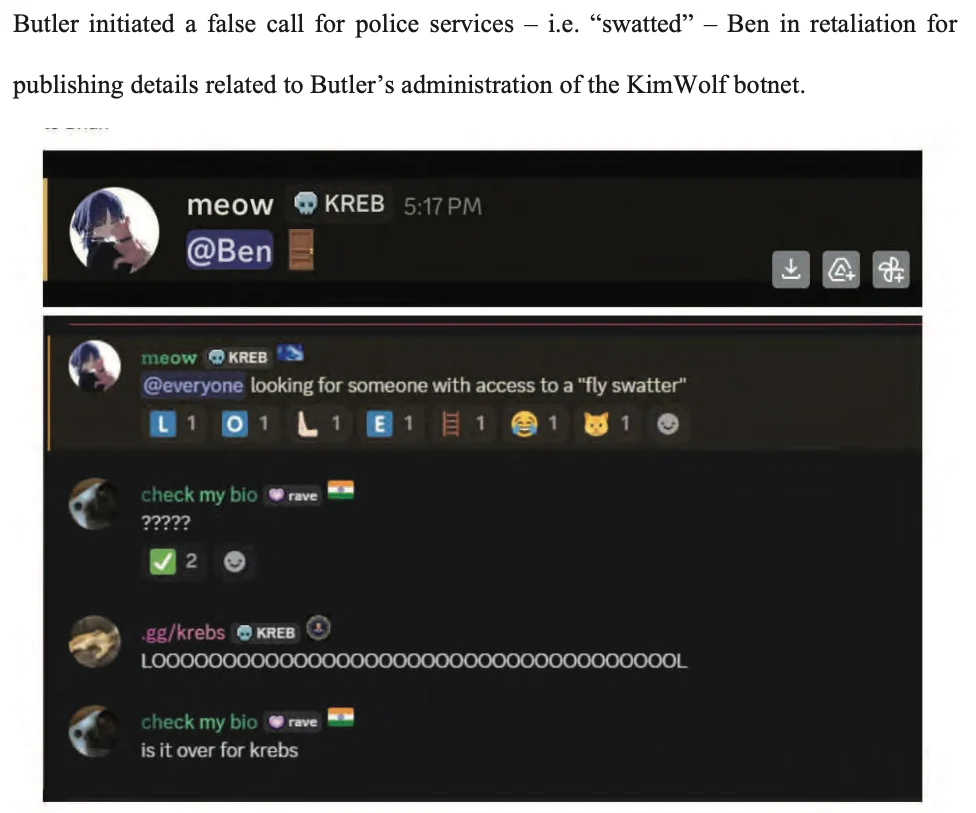
Rather than retreating, Butler responded with aggression. He launched a series of retaliatory DDoS attacks, doxing campaigns, and—most alarmingly—swatting attacks against the researchers who had unmasked him.
The March 19th Takedown
On March 19, 2026, the coordinated pressure from law enforcement reached a fever pitch. In a sweeping operation, U.S. authorities and their international partners seized the technical infrastructure governing Kimwolf. This operation also targeted three competing botnets—Aisuru, JackSkid, and Mossad—which had been vying for the same pool of vulnerable devices. Simultaneously, the Ontario Provincial Police executed a search warrant at Butler’s Ottawa residence, seizing a cache of digital evidence that would prove vital to the pending criminal complaint.
Technical Magnitude and Operational Scope
The Kimwolf botnet was not merely a nuisance; it was a record-breaking instrument of digital destruction. According to the U.S. Department of Justice, the botnet was responsible for DDoS attacks measured at nearly 30 Terabits per second (Tbps), a volume of traffic previously unseen in the history of recorded cyberattacks.
The Anatomy of an Attack
Kimwolf was uniquely effective because it exploited a critical security vulnerability in IoT hardware. By targeting devices that users assumed were secure, the botnet could propagate faster and more effectively than its competitors. The Justice Department reported that the botnet issued over 25,000 distinct attack commands, causing financial damages to victims that, in some instances, exceeded $1 million.
Collateral Damage: The Department of Defense
The reach of the Kimwolf botnet was so extensive that it impacted the Internet address ranges assigned to the United States Department of Defense (DoD). This triggered an investigation by the Defense Criminal Investigative Service, which coordinated with the FBI’s Anchorage field office. The inclusion of the DoD underscores the gravity of the threat, as the botnet’s indiscriminate "noise" began to bleed into the networks of national security agencies.
Official Responses and the Human Cost
The arrest of Jacob Butler has provided a measure of relief to the cybersecurity community, particularly to those who were targeted by his retaliatory tactics.
The Role of Private Sector Collaboration
A pivotal moment in the investigation involved the security startup Synthient. The company had identified and worked to remediate the very vulnerability that allowed Kimwolf to spread. In retaliation, Butler targeted Synthient’s founder, Ben Brundage, with multiple swatting attacks—a dangerous practice where perpetrators report fake emergencies to police to trigger a heavily armed tactical response at a victim’s home.
Following the announcement of the arrest, Brundage expressed a profound sense of relief. "Hopefully, this will end the harassment," he stated, noting the toll that the targeted intimidation had taken on his life and his team.
Legal Proceedings and Extradition
The criminal complaint unsealed in an Alaska district court outlines several charges against Butler, including unauthorized use of a computer, possession of devices to commit mischief, and aiding and abetting computer intrusion.
The Ontario Provincial Police have confirmed that Butler is currently in Canadian custody, where he is awaiting an initial court hearing. The U.S. government has already issued an extradition warrant. If extradited to the United States, Butler faces up to 10 years in federal prison. However, legal experts suggest that the final sentence will likely be tempered by the U.S. Sentencing Guidelines, which account for factors such as the defendant’s age, lack of prior criminal record, and the extent of his future cooperation with authorities.
Implications for the Global Cybersecurity Landscape
The collapse of Kimwolf serves as a cautionary tale for both the perpetrators of cybercrime and the manufacturers of connected devices.
The Failure of Anonymity
One of the most striking aspects of the case against Butler is the ease with which investigators linked his digital alias to his physical identity. The criminal complaint makes it clear that Butler failed to adequately silo his criminal activities from his personal life. By reusing email addresses and failing to obscure his online messaging records, Butler provided the proverbial "smoking gun" that investigators needed to secure legal process.
The Future of IoT Security
The Kimwolf case has once again brought the fragility of the "Internet of Things" to the forefront of the public consciousness. As long as millions of consumer devices remain unpatched and vulnerable, they will continue to be exploited as "zombie" nodes in massive, rented botnet armies. The coordinated seizure of nearly four-dozen DDoS-for-hire domains in April—part of a broader global crackdown—signals that international law enforcement is no longer willing to treat these botnets as isolated technical issues, but rather as organized criminal enterprises.
A Deterrent Effect?
While the removal of Kimwolf, Aisuru, JackSkid, and Mossad has temporarily reduced the volume of global DDoS traffic, the underlying business model of "DDoS-for-hire" remains lucrative. The question remains whether the prosecution of a 23-year-old in Ottawa will serve as a sufficient deterrent to the next generation of botmasters.
For now, the arrest of "Dort" stands as a significant milestone. It proves that despite the sophisticated encryption and anonymization tools available to modern hackers, the combination of persistent private-sector research and international legal cooperation remains a formidable barrier to those who seek to weaponize the internet.
As the case moves toward trial, the international security community will be watching closely, not just for the outcome of Jacob Butler’s sentencing, but for the precedent this case sets in the ongoing struggle to reclaim the stability of the digital landscape.