








For over a decade, the narrative surrounding stablecoins and blockchain technology was one of "disintermediation." The prevailing wisdom suggested that decentralized ledgers would render traditional payment networks obsolete, cutting out the middlemen and allowing value to flow directly across a borderless, peer-to-peer architecture.
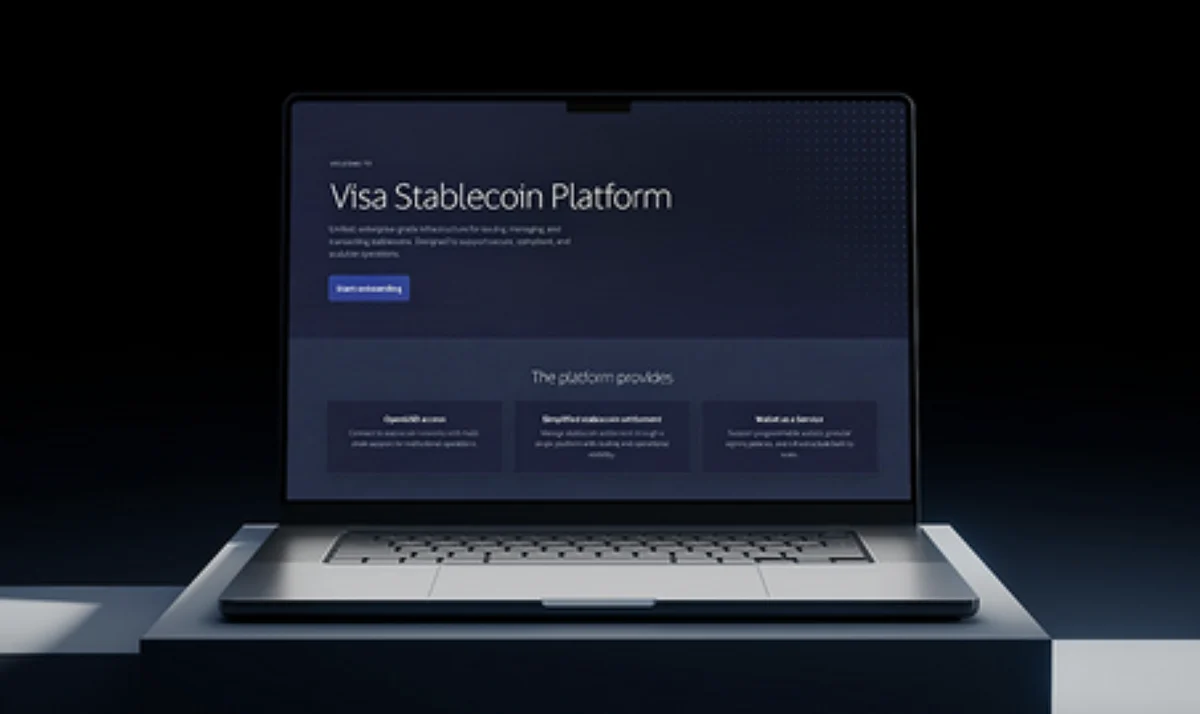
However, the reality of 2026 suggests a far more pragmatic, and perhaps messier, evolution. On July 16, payment giant Visa officially introduced the Visa Stablecoin Platform (VSP), a move that confirms a pivotal shift: rather than being bypassed by the blockchain revolution, established financial networks are positioning themselves to become the architects of the new digital plumbing.
The Main Facts: What is the Visa Stablecoin Platform?
The Visa Stablecoin Platform (VSP) is designed as a centralized, managed environment that allows financial institutions, FinTechs, and crypto-native enterprises to handle the lifecycle of stablecoins. While blockchains—such as Ethereum, Solana, or the networks supporting Open USD (OUSD)—provide the underlying settlement rails, they lack the "last mile" infrastructure that regulated businesses require to operate at scale.
VSP offers a suite of enterprise-grade tools, including:
- Minting and Redemption: Streamlined processes for creating and retiring digital tokens backed by fiat currency.
- Institutional Custody: Advanced wallet infrastructure that moves beyond the "self-custody" ethos of early crypto, focusing instead on secure, institutional-grade management.
- Compliance and Governance: Built-in audit logs, secure passkeys, dual-approval workflows, and "allow lists" that ensure transactions meet rigorous KYC/AML standards.
- Connectivity: Integration with existing bank-account systems, treasury management software, and legacy accounting processes.
By providing these functions as a managed service, Visa is effectively abstracting the complexity of blockchain technology, making it palatable for the risk-averse, highly regulated corporate sector.
A Chronology of the Shift
To understand the weight of this launch, one must look at the progression of Visa’s digital asset strategy over the last eighteen months:
- Early 2025: Visa accelerates its research into cross-border settlement using stablecoins, recognizing that while the "rails" are faster, the "on-ramps" and "off-ramps" remain bottlenecked by traditional banking inertia.
- June 2026: Visa makes a decisive move into standardization by joining a 140-plus member Open Standard consortium to launch Open USD (OUSD). This signaled that Visa was no longer just an observer, but a participant in the governance of the stablecoin asset class.
- July 16, 2026: The official launch of the VSP beta. By inviting select clients to participate, Visa transitions from theory to execution, effectively signaling that the future of money is not necessarily non-Visa, but Visa-plus-blockchain.
The "Reconciliation" Problem: Why Middleware Wins
The central thesis driving the VSP launch is that the actual product is not the stablecoin itself—it is the reconciliation.
For a Fortune 500 company or a major regional bank, the challenge of stablecoins is not the speed of the blockchain transaction; it is the friction of integrating that transaction into a standard balance sheet. Institutions are not merely moving tokens; they are moving corporate liquidity. This requires a rigorous audit trail: Who initiated the transfer? Who authorized it? What is the tax implication? How does this entry reflect in the ERP (Enterprise Resource Planning) software?
Prior to platforms like VSP, institutions were forced to "stitch together" their own infrastructure. They had to choose a blockchain, select a custodial provider, build a proprietary compliance engine, and bridge the gap to their fiat treasury. This fragmentation created a massive adoption barrier.
Visa’s strategy is to turn these "less glamorous" requirements—reconciliation, compliance, and reporting—into a managed service. By sitting above the blockchain, Visa becomes the trusted layer that makes on-chain activity legible to the traditional financial system.
Supporting Data: The Gap Between Potential and Practice
Despite the technical advancements, the adoption of digital assets in the corporate world remains tempered by caution. According to the March 2026 PYMNTS Intelligence report, “Waiting for Certainty: Why Most CFOs Are Holding Back on Crypto and Stablecoins,” the transition is still in its infancy.
- Limited Adoption: Only 13% of middle-market firms report using stablecoins for business operations.
- Crypto Usage: A mere 5% of firms employ other cryptocurrencies in their workflows.
- The Barrier to Entry: The primary deterrent remains a lack of clear regulatory certainty and the difficulty of integrating digital assets with existing accounting software.
Visa’s platform is a direct response to these statistics. By offering a familiar interface that mimics the security and compliance protocols of traditional banking, Visa hopes to push those adoption numbers higher, moving stablecoins from the "experimental" bucket to the "core treasury" bucket.
Implications: The Barbell Economy
The emergence of the Visa Stablecoin Platform has profound implications for the future of fintech. As Dan Romero, Go-To-Market Lead at Tempo, noted during a recent episode of the From the Block podcast, the digital asset sector has evolved into a "barbell economy."
On one end of the barbell are the speculative markets—highly volatile and ideological. On the other end are the real-world payment rails focused on the mundane but essential task of "moving money better."
The failure of many consumer-facing crypto experiments, such as decentralized social networks, has underscored a hard truth: crypto’s most lasting impact will likely be in the plumbing of finance, not the user experience of the average consumer. As Romero observed, much of the last decade’s ideological fervor in crypto failed to make a dent in the real world because it ignored the necessity of institutional infrastructure.
The Recombination of Finance
We are witnessing a period of "recombination" rather than "disruption." Visa is not attempting to replace the blockchain; it is attempting to colonize it. By providing the governance, risk management, and compliance frameworks that the blockchain natively lacks, Visa is ensuring that the global financial system retains its existing power structure.
For crypto-native firms, this partnership offers a massive upside: immediate access to the global distribution network and the risk-management capabilities of a major card network. For Visa, it offers a way to maintain relevance in a world where money moves across decentralized ledgers.
The Strategic Outlook: A New Standard
If the 20th century was about building global electronic payment networks, the 2026 move by Visa suggests that the 21st century will be about standardizing how those networks interact with digital assets.
The stablecoin race has officially become an "ecosystem battle." The winners will not be the developers who build the fastest blockchain, but the entities that can most effectively hide the blockchain from the end user. By making the underlying asset and the technical ledger invisible, Visa is betting that institutions will choose convenience and compliance over decentralization.
Ultimately, the Visa Stablecoin Platform suggests that the "stablecoin revolution" will not look like the utopian, bank-less future envisioned by early crypto-enthusiasts. Instead, it will look like the existing financial system, just running on slightly faster, slightly more transparent rails. The networks that built the world of plastic cards are now quietly re-engineering themselves to be the gatekeepers of the tokenized economy. In this new landscape, the most successful innovations are those that allow the old guard to integrate the new technology without losing their seat at the table.