










If you have traveled internationally, you have likely encountered the deceptively simple prompt at a payment terminal: "Would you like to pay in local currency or your home currency?" Whether you are grabbing a quick espresso in Rome, booking a boutique hotel in Tokyo, or withdrawing cash from an ATM in London, the machine presents you with a choice. While the option to pay in your home currency—such as US Dollars for an American traveler—may seem like a helpful convenience, it is frequently a financial trap that can cost you significantly more than necessary.
This process is known as Dynamic Currency Conversion (DCC), and understanding how it works is essential for every traveler looking to protect their hard-earned money from unnecessary fees.
What is Dynamic Currency Conversion (DCC)?
Dynamic Currency Conversion is a financial service that allows a cardholder to have a transaction converted into their home currency at the point of sale (POS) or at an ATM. Under normal circumstances, when you make a purchase in a foreign country, your bank or credit card network handles the conversion from the local currency to your home currency. This is typically done at the mid-market or wholesale exchange rate, which is the most favorable rate available.

With DCC, however, the merchant or ATM operator takes over that conversion process. By utilizing their own proprietary exchange rates and adding a significant markup, they provide you with a "guaranteed" final price in your home currency. On the surface, this appeals to human nature: it offers certainty in an uncertain environment, allowing travelers to see exactly what will appear on their bank statement without needing to perform mental gymnastics regarding exchange rates.
However, this "certainty" comes at a high price. The exchange rates offered through DCC are rarely, if ever, competitive. They are essentially a form of legalized price gouging that relies on consumer ignorance or a desire for comfort.
A Chronology of the Transaction: When the Trap is Sprung
To understand how DCC functions, it is helpful to follow the lifecycle of a typical international transaction.

- The Prompt: After you swipe or insert your credit card, the terminal identifies your card’s country of origin. It then displays the DCC prompt, often phrased in a way that implies the conversion is a "service" for your benefit.
- The Decision: The consumer is faced with two buttons. Option A is the local currency; Option B is the home currency. At this stage, the merchant or ATM operator is required by most payment networks to offer a choice, though the interface is often designed to nudge users toward the more expensive DCC option.
- The Markup: If you choose your home currency, the transaction is processed through the merchant’s selected DCC provider. This provider applies a fee, which can range from 1% to as high as 15% above the actual market rate.
- The Final Settlement: When the transaction clears, the merchant receives their commission—a kickback from the DCC provider—and the traveler is left paying a significantly inflated price for the exact same goods or services.
Supporting Data: Why "Convenience" Costs a Premium
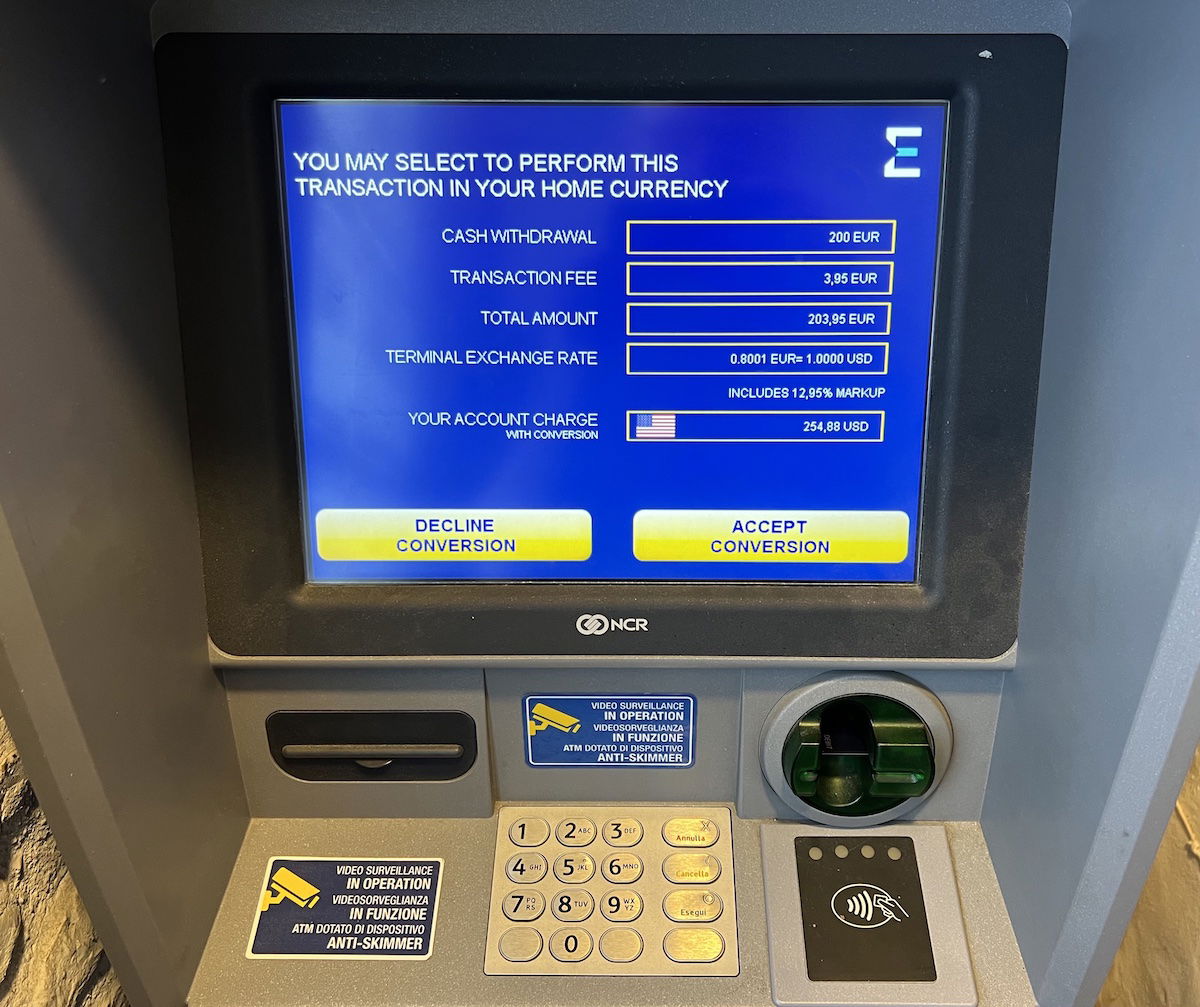
The financial disparity between selecting local currency versus home currency is often stark. In many cases, an ATM transaction involving DCC can include a markup exceeding 10% to 12%.
Consider a scenario where you withdraw 200 Euro from an ATM. If you decline DCC, your bank will charge you the standard, competitive exchange rate. If you accept DCC, you might be charged an additional 12.95% conversion fee on top of the base amount. For a withdrawal equivalent to $225 USD, that decision could cost you nearly $30 in additional fees alone.
When applied to high-ticket items—such as luxury hotel stays or fine dining—the cost of choosing DCC becomes even more egregious. A 5% markup on a $2,000 hotel bill results in an unnecessary $100 charge. These figures are not hypothetical; they represent the reality of a system designed to profit from the ambiguity of foreign exchange.
Official Stances and Industry Perspectives
Financial regulators and consumer protection agencies have long scrutinized DCC, though it remains a legal practice in most jurisdictions. Visa and Mastercard mandate that merchants provide clear disclosure that the consumer is opting into a service with a specific exchange rate, yet the way this is communicated often remains obscured.
Major banks and financial institutions, while not explicitly banning the use of DCC, frequently educate their customers on the risks. Their stance is consistent: the most efficient way to process foreign transactions is to allow the card issuer—not the merchant—to handle the currency conversion.
The industry consensus is that while DCC is not a "scam" in the criminal sense—because the consumer is technically given a choice and the pricing is disclosed—it is an predatory practice. The "service" being provided is the conversion itself, but since the bank would perform this task for a fraction of the cost, the merchant is essentially selling you a service you already have for free.

The Role of Foreign Transaction Fees
A critical component of this discussion is the credit card you choose to carry. Many traditional credit cards charge a "foreign transaction fee," typically around 3% of the transaction value. This fee is applied when you make a purchase in a foreign currency.
Travelers often wrongly assume that by choosing DCC, they can "avoid" this 3% fee because the transaction is billed in their home currency. This is a fallacy. While the 3% bank fee might technically be bypassed, the markup imposed by the DCC provider is almost always higher than the 3% bank fee you were trying to avoid.
The solution is not to use DCC; the solution is to obtain a credit card that waives foreign transaction fees. Today, there are numerous travel-oriented credit cards, many without annual fees, that allow you to make purchases abroad without any additional conversion penalties. By using such a card and opting for the local currency, you ensure that you are paying the lowest possible exchange rate without any hidden surcharges.

Implications for the Modern Traveler
The implications of failing to understand DCC are twofold: direct financial loss and the erosion of trust in the payment ecosystem.
- Financial Erosion: Over the course of a two-week international trip, a traveler who consistently uses DCC could lose hundreds of dollars. These are funds that could have been better spent on local experiences, higher-quality dining, or additional travel.
- Merchant-Consumer Dynamics: When merchants push for DCC, they are prioritizing their own bottom line over the customer’s value. While most merchants operate ethically, the presence of DCC incentivizes bad behavior. In some extreme instances, unscrupulous merchants may even select the DCC option on your behalf, hoping you will not notice the difference on your receipt.
Conclusion: How to Protect Yourself
To navigate international payments like a seasoned professional, follow these three simple rules:
- Always Choose Local: When prompted, whether at a restaurant, a shop, or an ATM, always select the local currency. This ensures the conversion is handled by your bank at a competitive rate.
- Audit Your Wallet: Ensure you are carrying at least one credit card that has no foreign transaction fees. This eliminates the need to fear bank-imposed surcharges and removes any incentive to use DCC.
- Stay Vigilant: Do not let the screen move too fast. If a merchant tells you that choosing your home currency is "easier" or "required," be skeptical. Politely insist on paying in the currency of the country you are visiting.
Ultimately, the power to save money while traveling rests in your hands. By declining the "convenience" of Dynamic Currency Conversion, you are reclaiming your money from a system that relies on your oversight. Knowledge is the most effective currency for any traveler, and in this case, it is worth the effort to understand exactly what you are signing up for.