







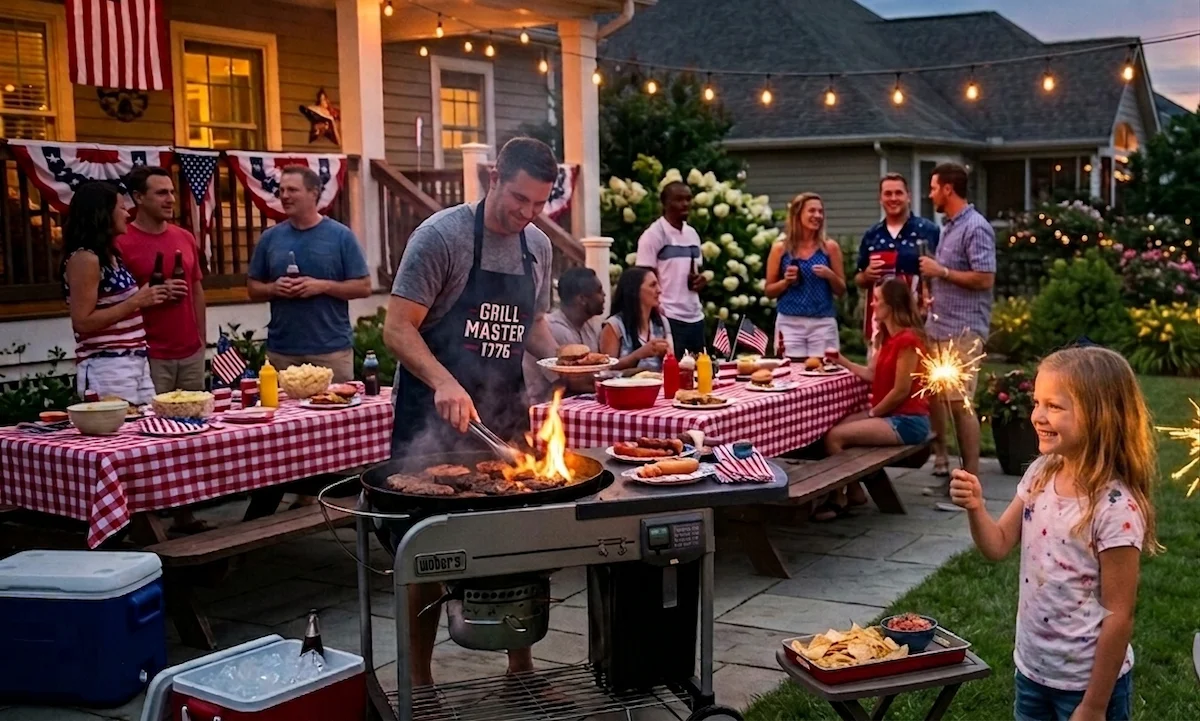
Every July, as the heat of summer settles over the United States, the nation gathers around the grill, gazes at the darkening sky, and engages in a ritual that has become as foundational to the American experience as the Declaration of Independence itself. Amidst the scent of charcoal and the rhythmic pop of neighborhood fireworks, a perennial, somewhat cynical question emerges: Can liberty be itemized?
In the modern era, the answer is an emphatic, often expensive, "yes." The celebration of Independence Day has evolved from a simple community gathering into a massive economic engine, characterized by surge-priced airfare, premium-priced coolers, and the inescapable realization that the cost of freedom now includes a significant premium for inflation.
The State of the Union: Main Facts on Holiday Spending
The Fourth of July has transformed into a unique intersection of patriotism, protein, and digital payment rails. For the average American household, the holiday occupies a niche that is distinct from gift-giving occasions like Christmas or birthdays; it is a "spending holiday," where the primary objective is the consumption of experiences, food, and convenience.
According to the National Retail Federation (NRF), 87% of consumers plan to participate in Independence Day festivities this year. This commitment to celebration comes with a record-breaking price tag: average food spending is projected to hit $94.41 per person. For a standard four-person household, that translates to approximately $378 in grocery spending alone—before factoring in the auxiliary costs of bug spray, gasoline, lawn chairs, or that emergency bag of ice that invariably costs $8 at the local convenience store.
Broader data from Numerator paints an even more comprehensive picture. When accounting for non-food holiday purchases—such as decorations, patriotic apparel, and pyrotechnics—the average shopping basket reaches $117 per person. For a family of four, the total expenditure on the holiday experience climbs to an average of $468. Across the United States, this represents a staggering $22 billion in potential holiday-related spending.
A Chronology of Consumption: Two Decades of Rising Costs
To understand how the current economic landscape of the Fourth of July compares to the past, one must look at the historical trajectory of consumer spending. The data reveals a clear, steady upward trend that mirrors both inflation and changing cultural expectations.
The 2016 Baseline
Ten years ago, the NRF’s 2016 survey projected the average household would spend $71.34 on food for barbecues and picnics, with total national food spending estimated at $6.8 billion. At the time, this was considered a significant figure, reflecting a post-recession recovery in consumer confidence.
The 2021 Pandemic Rebound
Five years ago, in 2021, the landscape was defined by the post-pandemic "revenge travel" and a surge in home-based celebrations. Expected food spending reached $80.54 per person, or $322 for a family of four, with total national spending hitting $7.52 billion. The atmosphere was one of cautious exuberance as families reunited after long periods of isolation.
The 2025-2026 Surge
By 2025, the cost of the holiday had noticeably hardened. NBC affiliate WGAL reported that consumers planned to spend $92.44 per person on food, totaling $8.9 billion nationally. Now, in 2026, those figures have continued to climb to the current record of $94.41 per person.
Comparing this to the 2006 landscape, captured by early media reports, the shift is stark. While direct "grocery" data from two decades ago is less uniform, news reports from 2006 suggested that a holiday trip or party could "easily" top $1,000 when accounting for the era’s costs of travel, entertainment, and logistics. While the dollar amount sounds similar to today, the purchasing power—and the sheer volume of goods consumed—has shifted significantly.
Supporting Data: The Logistics of the Holiday
The scale of the holiday is perhaps best measured not just in dollars, but in the sheer volume of logistics required to facilitate the celebration. A roundup by Fox and WalletHub provides the "receipt" for the national holiday:
- Culinary Consumption: Americans are expected to shell out over $4 billion on beer and wine alone, while consuming roughly 150 million hot dogs.
- Pyrotechnics: Fireworks spending has exploded, topping $2.95 billion in 2025, as local displays and backyard celebrations reach new heights of technical sophistication.
- Travel Volume: AAA projects that 72.2 million Americans will travel at least 50 miles from home for the holiday, turning the nation’s interstates into massive, slow-moving parking lots.
The travel component has arguably seen the most drastic change. In 2021, AAA reported 47.7 million travelers. This year’s projection of 72.2 million marks a massive increase in mobility. The financial burden of this travel is severe: domestic round-trip airfare is averaging $830. A family of four flying to a destination is looking at $3,320 in airfare alone—before booking a hotel, renting a car, or purchasing the obligatory airport snacks.
Official Responses and Economic Analysis
The American Farm Bureau Federation (AFBF) provides perhaps the most granular look at the cost of the holiday through its annual cookout price survey. Their analysis shows that a classic cookout for 10 people now costs $73.82, or $7.38 per person. This represents the highest nominal price point since the survey began in 2016.
The Drivers of Inflation
The Farm Bureau notes that beef, chicken, pork chops, hamburger buns, strawberries, and ice cream have all seen price increases. Interestingly, potato salad and chips have emerged as the "patriotic deflation heroes," offering some relief to the bottom line.
Economic analysts suggest that the rise in costs is not merely a result of corporate greed, but a reflection of the "choose-your-own-adventure" nature of modern holiday spending. Families are balancing the choice between staying home—a relatively contained expense—and the "total package" cost of traveling, which has seen prices for lodging and fuel climb consistently.
"Cruises are powering the growth in non-car, non-air travel," notes AAA, highlighting that consumers are increasingly looking for "bundled" costs to avoid the volatility of individual travel components. By opting for a cruise, families can mitigate the risk of fluctuating fuel costs and surge-priced dining, gaining a sense of budgetary predictability in an unpredictable economy.
Implications: The Psychological Value of the Ritual
Why, in the face of record-high prices and logistical headaches, does the American public continue to invest so heavily in the Fourth of July? The answer lies in the psychological function of the holiday.
Independence Day acts as a "national operating ritual." It is a moment of synchronization for a country that is often fragmented by politics, geography, and socioeconomic status. The act of gathering—of intentionally overspending slightly to provide for family and neighbors—serves as a tangible manifestation of national identity.
At 250 years old, the United States remains consistent in its appetites. The holiday is a reflection of the country’s character: confident, hungry, traffic-prone, and deeply convinced that one more sparkler, one more burger, and one more trip to the coast is not merely an expense, but a constitutionally necessary endeavor.
The Future of the Holiday Economy
As we look toward the future, the implications for the holiday economy are clear. The "itemized liberty" of the Fourth of July will likely continue to grow in cost as convenience and experience-based travel become more expensive. However, the data suggests that the American consumer is resilient. Whether through the Farm Bureau’s traditional cookout or the high-ticket travel packages favored by a growing segment of the population, the desire to participate in the collective experience of the holiday remains a powerful, if expensive, economic driver.
The Fourth of July has become a barometer for the American middle class. As long as the grill is lit and the sky is filled with light, the economy of the holiday will continue to expand, reflecting both our prosperity and the rising cost of maintaining our national traditions. In the end, the price of a sparkler may have tripled, but the perceived value of the memory it creates remains, for millions of Americans, entirely priceless.