








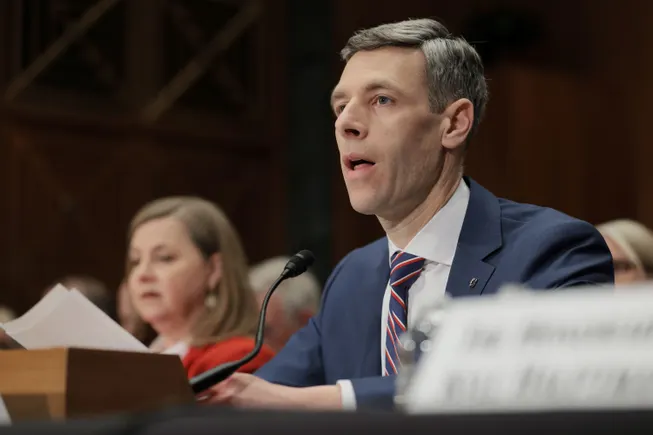
In a significant address to the Exchequer Club of Washington, D.C., this Wednesday, Comptroller of the Currency Jonathan Gould laid out a transformative agenda for the Office of the Comptroller of the Currency (OCC). Signaling a sharp departure from recent regulatory trends, Gould pledged to "double down" on three core mandates: tailoring supervisory oversight to focus exclusively on material financial risk, easing the regulatory burden to foster economic growth, and proactively embracing financial innovation.
Gould’s remarks serve as a definitive roadmap for the agency’s future, prioritizing a dynamic, competitive banking landscape over the rigid, checklist-driven compliance culture that has characterized the post-2008 era. By emphasizing that the OCC is "open for business," Gould is challenging the industry to move past the era of "too big to fail" and the subsequent, unintended consequence of "too small to succeed."
The Strategic Mandate: A New Philosophy of Supervision
At the heart of Gould’s vision is a fundamental shift in how the OCC interacts with the institutions under its purview. For years, the banking industry has complained of a "regulation by enforcement" approach, where examiners prioritize administrative compliance over substantive financial safety. Gould intends to reverse this, advocating for a "right-size" approach that focuses on material financial risk rather than procedural minutiae.
"Sound supervision and a healthy banking system are not objectives that can be achieved by subjecting all banks to the same standards," Gould told the audience. His approach suggests that the OCC will increasingly rely on examiner judgment rather than standardized checklists, aiming for a regulatory environment that is as agile as the technology banks are now deploying.
Chronology of Reform: From Stagnation to Renewal
The current regulatory climate has been years in the making. Since the 2007-08 financial crisis, the U.S. banking sector has undergone a massive consolidation, with nearly half of all community banks closing their doors. Historically, these exits have not been met with a corresponding surge of new entrants, leading to an environment where the "mega-banks" grow ever larger while the regional and community bank sectors remain stagnant.
The Recent Surge in Activity
- 2020–2024: The industry saw a period of relative dormancy in new charter applications, characterized by cautious regulatory oversight.
- 2025: A turning point. The OCC received as many charter applications in a single year as it had in the previous four combined.
- 2026: Under Gould’s leadership, the agency has approved 28 charters in the last two years, with "several dozen more in the pipeline," indicating a robust shift in the agency’s appetite for new market entrants.
Gould views this surge not as a risk, but as a necessary cycle of "creative destruction" essential to a modern economy. "A functional chartering process allows the banking system to renew itself and remain dynamic," he noted, emphasizing that new capital and fresh ideas are vital as consumer expectations for digital financial services continue to evolve.
Supporting Data: Deconstructing the "Community Bank Comeback"
The centerpiece of Gould’s policy initiative is the 2025 "Community Bank Comeback" program. The initiative is a direct response to the thinning out of local banking institutions. By dedicating specific examiner teams to banks with less than $30 billion in assets, the OCC is attempting to prevent the regulatory costs of serving smaller communities from becoming prohibitive.
Key Metrics and Trends:
- Consolidation Pressure: The loss of community banks since the Great Recession has created a "barbell" economy in banking, where the very large banks possess significant economies of scale, and smaller banks struggle under the weight of compliance costs designed for larger, more complex entities.
- Regulatory Efficiency: Gould highlighted that his administration has successfully finalized more rules in one-third the time frame of previous administrations. However, he cautioned that speed must not come at the expense of "fit for purpose" regulation.
- Supervisory Transparency: The OCC is working closely with the Federal Deposit Insurance Corp. (FDIC) to harmonize the definition of "unsafe or unsound" practices. This is intended to eliminate ambiguity, ensuring that when an examiner flags an issue, the bank understands exactly what the criticism is and how to resolve it.
Official Responses and Policy Shifts
Gould’s address touched upon several sensitive industry topics, most notably the integration of Artificial Intelligence (AI) and the ongoing issue of "debanking."
AI as a Component of Operations
Gould clarified that the OCC does not intend to create a separate "AI regulatory silo." Instead, AI will be treated as any other technological advancement—a component of existing business operations. The agency’s stance is that supervisory judgment should reflect the consequences of technology rather than the technology itself. If a bank uses AI for loan underwriting, the regulator will focus on the fairness and accuracy of the credit decisions, not the specific algorithmic code used to reach them.
Resisting "Inner Activists"
In a firm warning to the industry, Gould addressed the recent internal OCC investigation which found that nine banks under its supervision had engaged in practices that may have encouraged the debanking of customers based on political or religious beliefs.
"Banks are not a proper vehicle for achieving social or policy objectives outside of the legislative process," Gould stated. He signaled that the OCC will be watching closely to ensure that financial intermediaries do not use their privileged positions to indulge "inner activists" or bow to pressure from external interest groups. This marks a clear attempt to depoliticize the banking relationship and protect consumer access to the financial system.
Stablecoins and Financial Inclusion
Gould underscored that the future of finance, including stablecoins, should not be the exclusive domain of Silicon Valley fintech firms. He argued that community banks must have a seat at the table. By keeping the doors open to stablecoin innovation, the OCC hopes to ensure that the benefits of blockchain and digital asset technology are accessible to "Main Street" customers, rather than being sequestered in unregulated or non-bank financial environments.
Implications: A More Dynamic Banking System?
The implications of Gould’s speech are profound for both the banking industry and the broader economy. By acknowledging that "too big to fail" effectively created a "too small to succeed" environment, Gould is implicitly admitting that current regulations have inadvertently pushed lending and investment activity into the "shadow" or non-regulated banking sector.
The Shift Away from Risk Elimination
Gould’s assertion that "regulators’ short-sighted attempts to eliminate risk from the industry forced a significant amount of lending and investment activity outside of the regulated banking system" is a major philosophical pivot. It suggests that the OCC will accept a degree of calculated risk in exchange for a more vibrant, competitive market.
Impact on Future Bank Charters
For fintech companies, non-bank lenders, and regional banks looking to expand, the OCC’s current stance is a green light. The focus on "tailored supervision" implies that if a bank can demonstrate robust risk management, it will face fewer "check-the-box" hurdles. However, the expectation of transparency—both from the regulator to the bank and from the bank to the regulator—will likely increase.
The Road Ahead
The success of Gould’s vision will depend on the implementation of these policies by individual examiners on the ground. The transition from a checklist-heavy culture to one of "supervisory judgment" requires a highly skilled workforce, and Gould acknowledged that the OCC’s own internal structure will have to evolve alongside the industry it oversees.
As the OCC moves to finalize clearer standards for "matters requiring attention" and streamlines the chartering process, the banking sector faces a new reality: one where the regulatory burden is meant to be a guardrail, not a roadblock. Whether this leads to a new golden age for community banking or introduces new, unforeseen risks to the financial system remains to be seen. However, for now, the message from the Comptroller is clear: the era of static, uniform, and hyper-cautious regulation is coming to an end.
The banking system of the future, as envisioned by Gould, is one that is more diverse, more technologically savvy, and, crucially, more willing to serve the needs of the real economy without the weight of unnecessary administrative drag.