







The Trump administration is poised to re-enter the aviation industry, though in a capacity vastly different from the former president’s 1980s-era commercial venture, the Trump Shuttle. While the previous iteration sought to dominate the lucrative Northeast corridor, the new “Trump Shuttle”—a government-led initiative to bring deportation logistics in-house—is designed to facilitate a massive, state-directed effort to scale the removal of undocumented immigrants from the United States.
New details emerging from recent Department of Homeland Security (DHS) tenders suggest that Immigration and Customs Enforcement (ICE) is aggressively moving to establish its own sovereign fleet. This shift marks a departure from the long-standing practice of relying on private-sector commercial airlines to carry out removal flights, raising significant questions about government efficiency, long-term costs, and the operational viability of a state-run "deportation airline."
The Strategic Shift: Moving Beyond Private Contractors
For decades, the federal government has relied on a patchwork of private aviation providers to manage the logistics of moving detainees. Carriers such as Avelo Air, Eastern Air Express, GlobalX Air, Omni Air International, and World Atlantic Airlines have played a critical role in this system, viewing these government contracts as a consistent and lucrative revenue stream.
However, the current administration’s stated goal of deporting one million undocumented immigrants annually necessitates a paradigm shift. To hit these targets, the administration has concluded that the current reliance on third-party capacity is a potential bottleneck. Consequently, under the leadership of current DHS head Markwayne Mullin, the government is moving to acquire and maintain a dedicated fleet of aircraft.
The logistical goal is straightforward: by controlling the assets, ICE aims to eliminate the scheduling volatility associated with chartering private aircraft, thereby doubling the current monthly deportation capacity. This plan is not merely a logistical upgrade; it is a fundamental reconfiguration of how the U.S. government handles large-scale human movement.
Chronology of the "ICE Air" Initiative
The evolution of this project has been rapid, moving from concept to concrete procurement in less than two years.
- Summer 2025: Former Homeland Security Secretary Kristi Noem introduces the proposal for an independent, government-owned and operated aviation fleet. The core objective is to bypass private market constraints and increase the frequency of deportation flights.
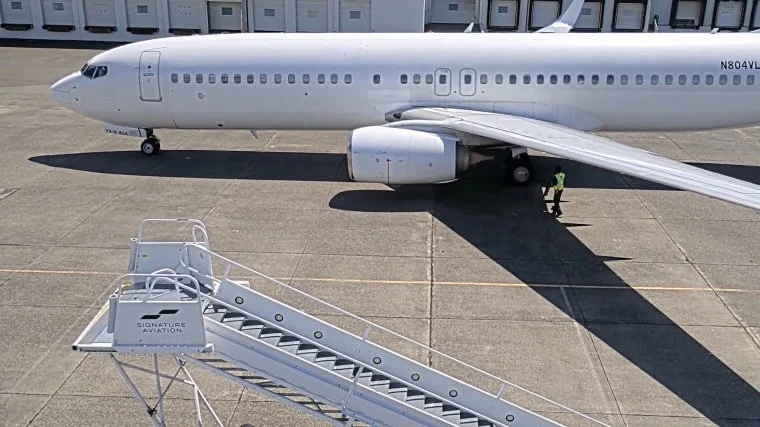
- Late 2025: The administration secures an initial investment to purchase six Boeing 737-700s for approximately $140 million. Notably, these assets were acquired from Avelo Airlines, which subsequently exited the deportation flight market entirely.
- 2026–2027: Despite leadership changes at the DHS—specifically the departure of Noem and the appointment of Markwayne Mullin—the administration reaffirms its commitment to the project.
- July 2027 (Target Date): The government has set this as the final deadline for the full launch of the expanded “ICE Air” fleet, which is expected to include the six Boeing 737-700s and two Gulfstream G650ERs (designated as C-37Bs in government configuration).
Financial Framework and Resource Allocation
The ambition of this program is backed by significant fiscal muscle. Through a series of legislative actions, the Trump administration has directed over $75 billion in total funding toward ICE. Of this, $30 billion is explicitly earmarked for deportation efforts—a massive increase from the previous baseline of roughly $9.5 billion annually.
From an aviation cost perspective, the economics are complex. Industry estimates suggest that a standard deportation flight currently costs roughly $25,000 per hour when accounting for fuel, maintenance, flight crews, security detail, and onboard medical personnel. Consequently, a typical deportation mission costs between $100,000 and $200,000 per trip.
The administration argues that ownership will provide long-term savings by reducing the markup paid to private charter firms. However, skepticism remains regarding the overhead associated with the government maintaining a fleet of specialized aircraft, particularly when they still intend to contract out the actual flight and ground operations.
Implications of a Government-Operated Airline
The move toward an in-house fleet invites a deep analysis of whether this represents a net gain for taxpayers or a bureaucratic expansion.
The Efficiency Paradox
The DHS maintains that owning the aircraft will save hundreds of millions of dollars. However, industry analysts point to a significant contradiction in the operational model. While the government will own the planes, they are currently seeking private contractors to provide the pilots, flight attendants, security, and medical staff. If the government is still paying market rates for highly skilled labor, the potential for efficiency gains is limited.
Furthermore, commercial airlines are experts at asset utilization. By owning the planes, the government is effectively removing the ability to "scale down" during periods of lower demand. In a charter model, the government pays only for the capacity it uses; in an ownership model, the government must pay for the maintenance, insurance, and storage of the aircraft regardless of flight volume.
Operational Scope
The proposed fleet—Boeing 737-700s and Gulfstream G650ERs—indicates a dual-track mission profile. The 737s are clearly intended for high-volume deportation flights. The Gulfstream G650ERs, however, suggest a more specialized capability. These long-range, high-speed aircraft are often used for government transport, hinting that the "ICE Air" fleet may also be used for high-risk charter operations, emergency response, and potentially the rapid transport of high-value individuals involved in detention or legal proceedings.
Precedents and Comparisons
It is important to note that the U.S. government has historically operated aviation assets for prisoner transport. The Justice Prisoner and Alien Transportation System (JPATS), managed by the U.S. Marshals Service, is the most direct parallel. JPATS operates its own terminals—most notably at the Oklahoma City Airport—and manages the logistical movement of federal prisoners across the country. The "ICE Air" project essentially represents an expansion of this existing, albeit secretive, government-airline model.
Critical Analysis: Is the Bottleneck Real?
A central tenet of the administration’s argument is that the current reliance on the private sector limits their ability to conduct deportations. However, aviation industry experts have expressed doubt that there is a shortage of available aircraft capacity. In the current economic climate, providing steady, government-backed flight hours is an attractive proposition for regional and charter carriers.
If there is no shortage of private capacity, the move to acquire a fleet suggests that the administration’s goal is not just to increase volume, but to achieve total autonomy over the deportation process. By controlling the fleet, the government shields itself from public or private pressure that might influence airlines to drop deportation contracts—a phenomenon that has occurred previously when airlines faced public backlash.
Conclusion: The Road Ahead
As July 2027 approaches, the launch of this expanded "ICE Air" program will serve as a definitive test of the administration’s logistical strategy. The success of the project will be measured not just by the number of flights conducted, but by the ultimate cost-per-deportation.
For now, the project remains a massive undertaking that merges the rigid requirements of government policy with the complexities of the global aviation market. Whether the "Trump Shuttle" of the 2020s succeeds in its mission to streamline mass deportation remains a subject of intense debate, but there is no question that it will leave an indelible mark on both the Department of Homeland Security and the private aviation sector that has served it for so long.