







For the frequent traveler, the landscape of airline elite status has undergone a seismic shift. No longer is loyalty defined merely by miles flown in a metal tube; it is increasingly a complex calculation of credit card spending, milestone thresholds, and the strategic layering of partnerships. Recently, I made the decision to pivot my primary loyalty focus from American Airlines AAdvantage to Alaska Airlines’ "Atmos Rewards" program.
Having officially secured Platinum status—the second-highest tier in the program—I have achieved my primary objective: oneworld Emerald status, which guarantees access to some of the world’s most exclusive airport lounges. However, as I sit at the crossroads of the current qualification cycle, I am forced to weigh the merits of pushing for the program’s top tier, Titanium, against the pragmatic reality of my travel patterns.
The Foundation: Why Atmos Rewards Platinum?
The decision to transition away from American AAdvantage was not made lightly. For years, I held Executive Platinum status, enjoying the perks of a traditional legacy carrier model. However, the current environment of elite status has rendered standard upgrade perks increasingly elusive due to high demand and the proliferation of status-earning credit cards.
As a Miami resident, I remain a frequent flyer on American Airlines. Consequently, oneworld Emerald status is non-negotiable for me. It provides consistent access to premium lounges, priority check-in, and expedited security across the entire oneworld alliance. Alaska Atmos Rewards, through its integration with oneworld, provides this same tier benefit while offering a more favorable path to status for those who leverage credit card spend.
My path to Platinum was largely inorganic, fueled by a combination of:
- Credit Card Synergy: Utilizing the Atmos Rewards Summit Card for substantial business and personal expenditures.
- Award Flight Utility: Unlike many legacy programs, Atmos Rewards allows for the accumulation of status points on award travel, a game-changer for those who frequently use points to book business class.
- Strategic Spending: By maximizing the 10,000-point base award for cardholders and an additional 30,000+ points through strategic category spend, the climb to the 80,000-point Platinum threshold was achieved with greater efficiency than traditional butt-in-seat flying.
Chronology of the Status Pursuit
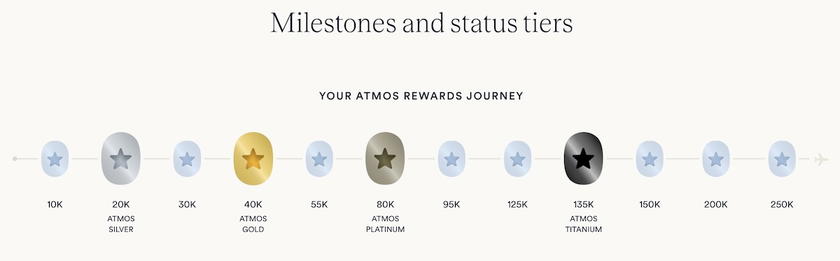
To understand the current dilemma, one must look at the mathematical progression of the Atmos Rewards structure. The tiers are clearly delineated: 20,000 points for Silver, 40,000 for Gold, 80,000 for Platinum, and 135,000 for the coveted Titanium.
Having cleared the 80,000-point hurdle, I found myself looking at the 95,000-point milestone perk threshold. At this juncture, the program offers a dual-choice reward system. By selecting bonus points or upgrade certificates, I effectively boosted my travel equity. This "milestone" approach is the cornerstone of modern loyalty: it rewards the behavior of the spender, not just the flyer.
Currently, I am positioned 30,000 points away from the next milestone and 40,000 points from the apex of Titanium status. The question now becomes one of opportunity cost: Is the pursuit of an additional 40,000 points a rational financial move, or is it an exercise in "chasing status" for the sake of a title?

Supporting Data: The Case for Titanium
When analyzing the incremental return on spending, the argument for Titanium becomes surprisingly compelling. The primary incentive is the "Global Upgrade" perk. Titanium members are eligible for complimentary upgrades on long-haul flights—a significant value proposition for any international traveler.
However, the math relies on the "Double-Dip" strategy. By leveraging the difference between calendar year qualifications and card anniversary cycles, a savvy traveler can theoretically stack rewards. If I were to push $60,000 in additional spending through the Summit Card before the end of the year, the resulting influx of points would trigger:
- Status Advancement: A direct trajectory toward the 135,000-point Titanium threshold.
- Milestone Bonuses: The acquisition of a 100,000-point Global Companion Award.
- Future-Proofing: Positioning myself to revert to a "maintenance mode" next year, allowing for a focus on American AAdvantage to keep my options open.
The return on investment (ROI) here is not in the "status" itself, but in the tangible assets earned along the way. When the incremental points and the companion pass are valued against the opportunity cost of putting that same $60,000 of spending on a different financial product, the Atmos Rewards program remains highly competitive.
Official Perspectives and Program Mechanics
Alaska Airlines has designed the Atmos Rewards program to bridge the gap between regional travelers and high-spending credit card users. By offering status points on award flights and through card spend, they have effectively dismantled the "flying only" gatekeeper model that has frustrated many high-value customers for years.
In official communications regarding the program’s trajectory, leadership at Alaska has emphasized the importance of "rewarding the total relationship." This indicates that they are prioritizing the lifetime value of a customer over the frequency of individual flights. For the consumer, this means that if you are a "whale" in terms of spending, you can achieve top-tier status without ever needing to step foot on an Alaska Airlines flight.
However, there is an inherent risk. The "Global Upgrade" perk, while marketed as a premium benefit, is subject to availability. As someone who resides in Miami—far from the primary Alaska hubs—my ability to utilize these upgrades is limited to their partner network. Relying on an upgrade to clear at the gate is a high-anxiety endeavor, and for a traveler who values predictability, this is the most significant "con" in the Titanium equation.
Implications: The "Every-Other-Year" Strategy
The broader implication of my current situation is the rise of the "rotating status" model. Many high-level travelers have moved away from the traditional model of holding top-tier status with one airline year-over-year. Instead, they pursue the "double-dip" every two years.
By pushing hard for Titanium this year, I effectively exhaust the "low-hanging fruit" of the milestone perks. Next year, I can afford to spend less aggressively on this program, allowing me to focus my financial energy on American AAdvantage. This rotation allows a traveler to:
- Maximize the high-value milestones of multiple programs.
- Maintain a portfolio of status that ensures lounge access and priority service regardless of which carrier is flying the route.
- Avoid the diminishing returns associated with repeating the same elite status tier annually.
Conclusion: To Climb or to Coast?
The decision to pursue Titanium is essentially a bet on my own travel frequency and my appetite for risk. If I successfully reach the 135,000-point mark, I will be rewarded with a suite of benefits that are undeniably superior to Platinum. Yet, for a Miami-based flyer, the utility of those benefits is tempered by the lack of frequent Alaska Airlines operations.
If I remain at Platinum, I maintain the oneworld Emerald status that is my actual goal, without the stress of "manufactured" spending to reach the next tier. However, the prospect of the 100,000-point Global Companion Award acts as a powerful siren song.
Ultimately, loyalty programs are financial instruments. Whether one chooses to chase the next status tier should be decided by the spreadsheet, not the ego. As I approach the final quarter of the year, I invite fellow travelers to consider: when the status benefits are largely redundant, does the quest for the top tier provide actual value, or is it simply a game of points-chasing that distracts from the primary goal of travel?
I am inclined to lean toward the aggressive path, not for the title of "Titanium," but for the systemic efficiency of the rewards earned along the way. In the modern era of airline loyalty, the status is the trophy, but the points are the prize.