






As the United States prepares to unfurl the bunting for its 250th anniversary this July, the nation is bracing for a spectacle of historic proportions. From the majestic arrival of tall ships in New York Harbor to the carefully scripted oratory of political leaders invoking the ideals of the Founders, the Semiquincentennial promises to be a masterclass in American pageantry. Yet, beneath the veneer of fireworks and national pride, a sobering reality has taken hold. A cursory glance at the economic landscape reveals a phenomenon of striking historical déjà vu.
We are not merely observing a birthday; we are confronting a mirror. Fifty years ago, as the nation marked its Bicentennial, it was entangled in a web of economic instability that feels hauntingly familiar in 2026. Today, we are blowing out the candles alongside the same persistent triad that plagued the 1970s: sticky, stubborn inflation; volatile energy costs that sting at the pump; and a looming, existential deadline to overhaul the Social Security system.
The Core Economic Triad: A Resilient Struggle
The takeaway of the Semiquincentennial is not that we are trapped in a grim, circular rerun of history, but rather that certain structural hurdles in the American economy possess a unique, frustrating resilience. While the political establishment often frames the American experiment as one of perpetual progress, these three specific challenges serve as a reminder that some "homework" from the 1970s was never fully completed.
1. The Social Security Crisis: A Half-Century of Kicking the Can
The Bicentennial year of 1976 was a time of quiet crisis for the Social Security Administration. A flawed statutory formula, enacted in 1972 to implement Cost of Living Adjustments (COLA), was inadvertently draining the Social Security Trust Fund. This "double indexing" error—or "decoupling" problem—was a technical failure with massive real-world consequences. Rather than addressing the core demographic and structural imbalance, Congress opted for a series of minor patches in 1977.
By 1983, the situation had become untenable. The landmark 1983 legislative rescue—the result of the bipartisan Greenspan Commission—introduced benefit taxation, adjusted the retirement age, and delayed COLA increases. It was explicitly designed to buy 40 to 50 years of breathing room. In 2026, that borrowed time has officially expired.
The demographic landscape has shifted dramatically since the 1970s. In 1976, there were roughly 23 million Americans aged 65 and older, representing 10.4% of the population. Today, that number has surged to approximately 62 million, or 18% of the total population. As the Social Security Trust Fund hurtles toward projected insolvency in 2032, the public’s confidence in the government’s ability to act is at a nadir. A recent survey by PlanGap found that 70% of Americans aged 45 to 60 lack confidence that the government can resolve the funding shortfall without slashing benefits.
2. Inflation: The Ghost of Stagflation
During the Bicentennial summer, the U.S. economy was enjoying a fleeting, illusory "exhale." Inflation had cooled to 5.8% from its 1974 double-digit peak of 11.1%. Policymakers at the time hoped the worst was over. They were wrong. Inflation rebounded with a vengeance, climbing annually until it reached a crushing 13.5% by 1980.
The modern economy is tracing a similar trajectory. Following the pandemic-era surge—which saw inflation peak at 8.0% in 2022—the nation has struggled to return to the stability of the 2010–2020 decade, when inflation averaged a modest 1.77%. As of May 2026, the U.S. is grappling with a persistent 4.2% inflation rate. Even if the rate of increase fluctuates, the cumulative impact of "sticky" prices means that the cost-of-living crisis is far from over. For the average American household, the affordability crisis is not a temporary statistical anomaly but a permanent shift in the cost of basic existence.
3. The Energy Wildcard: Geopolitical Fragility
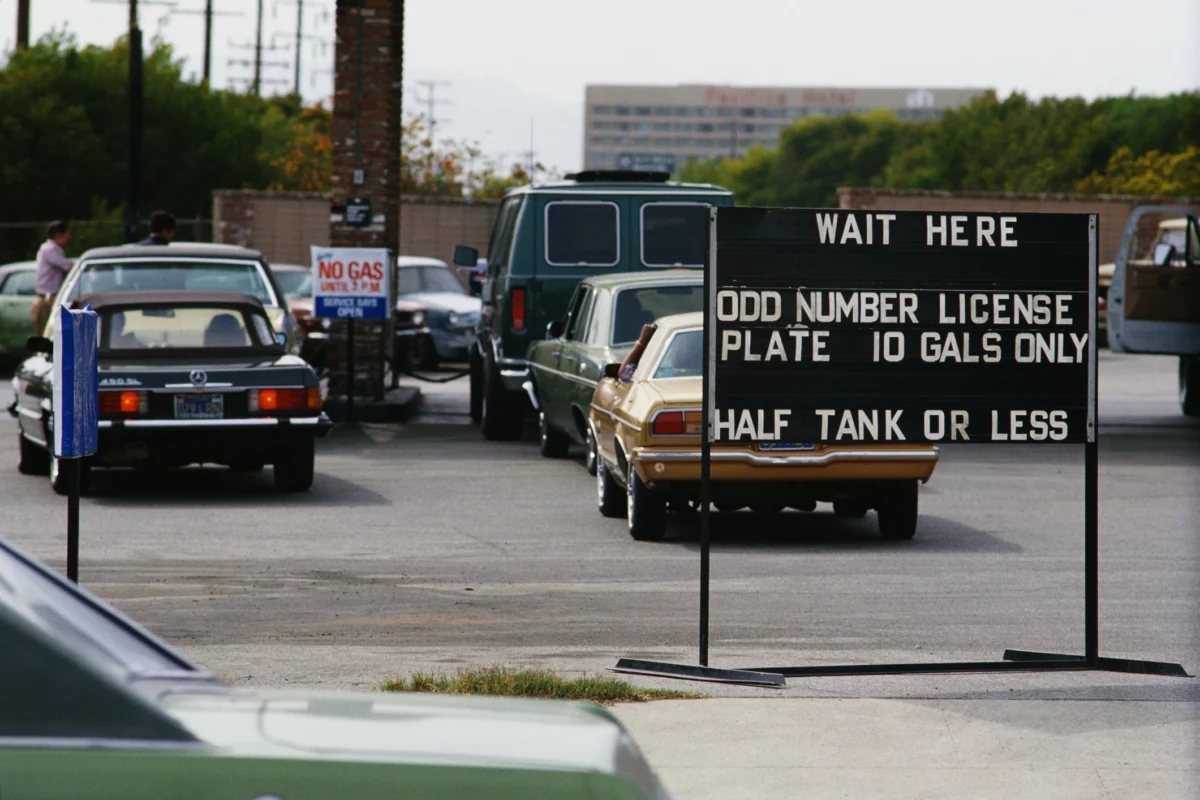
In November 1972, U.S. Commerce Secretary Peter Peterson famously remarked, "The era of low-cost energy is almost dead. Popeye is running out of cheap spinach." He was prescient. By 1976, the visceral shock of the 1973–74 OPEC oil embargo had faded, but the structural vulnerability of the U.S. energy market remained.
Fifty years later, that vulnerability is unchanged. With the national average price at the pump lingering around $4 a gallon, modern consumers are discovering that decades of political rhetoric regarding "energy independence" cannot entirely insulate local fuel prices from overseas supply shocks. Tensions with the Iranian government, combined with global inventory constraints and the logistical demands of a fragile post-war world, ensure that energy prices remain an unpredictable, volatile variable.
Chronology: From Bicentennial to Semiquincentennial
- 1972: Implementation of the flawed Social Security COLA formula.
- 1973–1974: The OPEC oil embargo triggers the first major energy crisis of the modern era.
- 1976 (The Bicentennial): Inflation sits at 5.8%; the Social Security system begins to show signs of long-term structural failure.
- 1980: Inflation reaches a historic peak of 13.5%.
- 1983: The Greenspan Commission enacts a bipartisan rescue package for Social Security, buying 40+ years of time.
- 2022: Post-pandemic inflation peaks at 8.0%.
- 2026 (The Semiquincentennial): The 1983 "breathing room" expires; Social Security faces a 2032 insolvency cliff; inflation remains sticky at 4.2%.
Official Responses and Political Implications
The political response to these recurring challenges has been characterized by a preference for short-term fixes over long-term structural reform. In the late 1970s, the political capital required to overhaul Social Security was deemed too expensive for a Congress facing reelection. Today, we see a similar paralysis.
"The problem is not a lack of data; it is a lack of political consensus," says Dr. Helena Vance, a senior economist at the Brookings Institution. "We have known the Social Security insolvency date for decades. We have known that energy volatility is a byproduct of our global footprint. Yet, every administration approaches these issues as if they are ‘black swan’ events rather than systemic, predictable outcomes of our current policy frameworks."
The legislative branch has, thus far, remained largely silent on the looming 2032 insolvency date. While some advocacy groups have proposed raising the cap on taxable earnings or further adjusting the retirement age, these remain "third-rail" issues that few politicians are willing to touch during an anniversary year that is meant to celebrate national unity.
The Human Cost: A Crisis of Confidence
The most profound implication of this historical repetition is the erosion of the American social contract. When 68% of older Americans report "a great deal" of concern that they will not receive the benefits they were promised, the trust between the governed and the government is fundamentally compromised.
For the average citizen, the "American Dream" of a comfortable, predictable retirement is being replaced by a climate of anxiety. The 1976 generation dealt with the uncertainty of stagflation by demanding better leadership and economic discipline. The 2026 generation is, in many ways, more cynical. Having witnessed the failure to permanently fix the problems of the 20th century, there is a growing belief that the current economic structure is incapable of adapting to a world with an aging population and volatile energy markets.
Conclusion: Lessons from the Mirror
The Semiquincentennial is an opportunity to look back, but if we only look at 1776, we ignore the lessons of 1976. The true strength of American exceptionalism should not be found in our ability to ignore structural decay, but in our capacity to finally address it.
We are standing at a juncture where the "leftover homework" of the 1970s is no longer a matter of policy debate—it is a matter of impending financial necessity. If America is to thrive in its next 250 years, it must break the cycle of temporary patches and short-term political posturing. The mirror is showing us that the crises of the past are the crises of the present. The question for the next generation of American leadership is whether they will finally pick up the pen and complete the assignment, or if the next anniversary will be marked by the same familiar, and increasingly unsustainable, echoes of the past.