








In the urgent global push to curb greenhouse gas emissions, Europe has emerged as the world’s primary laboratory for environmental fiscal policy. Through a combination of national carbon taxes and sophisticated emissions trading systems (ETS), European nations are attempting to internalize the environmental costs of fossil fuel consumption. From Finland’s pioneering move in 1990 to the sophisticated, overlapping market mechanisms of 2026, the continent has set the standard for how governments can leverage tax policy to incentivize a transition to a low-carbon economy.
Main Facts: The Architecture of Carbon Pricing
At its core, a carbon tax is a levy imposed on the carbon content of fossil fuels. By assigning a financial value to the emissions produced by businesses, consumers, and governments, policymakers aim to make high-carbon activities prohibitively expensive, thereby steering the economy toward cleaner energy alternatives.
As of April 1, 2026, the landscape of European carbon pricing is defined by 24 countries that have implemented national carbon taxes. However, the rigor of these systems varies wildly. While some nations have established robust, high-rate regimes, others utilize nominal taxes that serve more as a symbolic signal than a structural deterrent.
The diversity of these schemes is further complicated by their scope. A "carbon tax" does not always cover every source of pollution. Some nations, such as Spain, maintain narrow mandates—applying their tax solely to fluorinated gases, which accounts for just 2 percent of the nation’s total greenhouse gas output. Conversely, nations like Luxembourg, Albania, and Liechtenstein have designed frameworks that, in principle, capture upwards of 72 percent of their total national emissions.
A Chronological Evolution of Climate Taxation
The history of carbon taxation is a narrative of rapid expansion, moving from a radical economic experiment to a cornerstone of European governance.
The 1990s: The Finnish Innovation
In 1990, Finland broke new ground by becoming the world’s first country to implement a carbon tax. This historic policy shift set a precedent that would soon be adopted by neighboring Scandinavian nations, creating a "green belt" of environmental taxation in Northern Europe.
The 2010s: Expansion and Integration
As climate goals became more ambitious, the 2010s saw the proliferation of these taxes across Central and Western Europe. This decade was also defined by the integration of national systems with regional ones. The EU Emissions Trading System (EU ETS)—a market-based cap-and-trade mechanism—became the dominant framework for heavy industry. In 2020, Switzerland linked its national ETS to the EU’s, signaling a move toward regional harmonization.
The 2020s: The Era of Complexity and Transition
The current decade has been characterized by legislative refinement. Post-Brexit, the United Kingdom launched its own independent ETS in 2021. Germany and Austria introduced national carbon taxes in 2021 and 2022, respectively, while nations like Serbia joined the fray in 2026. Looking ahead, the continent is preparing for the transition to "EU ETS-2," a broader, more inclusive successor to the current system that aims to harmonize coverage across building, transport, and additional industrial sectors.
Supporting Data: The Disparity of Rates
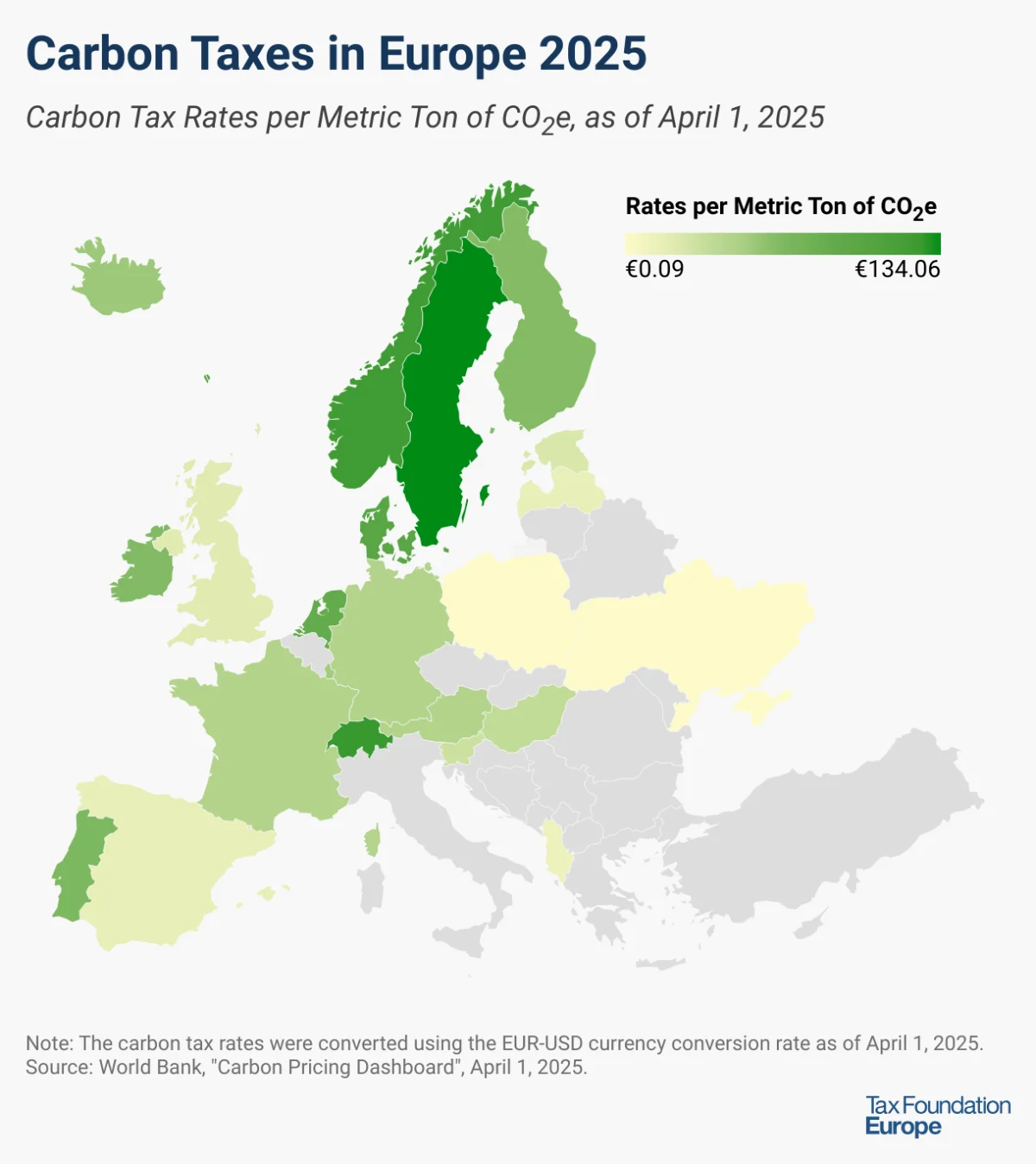
The financial burden of carbon taxation across Europe is marked by extreme inequality, reflecting different economic priorities and political climates. As of the second quarter of 2026, the average carbon tax rate among the 24 European countries stands at €53.63 per metric ton.
However, the "average" masks a stark reality:
- The High-Tax Tier: Norway leads the continent with a tax rate of €146.23 ($169.71) per ton. It is closely followed by Sweden (€133.17) and the Swiss-Liechtenstein duo, both at €129.09. These nations use high prices to aggressively discourage the use of carbon-intensive fuels.
- The Low-Tax Tier: At the opposite end of the spectrum, Poland and Ukraine maintain symbolic rates of €0.09 and €0.59 per ton, respectively. These figures suggest that while these nations have "carbon taxes" on the books, their primary function is not to provide a meaningful price signal for decarbonization.
Official Responses and Strategic Hurdles
While the proliferation of carbon taxes is widely seen as a positive step toward meeting the goals of the Paris Agreement, government agencies and independent analysts have identified several critical "friction points" in current policy designs.
The Problem of Double Taxation
A significant concern for policymakers is the overlap between national carbon taxes and the EU ETS. When a company is forced to pay a national tax on emissions that are already subject to a capped allowance under the EU ETS, it creates a state of "double taxation."
Economic experts warn that this is not just an administrative nuisance; it is an inefficient policy lever. When national taxes overlap with an ETS, the result is often a "leakage" effect. Businesses may simply shift their emissions-heavy operations to sources outside the national tax base, while the total emissions remain unchanged because they are still capped by the regional ETS allowance. Essentially, the national tax fails to reduce overall pollution while simultaneously increasing the cost of doing business within that specific jurisdiction.
Collection Efficiency
Even when a country mandates a high carbon tax, the actual revenue collected and the subsequent reduction in emissions can be undermined by complex exemption regimes. Many countries offer "carve-outs" for energy-intensive, trade-exposed industries to prevent them from relocating to countries with lower environmental standards. While this protects local jobs, it significantly compromises the "collection efficiency" of the carbon tax and dilutes its impact on the climate.
Implications for the Future of Global Policy
The European experience offers several vital lessons for the rest of the world, including emerging markets like Turkey, which is currently weighing the implementation of its own national ETS.
1. The Need for Harmonization
The current "patchwork" of European carbon pricing is increasingly viewed as unsustainable. The transition toward the EU ETS-2 demonstrates that the future of effective climate policy lies in broader, more unified market mechanisms that cover more sectors and minimize the need for conflicting national taxes.
2. Efficiency Over Complexity
The most effective carbon taxes are those with the broadest tax bases and the fewest exemptions. A narrow tax base is inherently inefficient and costly to administer. As countries look to implement or refine their own systems, they are increasingly advised to follow the principle of neutrality: applying a single, consistent rate to all carbon-emitting sectors to avoid the distortions caused by fragmented policy.
3. The Role of Subnational Actors
The interest from regions like Catalonia in pursuing subnational carbon taxes highlights a growing trend: climate policy is no longer the sole purview of the nation-state. As local governments seek to meet ambitious climate targets, we may see a rise in regional carbon pricing models that complement—or in some cases, clash with—national and international systems.
Conclusion
The evolution of carbon taxation in Europe serves as a roadmap for the global community. While the continent has succeeded in establishing a clear price signal for carbon, the journey has been far from seamless. The challenges of double taxation, the persistence of low-rate symbolic taxes, and the difficulties of balancing economic competitiveness with environmental integrity remain at the forefront of the debate.
As Europe moves toward more unified frameworks like the EU ETS-2, the world is watching. The success of these policies will ultimately be measured not by how many countries have a tax on the books, but by how effectively these systems drive the systemic decarbonization of the modern economy. For now, Europe remains the leader in this high-stakes economic experiment, proving that while carbon pricing is a complex instrument, it is an essential one in the fight against climate change.