






The landscape of federal student loan repayment has shifted dramatically following the judicial intervention that effectively dismantled the Saving on a Valuable Education (SAVE) plan. For millions of borrowers, particularly those working toward Public Service Loan Forgiveness (PSLF), the loss of this cornerstone program creates immediate financial uncertainty. However, while the headlines are alarming, a granular analysis of the impact reveals that the fallout is not uniform.
For many, the transition to alternative plans—such as the Income-Based Repayment (IBR) plan or the Repayment Assistance Plan (RAP)—will result in only marginal payment increases. Yet, for a specific cohort of middle-income families, the shift represents a significant, if not burdensome, increase in monthly obligations. Understanding the nuances of this change is essential for maintaining a viable path toward loan forgiveness.
The Chronology of a Policy Shift
The SAVE plan was introduced by the Biden-Harris administration as the most generous income-driven repayment (IDR) option in history. By shielding more income from calculation and preventing interest ballooning, it was intended to serve as a long-term safety net for borrowers.
However, the program faced immediate legal challenges. In the summer of 2024, federal courts issued injunctions that blocked key components of the SAVE plan. As litigation continues to wind its way through the appellate system, the Department of Education has been forced to pause enrollment and recertification for the plan. For borrowers, this means that the "SAVE" era has effectively ended for the time being, forcing a reversion to older, less flexible frameworks.
Supporting Data: The Impact on Monthly Payments
The financial reality of the SAVE repeal depends entirely on the borrower’s income level, family size, and filing status. To understand the magnitude of the change, we must compare the monthly costs under the now-defunct SAVE plan against the current alternatives, such as the New IBR or the Repayment Assistance Plan (RAP).
Case Study 1: The Single Professional
Consider a single borrower earning $50,000 annually. Under the SAVE plan, this borrower would have enjoyed a monthly payment of approximately $59. With the pivot to the Repayment Assistance Plan (RAP), that payment rises to $167.
While an increase of $108 per month is never welcome, it represents a manageable shift for many individuals. On an annual basis, this is roughly a $1,200 difference, or about 2.4% of the borrower’s gross income. While not ideal, it remains within the realm of affordability for most single-income households.
Case Study 2: High-Earning Physicians
High earners often experience the "flattening" effect of IDR plans. Take a married physician earning $400,000, carrying $400,000 in debt, and filing taxes separately. Under the SAVE plan, the payment would have been $3,040. Under the current RAP, the payment rises to $3,333.
The delta here is even smaller as a percentage of income—just 0.88% more than what was projected under SAVE. In the context of a high-income medical career, the repeal of SAVE does not fundamentally break the financial viability of their PSLF strategy.
The "Middle-Class Gap": Who Is Most Vulnerable?
The most acute pain point of the SAVE repeal is not found at the extremes of the income spectrum, but rather in the middle. Specifically, middle-income earners with multiple children are disproportionately impacted.
The SAVE plan was uniquely advantageous to families because it provided a deduction equal to 225% of the federal poverty line. In contrast, the Repayment Assistance Plan (RAP) is far less generous regarding dependents, offering a deduction of only $50 per dependent per month.
The Pharmacist’s Dilemma
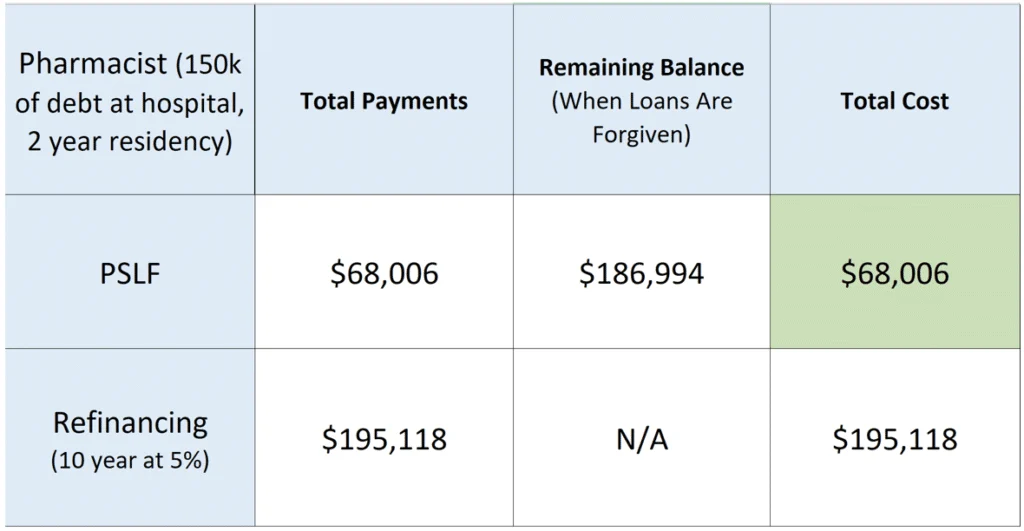
To illustrate this, consider a pharmacist working at a nonprofit hospital earning $120,000 annually, filing separately from a spouse, with four children.
- SAVE Payment: $294
- RAP Payment: $800
The difference here is a staggering $6,072 per year. This represents a 5% increase in the borrower’s total income, a massive shift that can disrupt a family’s monthly budget. This specific demographic—middle-class families with children—is the primary victim of the legal dismantling of the SAVE program.
Implications for PSLF Buyback
The repercussions extend beyond monthly payments to the "PSLF Buyback" program. This mechanism allows borrowers to "buy back" months that would have otherwise been ineligible for PSLF credit, provided they can prove that their income at the time would have resulted in a $0 payment under an IDR plan.
The loss of SAVE means that the calculation for buyback amounts is now tethered to less favorable plans. Much like the monthly payment issue, low- and high-income earners will find the buyback costs under RAP to be relatively close to the now-defunct SAVE calculations. However, middle-class earners with large families will find that the "cost of admission" for buyback months has increased significantly. Borrowers in the $70,000 to $150,000 income bracket should exercise extreme caution before initiating a buyback request without a thorough analysis of the new, higher costs.
Official Responses and the Path Forward
The Department of Education has maintained that it is working to transition affected borrowers into the most suitable remaining plans. However, the sheer volume of account adjustments has led to processing delays, errors in payment calculation, and general confusion.
The official stance remains that borrowers should stay the course with their PSLF-eligible employment, even if the repayment plan landscape feels volatile. The core promise of PSLF—tax-free forgiveness after 120 qualifying payments—remains intact. The challenge is no longer about the program itself, but about managing the "bridge" period while the legal battles continue.
Strategic Recommendations: Don’t Fret, Plan
While the uncertainty is frustrating, panic is not a financial strategy. The end of the SAVE plan does not necessitate the abandonment of the PSLF path. Instead, it requires a more tactical approach to debt management.
1. Optimize Your Plan
There are multiple IDR plans still available. Borrowers should perform a side-by-side comparison of the New IBR and the Repayment Assistance Plan based on their specific income and family size. Often, one plan will be mathematically superior for your specific household structure.
2. Time Your Recertification
Because payment changes are often triggered by annual recertification, managing the timing of your income disclosure is critical. Ensure that you are not recertifying prematurely if you have had a recent increase in income or a change in household size that could negatively impact your payment calculation.
3. Leverage Professional Expertise
With the shifting legal landscape, "cookie-cutter" advice is no longer sufficient. Borrowers with significant debt loads—particularly those in the middle-income bracket with children—should consider consulting with student loan experts. A professional can help identify legal loopholes and ensure that you are utilizing the most cost-effective path toward the 120-payment mark.
4. Monitor Litigation Closely
The legal status of the SAVE plan is fluid. Future court rulings could reinstate parts of the plan or provide further clarity on how income-driven repayment should be calculated. Stay informed through reputable sources, but do not make impulsive decisions based on speculative headlines.
Conclusion
The repeal of the SAVE plan is a setback, but it is not a defeat for the millions of public service workers pursuing loan forgiveness. While the loss of the 225% poverty line deduction is a genuine blow to middle-class families, the fundamental structure of the PSLF program remains a powerful tool for financial independence.
By understanding the math, optimizing your repayment plan, and staying proactive, you can navigate this transition. Your student loan strategy should be a living, breathing plan that adjusts to the environment—not a static set of expectations. Focus on the 120 payments, maintain your qualifying employment, and ensure that every dollar you pay toward your loans is the minimum amount required by law. In the end, the path to forgiveness is still open; it has simply become a bit more narrow.