









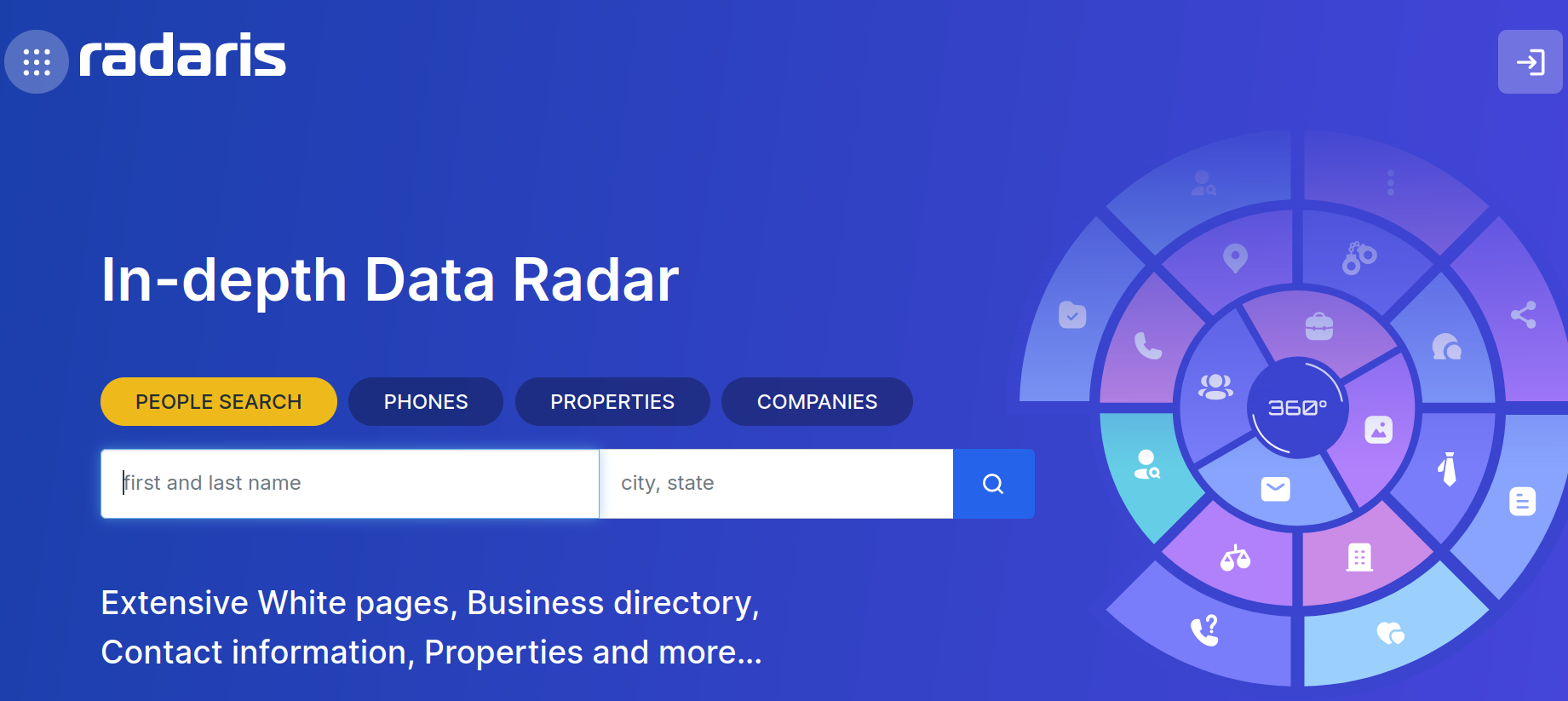
For years, the consumer data broker Radaris.com operated with a sense of untouchable immunity. Despite a mounting pile of complaints from privacy advocates and a reputation for aggressively ignoring requests to scrub personal information from its databases, the company remained a fixture of the online people-search ecosystem. However, that veneer of invincibility has finally shattered.
In a landmark legal development, a New Jersey judge has ordered the transfer of Radaris.com—along with more than a dozen associated data broker domains—to the plaintiffs in a high-stakes privacy lawsuit. The judgment marks a significant escalation in the battle over "Daniel’s Law," a New Jersey statute designed to shield the private information of law enforcement officials, judges, and government personnel from the prying eyes of the commercial surveillance industry.
The Genesis of the Legal Assault: Daniel’s Law
The legal proceedings were initiated in February 2024 by Atlas Data Privacy Corp, an organization that has systematically pursued data brokers accused of violating Daniel’s Law. Named in honor of Daniel Anderl, the son of a federal judge who was murdered by an aggrieved litigant who had easily tracked the judge’s home address online, the statute is one of the most stringent privacy protections in the United States.
Under the law, protected individuals—including judges, law enforcement officers, and their families—have the right to demand the total removal of their personal data from people-search platforms. Failure to comply can result in fines of $1,000 per violation. For Atlas, the mission was clear: force the data brokerage industry to respect the safety of those who serve the public.
A Web of Deceit: The "Shell Game" Strategy
The downfall of Radaris was not immediate. It was the culmination of a protracted, cat-and-mouse game involving international corporate structures, fake executives, and aggressive legal intimidation.
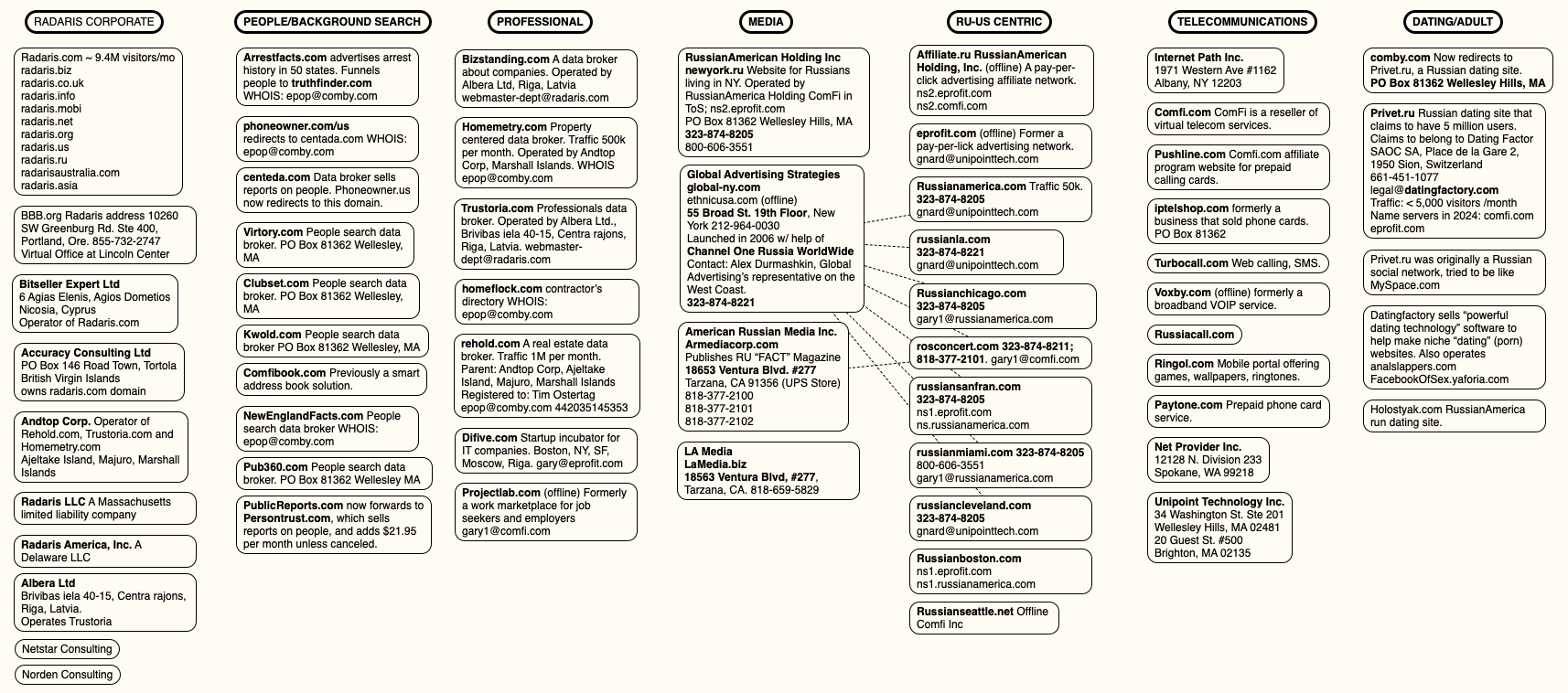
In March 2024, reporting by KrebsOnSecurity exposed the true architects behind the Radaris empire: Igor and Dmitry Lubarsky. The Russian-born brothers, based in Massachusetts, were revealed to be operating a sprawling network of people-search sites, Russian-language dating services, and affiliate marketing programs. When the initial reporting surfaced, the Lubarsky brothers’ attorneys threatened defamation lawsuits, claiming the reports were inaccurate and alleging the true owners were Ukrainians living in Ukraine.
Subsequent investigations proved that the brothers had gone to extraordinary lengths to hide their involvement, even inventing a fictitious CEO named "Gary Norden." Radaris had even issued press releases quoting this non-existent executive to court potential investors.
Matt Adkisson, CEO of Atlas Data Privacy, described the company’s defense strategy as "island-hopping." Whenever legal pressure mounted, the defendants would reorganize their corporate structure, shifting management to entities in the Marshall Islands, the British Virgin Islands, or the Seychelles. "It felt like a shell game," Adkisson remarked. "Defense lawyers would claim a certain entity owned the domain, but by the time a judgment neared, that entity would be discarded, and a new one would appear."
Chronology of a Corporate Collapse
- 2017: Radaris lost a class-action lawsuit by default but successfully stalled the resulting $7.5 million judgment by arguing that the plaintiffs had sued the wrong corporate entity.
- February 2024: Atlas Data Privacy Corp filed its initial lawsuit against Radaris under Daniel’s Law.
- March 2024: KrebsOnSecurity published a deep-dive investigation into the Lubarsky brothers, revealing their use of a fake CEO to front the company.
- June 2025: After Radaris’s legal team repeatedly stonewalled, Atlas refiled the lawsuit, expanding the scope of the claims to include a wider array of the Lubarsky family’s data broker domains.
- August 2026: A New Jersey judge ruled that the defendants had been given ample opportunity to defend the claims but failed to appear in good faith. The court ordered the transfer of Radaris.com and 14 other domains to Atlas.
Behind the Curtain: Evidence of a Unified Empire
During the discovery phase of the litigation, Atlas reportedly secured over 10,000 emails and internal documents. These files dismantled the defendants’ claims of separate, independent corporate entities. The evidence demonstrated that dozens of domains—including Radaris, Veripages, and others—were managed by the same core group of people from the same office, sharing the same payment processors and administrative back-end.
According to data analyzed by Atlas, these sites are lucrative. Radaris.com was estimated to earn approximately $42,000 per month, while sister site Veripages.com brought in roughly $45,000 monthly, largely through partnerships with marketing giants like the Lifetime Value Company. Perhaps most ironically, the emails revealed that the Radaris network also profited from partnerships with "privacy" services like Onerep—a firm that purports to help users remove their data while its founder simultaneously operates other data-broker sites.

Official Responses and Legal Maneuvering
The legal battle remains active. Victor Worms, an attorney representing the defendants, has moved to vacate the default judgment. Worms argues that the transfer of the domain is void because "Radaris.com" is a domain name, not a legal entity capable of being sued. "We intend to pursue all appropriate appeals because we believe the transfer of Radaris.com amounts to a forfeiture in violation of various constitutional principles," Worms stated.
Despite these protests, the impact is visible. The Radaris.com website, once a source of intimate dossiers on millions of Americans, now serves only to redirect visitors to a notice regarding the court-ordered transfer, marking a rare victory for those seeking to curb the commercial data-scraping industry.
Broader Implications: The Constitutional Tug-of-War
The Radaris case is a microcosm of a much larger national crisis. As more states adopt laws modeled after Daniel’s Law, the data broker industry has mobilized a massive constitutional challenge, arguing that such regulations violate the First Amendment.
At least 70 of the lawsuits filed by Atlas have been moved to federal court, with the industry claiming that limiting their ability to aggregate and sell "public" data constitutes an infringement on free speech. A federal district court in West Virginia recently ruled that the state’s version of Daniel’s Law was facially unconstitutional, setting up a potential showdown that many believe will eventually reach the U.S. Supreme Court.
The "Middlemen" and the Need for Federal Reform
Privacy expert Justin Sherman, author of the upcoming book The Middlemen, emphasizes that the current state-by-state patchwork of privacy laws is insufficient. The fundamental problem, according to Sherman, is that most privacy laws contain broad exemptions for "public" or "government" records—a category that includes everything from motor vehicle records and property filings to criminal histories and marriage certificates.
"The average person can look at Daniel’s Law and have a perfectly normal reaction, which is that everyone should be covered, not just police and judges," Sherman said. He argues that the tech industry, including social media giants, cryptocurrency firms, and AI developers, have lobbied heavily against comprehensive federal privacy legislation, often by framing the regulation of data scraping as a threat to American economic competitiveness.
The consequences of this regulatory void were underscored by the recent breach at IDScan.net, where the drivers’ license information of 153 million Americans was exposed and subsequently sold on the dark web. Without federal standards to dictate how companies can collect, store, and share the sensitive data they scrape from public records, the "Radaris model"—building wealth by selling the personal information of private citizens—will continue to be a profitable, albeit controversial, enterprise.
For now, the victory in the New Jersey court serves as a powerful, if temporary, warning to the data brokerage industry. However, as the legal appeals process begins, the broader question of whether an individual’s digital privacy can ever truly be reclaimed in the 21st century remains unanswered.