









As traditional cigarette consumption steadily declines across the United States—a major victory for public health—state lawmakers are confronting an unexpected fiscal headache: a widening revenue crater in state budgets. For decades, lucrative cigarette excise taxes served as a reliable stream of income for state treasuries. Now, as smokers successfully transition away from combustible tobacco, those revenue streams are drying up.
Enter oral nicotine pouches. Rapidly surging in popularity, these alternative nicotine products (ANPs) offer consumers the nicotine they desire without the harmful combustion, tar, and toxic chemicals associated with traditional cigarettes. However, as consumers swap smoke for pouches, state governments have scrambled to incorporate these modern goods into their existing tax regimes.
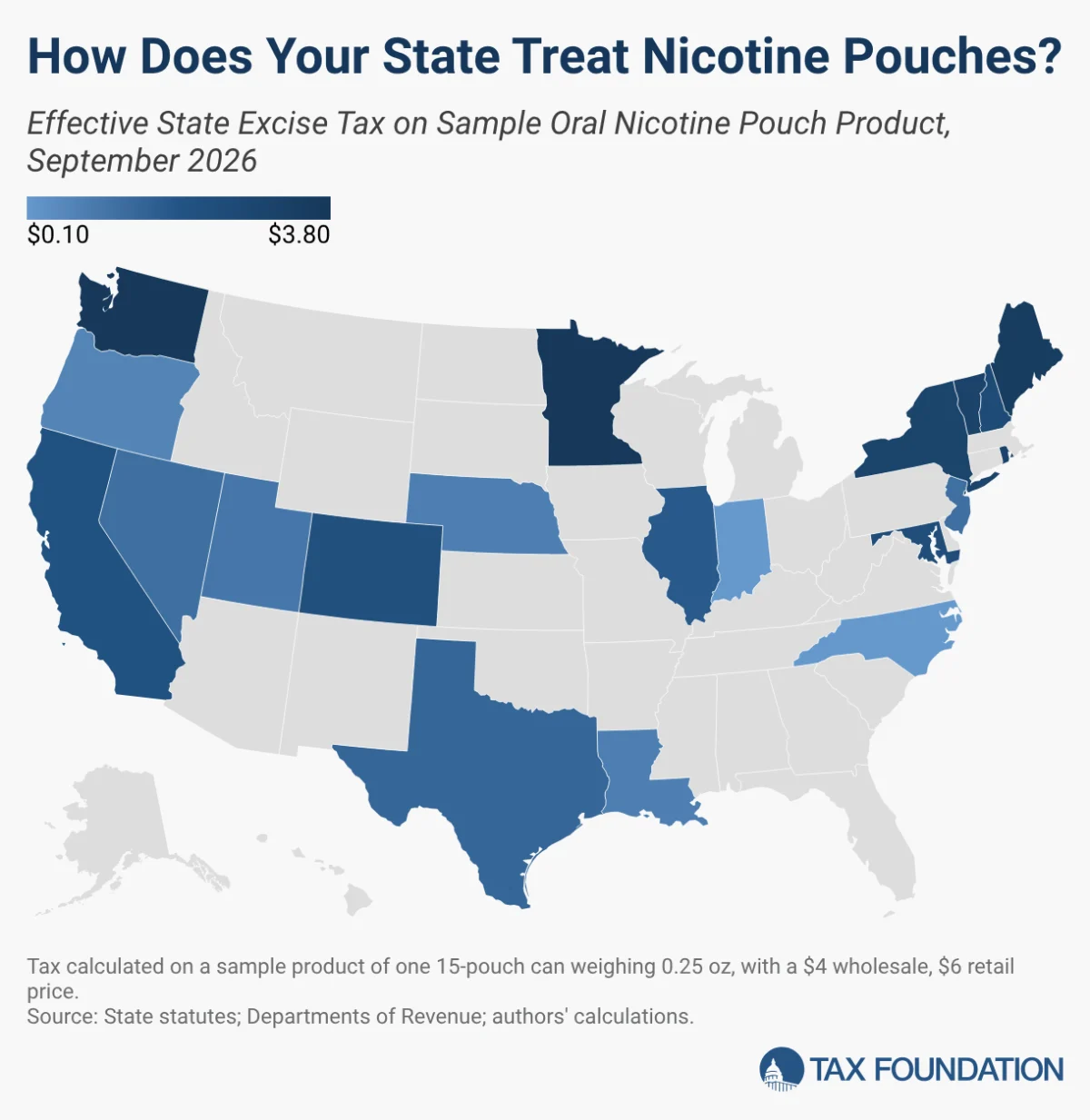
As of September 2026, 20 states and the District of Columbia have formally established tax frameworks for nicotine pouches. Yet, the resulting patchwork of state policies reveals a deeply fractured landscape. Driven by the need to plug budget gaps, many states are miscategorizing oral pouches, levying punitive tax rates that threaten public health goals, distort markets, and spur cross-border smuggling.
Main Facts: The Great Pouch Patchwork and the "OTP" Mistake
The core issue facing state legislators is a complex trade-off: how to offset lost cigarette tax revenue without disincentivizing smokers from switching to drastically safer alternatives.
To date, the most common method states have used to tax nicotine pouches has been to lump them into broad, pre-existing categories designed for "Other Tobacco Products" (OTP). Tax policy experts argue this is a fundamental mistake.
Oral nicotine pouches are materially different from the items traditionally housed in the OTP category—such as cigars, loose-leaf chewing tobacco, and snuff. In fact, the vast majority of modern oral nicotine pouches do not contain tobacco leaf at all. Instead, they rely on synthetic or extracted nicotine absorbed in a cellulose matrix. Furthermore, oral pouches are demonstrably less harmful than virtually all other products traditionally categorized as OTPs. By treating a lower-risk innovation the same as traditional tobacco goods, states undermine the financial incentive for consumers to choose healthier alternatives.
Tax experts advocate for a more pragmatic approach: taxing oral pouches with their own distinct, specific rate. Specifically, an ad quantum tax (levied per can or per ounce) provides a far superior tax base than an ad valorem tax (levied as a percentage of wholesale or retail price), shielding the market from price inflation distortions while still generating state revenue.
Chronology: The Evolution of Alternative Nicotine Taxation
The regulatory and tax evolution of alternative nicotine products has unfolded in distinct phases over the last decade, marked by a slow initial response followed by a frantic legislative rush:
- Pre-2018 (The Rise of ANPs): Alternative nicotine products enter the U.S. market, offering smokeless, spitless nicotine delivery. Early adoption is slow, and most states leave the products untaxed or unregulated outside of general sales taxes.
- 2018–2022 (The Decline of Cigarette Revenues): Decades of successful public health campaigns drive down cigarette smoking rates. State treasuries begin noticing significant erosion in cigarette excise tax collections, forcing fiscal analysts to look for replacement revenue sources.
- 2023–2025 (The Legislative Scramble): Major brands scale up distribution. States begin aggressively redefining "tobacco products" in state statutes to capture synthetic and extracted nicotine pouches under existing or newly minted tax codes.
- September 2026 (Current Landscape): Twenty states and Washington, D.C., officially incorporate nicotine pouches into their dedicated excise tax regimes. Wide disparities emerge, with extreme tax variations established from coast to coast.
- January 2027 (Upcoming Shifts): States like Iowa prepare to implement new targeted statutes, such as a forthcoming $0.05-per-can tax set to take effect, signaling a trend toward more granular, product-specific legislative frameworks.
Supporting Data: A Wide Spectrum of State Tax Rates
Even with less than half of U.S. states currently taxing nicotine pouches explicitly, the spectrum of tax treatments is remarkably wide. To fairly compare rates across diverse state tax structures, economists estimate the taxes due on a standardized sample product: one can containing 15 pouches, sold for $4 wholesale and $6 at retail.
The Highest-Tax States
States leaning heavily into punitive taxation are led by Minnesota and Washington, which levy a staggering $3.80 tax on the sample product via their 95 percent wholesale tax rates. They are closely followed by:
- Maine: $3.54 (via a weight-based tax with a one-ounce minimum)
- Rhode Island: $3.20 (via an 80 percent wholesale tax)
- Vermont: $3.08 (via a weight-based tax with a 1.2-ounce minimum)
The Lowest-Tax States
At the other end of the spectrum, states utilizing lighter touchpoints or flat, per-unit taxes maintain much friendlier environments for harm reduction:
- North Carolina: Lowest in the nation at $0.005 per pouch, amounting to just $0.10 per standard can of 20.
- Indiana: $0.13 on the sample product (via a $0.50 per-ounce tax with no minimum weight)
- Oregon: $0.65 per standard can
- Louisiana & Nebraska: $0.80 on the sample product (via a 20 percent wholesale tax)
Official Responses and Perspectives: Public Health vs. Fiscal Need
The debate over nicotine pouch taxation exposes a sharp friction point between state budget directors and public health advocates.
State Fiscal Officers:
From the perspective of state revenue departments, falling cigarette sales represent an urgent fiscal crisis. As traditional tobacco consumption drops by single digits annually, budgets supported by tobacco bonds and dedicated cigarette taxes face structural deficits. State officials argue that expanding the excise tax base to capture modern nicotine users is not just prudent, but necessary to fund vital public services like education, infrastructure, and healthcare.
Public Health Advocates and Tax Economists:
Conversely, public health experts emphasize the doctrine of harm reduction—a pragmatic framework that focuses on minimizing the adverse consequences of behavior rather than demanding total abstinence. Nicotine itself is not a carcinogen; the overwhelming majority of smoking-related illnesses, cancers, and deaths are caused by the combustion of tobacco and the inhalation of tar and toxic gases found in cigarette smoke.
By taxing oral nicotine pouches at rates comparable to or higher than combustible cigarettes—as seen in states like Minnesota and Washington—governments inadvertently price out safer alternatives, trapping consumers in deadlier smoking habits and protecting the legacy cigarette market from competition.
Implications: Smuggling, Border Arbitrage, and the Path Forward
The extreme jurisdictional disparities in state nicotine pouch taxes carry profound real-world implications, closely mirroring the well-documented pitfalls of cigarette taxation.
The Threat of Illicit Markets and Border Arbitrage
When tax rates vary wildly across neighboring jurisdictions, economic incentives shift rapidly. Just as massive cigarette tax differentials encourage interstate smuggling and cross-border gray markets, nicotine pouch taxes are proving no different.
Consider the Pacific Northwest. A consumer in Washington who faces a $3.80 tax burden on a sample can of pouches can save approximately $3.15 simply by crossing the border to shop in Oregon, or they can bypass excise taxes entirely by purchasing their goods in Idaho. These glaring price gaps inevitably spur consumer behavioral shifts, driving cross-border shopping sprees and fostering lucrative illicit arbitrage enterprises that evade state collections entirely.
Designing Principled Tax Policy
As more states inevitably move to capture nicotine pouch revenues in the coming years, policymakers face a clear choice. They can repeat past mistakes by viewing ANPs merely as cash cows to plug budget deficits, thereby punishing consumers who choose lower-risk products.
Alternatively, policymakers can embrace a principled tax framework rooted in harm reduction:
- Proportional Taxation: Excise tax rates on alternative products should be kept to a fraction of the tax levied on combustible cigarettes, perfectly proportioned to their vastly reduced health risks.
- Product-Specific Rates: Avoid lumping non-tobacco oral pouches into broad "OTP" categories. Use clear, predictable ad quantum taxes (per can or per ounce) rather than volatile ad valorem wholesale structures.
- Market Protection: Moderate, reasonable taxation preserves the price differential necessary to encourage smokers to quit combustible cigarettes, while simultaneously undercutting illicit black markets and minimizing cross-border smuggling distortions.
Ultimately, states do not have to tax nicotine pouches; leaving them untaxed maximizes the financial incentive for smokers to make the life-saving switch. But if fiscal realities demand taxation, lawmakers must do so responsibly—ensuring that state budgets are balanced without sacrificing public health on the altar of short-term revenue collection.