








WASHINGTON — For millions of Americans, particularly younger demographics and low-income households, wireless mobile devices are no longer a luxury; they serve as the primary and often exclusive lifeline for communication, employment, education, and access to essential services. Yet, even as market competition drives down the baseline costs of mobile service plans, government-imposed taxes, fees, and surcharges continue to scale upward, imposing a mounting financial burden on consumers.
According to new industry analyses, a typical American household utilizing a shared plan with four mobile phones—paying an average of $100 per month for taxable wireless services—will shell out approximately $345 in government surcharges and taxes over the course of 2026. This represents a noticeable increase from the $330 projected for 2025, sustaining a multi-year trajectory of escalating state, local, and federal impositions on basic connectivity.
Main Facts: The 2026 Wireless Tax Landscape
The broader telecommunications market has experienced healthy, competition-driven price deflation over the past two decades. Driven by aggressive competition among carriers, the average monthly revenue generated per wireless line has plummeted from $50.64 two decades ago to $33.14 today.
Regrettably, these consumer savings have been steadily eroded by government intervention. While base service costs have declined, cumulative tax burdens have surged. Two decades ago, taxes accounted for roughly 16.2 percent of an average monthly wireless bill. Today, that national average effective tax rate has nearly doubled, reaching a historic high of 28.8 percent.
This record-high tax burden is primarily the result of upward adjustments at both the federal and local levels. The federal Universal Service Fund (FUSF) surcharge rate ticked upward from 13.26 percent to 14.39 percent. Simultaneously, the nationwide weighted average of state and local tax and fee burdens edged upward from 14.25 percent to 14.42 percent.
With nearly 600 million wireless subscriber connections active across the United States, these percentages translate into staggering sums. State and local governments alone are projected to rake in approximately $11.4 billion in wireless-specific taxes during 2026.
Chronology: The Evolution of Wireless Taxation
Understanding how wireless bills became so heavily burdened requires looking back at how telecommunications taxation has shifted alongside technological advancements:
- Early 2000s: Wireless services were traditionally viewed through the legacy lens of landline telephone services, making them prime targets for heavy luxury and excise taxes. At this stage, the average monthly tax burden hovered around 16.2 percent.
- The 2010s: As smartphone adoption exploded and reliance on mobile data superseded traditional landline infrastructure, state and local governments increasingly relied on telecommunications taxes to backstop declining revenues from other sources.
- 2021: The federal government mandated the creation of the national 988 suicide prevention hotline, giving states the statutory green light to implement dedicated per-line surcharges. Virginia became the pioneer in this space, introducing a $0.12 per-line monthly fee, a policy quickly replicated by more than ten additional states.
- 2025: Facing mounting pressure from consumer advocacy groups and industry stakeholders, lawmakers in states like Maine took corrective action, with the Maine legislature voting to repeal its discriminatory Service Provider Tax, which had historically subjected wireless services to higher rates than standard retail sales.
- 2026: Effective tax rates hit an all-time high of 28.8 percent combined (state/local plus federal), ensuring that the average four-phone family pays roughly $345 annually purely in government overhead.
Supporting Data: State-by-State Disparities
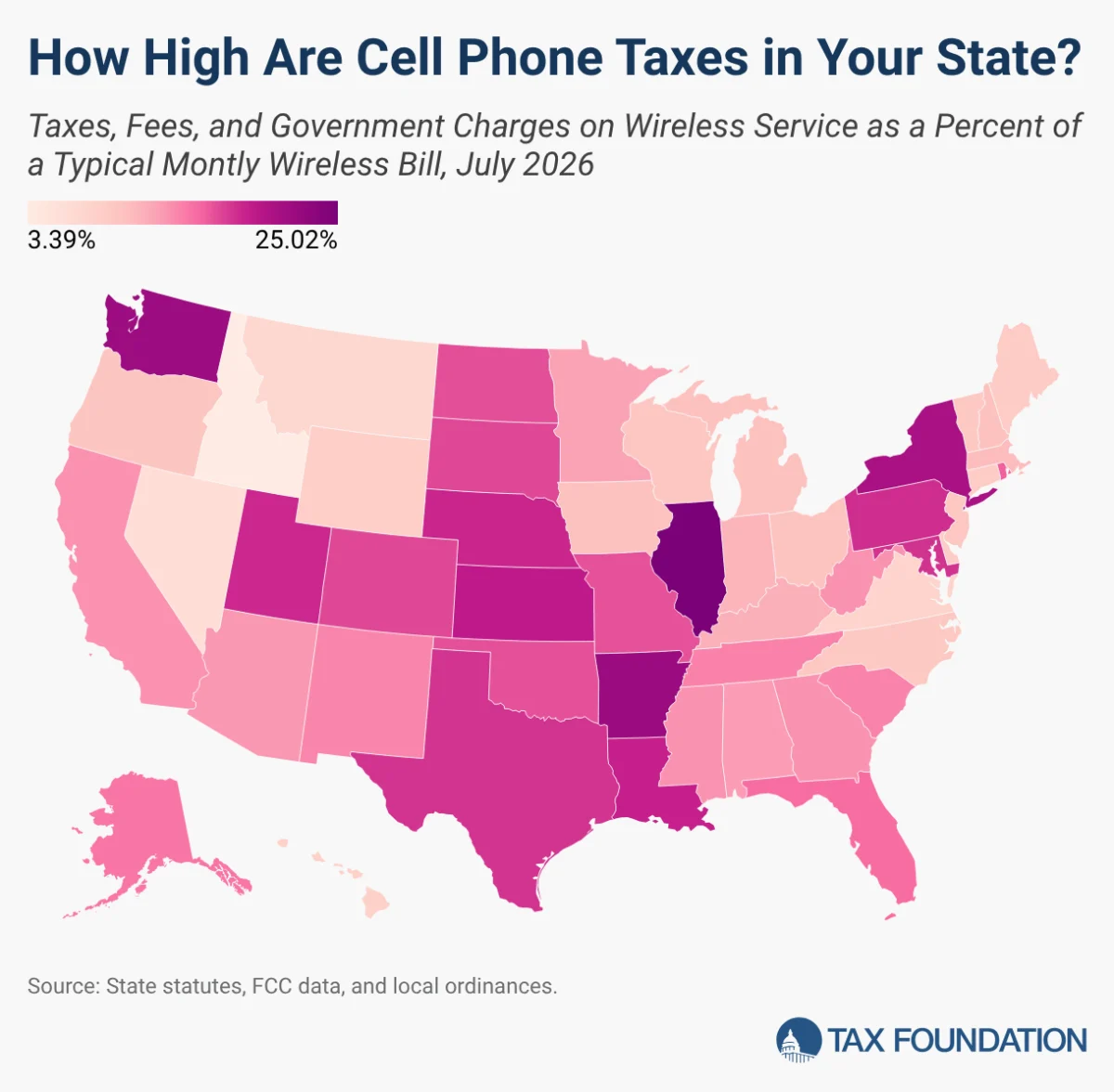
The tax burden borne by wireless consumers varies wildly depending on geographic location. A patchwork of state statutes, municipal ordinances, and local fees means that consumers in some states enjoy relatively low friction, while others face punitive rates.
The Highest-Taxed States
- Illinois: Retains its dubious distinction as the most expensive state in the nation for wireless users, with combined state and local rates exceeding 25.0 percent.
- Arkansas: Ranks second nationally, with an aggregate wireless tax burden hitting 22.0 percent.
- Washington: Closely follows at 21.9 percent.
The Lowest-Taxed States
- Idaho: Levies the lowest wireless taxes and fees in the country, maintaining a minimal burden of just 3.4 percent.
- Nevada: Ranks second-lowest, with rates resting at 6.1 percent.
- Montana: Rounds out the bottom three with a combined burden of 7.1 percent.
To establish these figures, economists and policy researchers evaluate flat-rate impositions—such as a fixed $1.00 per month per line 911 fee—and convert them into percentage equivalents using baseline industry revenue metrics tracked by organizations like CTIA (The Wireless Association).
Crucially, consumers remain shielded from an even heavier tax burden thanks to the Permanent Internet Tax Freedom Act. This federal statute bars state and local governments from imposing excise taxes on internet access services. Without this statutory firewall, the aggressive excise taxes levied on traditional voice and taxable wireless services could theoretically be applied to mobile broadband and data access, driving consumer communication costs into uncharted territory.
Official Responses and Fee Breakdown
The composition of a modern wireless bill is a complex ecosystem of statutory fees, emergency service costs, and administrative subsidies. Beyond standard sales taxes, bills are frequently packed with specialized impositions:
- 911 Emergency Fees: Nearly every state imposes a flat, per-line tax designed to fund the capital and operating expenses of public safety answering points (PSAPs) and local emergency dispatch systems. These fees fluctuate dramatically by jurisdiction. For instance, while most counties in Missouri assess a $0 local 911 fee, the city of Chicago levies a steep $5.00 per line, per month.
- 988 Suicide Prevention Fees: Authorized by federal legislation to support mental health crisis infrastructure, 11 states now assess dedicated 988 fees on wireless lines, varying from a few cents to over a dozen cents per line monthly.
- Universal Service Funds (USF): While the Federal Communications Commission (FCC) levies the FUSF on interstate revenues, nearly half of all states enforce their own State Universal Service Funds (SUSFs) to subsidize rural and low-income connectivity. In recent years, several states have transitioned from traditional percentage-based SUSF impositions to flat, per-line fees—a shift that disproportionately penalizes multi-line family plans.
- Discriminatory State Excise Taxes: At least 13 states impose specialized communication services taxes that either sit on top of standard sales taxes or replace them with significantly inflated rates.
Policymakers and industry representatives have increasingly voiced concern over these structural layers of taxation. Consumer advocates argue that treating mobile phones as cash cows for municipal budgets directly undermines digital equity goals.
Implications: Regressive Impacts and Economic Friction
Economic analysts point to two primary policy arguments against the continued expansion of wireless taxes and fees:
1. Regressive Impact on Low-Income Households
Wireless taxes are inherently regressive. Because mobile connectivity is a non-negotiable modern utility, low-income consumers spend a substantially larger percentage of their disposable income on communications services than wealthier households. Excessive government fees directly threaten affordability, risking the digital disenfranchisement of vulnerable populations who rely exclusively on mobile devices to navigate the modern economy.
2. Disincentivizing Infrastructure Investment
Discriminatory taxation acts as a drag on capital expenditure. Robust wireless networks require continuous, multi-billion-dollar investments in spectrum, cell towers, fiber backhauls, and next-generation 5G architecture.
The economic fallout of high connectivity taxes extends far beyond individual consumers. Modern sectors spanning healthcare, education, logistics, energy, and remote employment depend entirely on resilient, high-speed wireless networks to drive efficiency and productivity. Heavy-handed taxation siphons capital away from network upgrades and expansions—investments that proved vital during the remote-work shifts of the COVID-19 pandemic and continue to fuel post-pandemic economic growth.
Conclusion: Reevaluating Telecommunications Policy
While the application of broad-based, neutral consumption taxes like a standard retail sales tax remains a universally accepted mechanism for public finance, the targeted over-taxation of wireless services lacks traditional economic justifications. It neither internalizes social costs nor operates on a clean user-pays principle. As state legislatures and local governments craft their budgets for the remainder of 2026 and beyond, experts suggest that policymakers exercise extreme caution before introducing new fees that penalize connectivity and slow the growth of America’s digital infrastructure.