







Main Facts
Property taxation stands as one of the oldest fiscal instruments in human civilization, tracing its operational roots back to feudal obligations levied primarily upon agricultural land and agrarian workers. In the modern era, this mechanism has evolved into a sophisticated fiscal tool deployed by local, state, and national governments to capture value from immovable assets—such as land, residential real estate, commercial buildings, and, in some jurisdictions, tangible personal property like vehicles and industrial equipment. While property taxes provide a vital, stable source of revenue for sub-national governments to fund public goods like education, infrastructure, and emergency services, their structural design heavily dictates their economic efficiency.
At its core, an ideal property tax incentivizes local municipalities to permit new development, as the resulting growth directly expands the tax base and funds localized public amenities whose value ultimately capitalizes into higher property prices. However, when property taxes are poorly structured—such as when they are levied heavily not just on the underlying value of the land, but also on physical structures, capital improvements, and commercial buildings—they act as a penalty on investment. Businesses face additional tax liabilities for constructing facilities, expanding operations, or upgrading equipment. Consequently, high structural property taxes can distort geographic choices, driving businesses to relocate away from heavily taxed municipalities and into regions with more competitive fiscal climates.
Globally, the implementation of recurrent property taxes varies wildly. Among 34 surveyed European nations, structural approaches diverge significantly. Liechtenstein and Malta levy no recurrent taxes on property whatsoever, opting for alternative revenue streams. Conversely, Estonia stands out as a singular model of economic efficiency by taxing strictly the value of the land while exempting buildings entirely. Furthermore, the treatment of business property taxes within corporate income frameworks creates stark divides: 28 European countries permit businesses to deduct property or land taxes from their corporate income, alleviating the total tax burden and encouraging capital formation. However, Austria, Iceland, Italy, and Slovenia strictly prohibit this deduction, resulting in the economic inefficiency of double taxation on business assets.
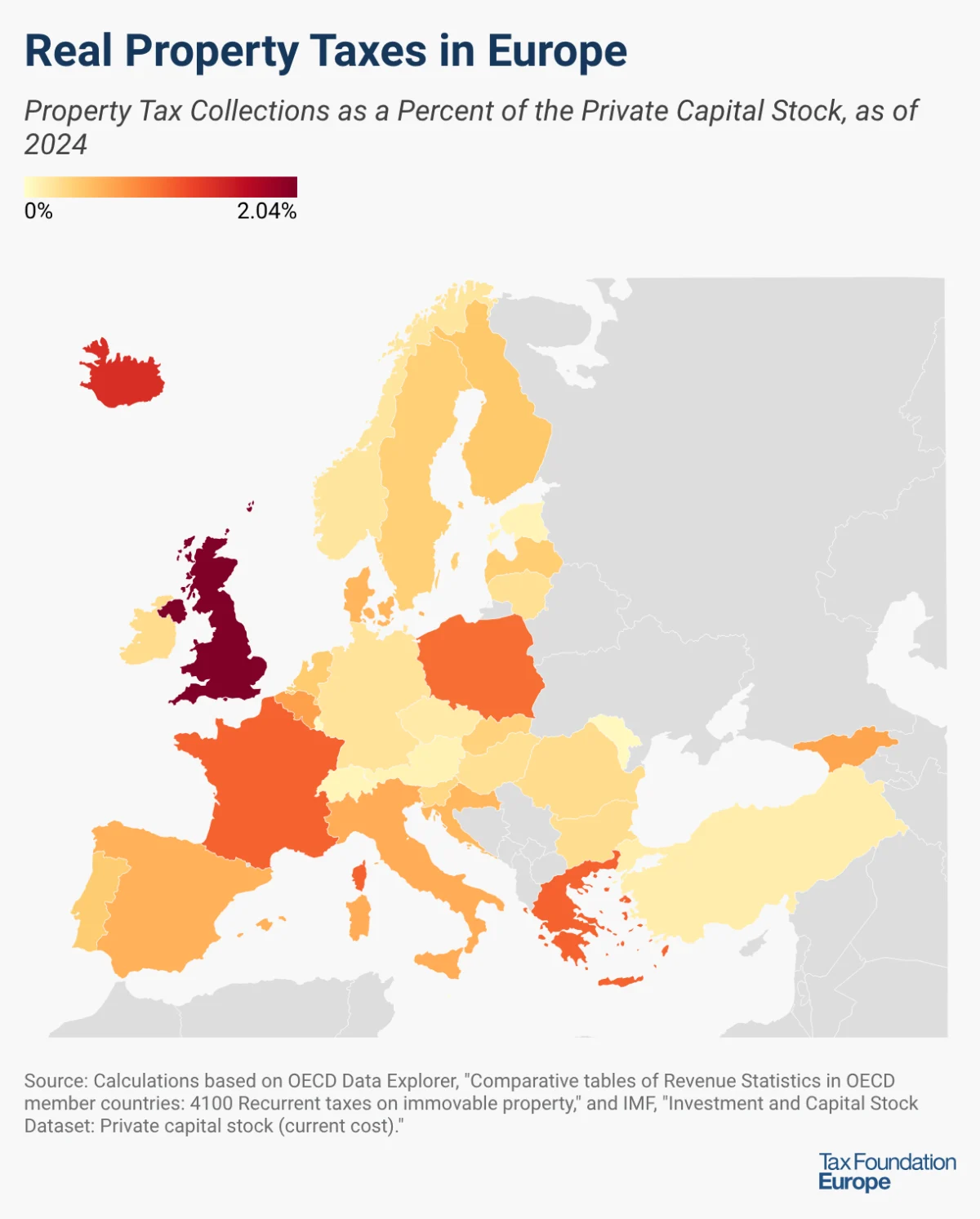
Revenue generation relative to private capital stock also highlights vast international divergences. Microstates and select European nations—such as Luxembourg and Moldova—raise the lowest property tax revenues as a share of private capital stock at approximately 0.05 percent, followed closely by Switzerland (0.08 percent) and Estonia (0.09 percent). At the other end of the spectrum, the United Kingdom (2.04 percent), Iceland (1.43 percent), and France (1.08 percent) impose the heaviest burdens among European nations. Across all 32 European countries that collect recurrent property taxes, the average revenue yields roughly 0.45 percent of private capital stock. By contrast, the United States relies heavily on these mechanisms, raising an average of 1.88 percent of its private capital stock in property taxes—more than four times the European average.
Chronology
The historical timeline of property taxation spans millennia, transitioning from feudal extractions to modern economic policy instruments:
- Feudal Era: Early iterations of property taxes emerge in feudal societies, serving as mandatory levies on agricultural land imposed primarily upon farmers and laborers to support ruling authorities.
- 19th to 20th Century: Modernizing economies formalize property valuations, establishing land and real estate registries. Local governments across the Western world begin institutionalizing property taxes as the primary mechanism for funding public infrastructure, local policing, and compulsory public education.
- Late 20th Century: Economists increasingly critique traditional property taxes for penalizing structural improvements. Landmark theoretical frameworks champion land value taxation (LVT) as an economically neutral alternative that discourages land speculation without disincentivizing construction.
- Early 21st Century: Cross-border comparative tax analyses reveal deep disparities in how nations treat property, highlighting the distinction between land-only taxation models and those that penalize capital investments through structural building taxes.
- 2025 and Beyond: Significant structural reforms unfold in Europe. Germany moves to devolve its property tax base to the state level, prompting the state of Baden-Württemberg to adopt a pure land-value-based tax model. Simultaneously, Croatia institutes a brand-new recurrent property tax calculated on the square meterage of land and floor areas, signaling a continuous evolution in modern property tax policy.
Supporting Data
A granular examination of international tax datasets reveals striking variations in revenue collection, burden-sharing, and structural design across jurisdictions:
European vs. United States Revenue Share of Private Capital Stock
- Luxembourg: ~0.05%
- Moldova: ~0.05%
- Switzerland: 0.08%
- Estonia: 0.09%
- European Average (32 Countries): 0.45%
- France: 1.08%
- Iceland: 1.43%
- United Kingdom: 2.04%
- United States: 1.88%
Business Deductibility of Property Taxes in Europe
- Total Countries Surveyed: 34
- Countries with No Recurrent Property Tax: 2 (Liechtenstein, Malta)
- Countries Allowing Corporate Deductibility: 28 (Mitigates tax burden, encourages investment)
- Countries Prohibiting Deductibility: 4 (Austria, Iceland, Italy, Slovenia – causing double taxation)
Burden Distribution Between Households and Businesses (Sample of 16 European Countries)
- Across reporting nations, households remit an average of approximately 60 percent of total property tax revenue.
- Slovak Republic: Households remit only 7.4 percent of total receipts (businesses bear the heavy share).
- France: Households remit 71.4 percent of total receipts (households shoulder the primary burden).
Official Responses
As structural shifts and economic pressures mount, policymakers, economists, and international tax authorities have increasingly focused on the mechanics of property taxation. Fiscal organizations and think tanks have emphasized the vital distinction between taxing land and taxing capital improvements.
Tax policy experts argue that broadening the tax base while lowering marginal rates minimizes economic distortions. According to fiscal analysts, a narrow tax base is inherently non-neutral and inefficient, driving up administration costs and encouraging tax avoidance or geographic relocation. Conversely, simplifying tax structures—such as Estonia’s exclusive taxation of land value—enhances economic efficiency and promotes sustainable urban development.
In Germany, the decision to devolve the property tax base to the state level beginning in 2025 has drawn praise from economists advocating for localized fiscal autonomy. State-level authorities, such as those in Baden-Württemberg, have utilized this newfound legislative freedom to pivot away from archaic building valuations, embracing land-only valuation models that remove penalties for structural maintenance, energy-efficient retrofits, and new architectural development.
However, the introduction of new compliance burdens, such as Croatia’s 2025 square-meter-based recurrent property tax, has sparked localized debates regarding property valuation accuracy, administrative overhead, and the immediate impact on household cost-of-living expenditures. Governments defending these measures maintain that predictable local revenues are indispensable for maintaining community infrastructure and servicing municipal debts.
Implications
The structural design of property taxes carries profound macroeconomic and microeconomic implications for businesses, households, and regional development.
Economic Distortion vs. Efficiency
When tax authorities levy recurrent taxes on buildings, commercial structures, and physical equipment, they effectively impose a penalty on capital investment. Businesses contemplating whether to expand facilities, build modern distribution hubs, or upgrade manufacturing machinery must factor in recurring annual tax penalties on those very improvements. This dynamic discourages capital formation and can induce businesses to bypass economically vibrant regions in favor of jurisdictions with lighter tax burdens on capital. In contrast, land-only taxation models—exemplified by Estonia and implemented by Germany’s Baden-Württemberg—encourage landowners to put vacant or underutilized land to productive economic use, as the tax liability remains identical regardless of whether a skyscraper or a vacant lot occupies the parcel.
The Double Taxation Dilemma
The prohibition of property tax deductibility from corporate income—practiced in nations like Austria, Iceland, Italy, and Slovenia—creates an acute case of double taxation. Businesses in these countries pay taxes on the income generated by their operations, yet are barred from deducting the mandatory property taxes paid to maintain the physical spaces where that income is generated. This compounds the corporate tax burden, reduces net profit margins, and dampens domestic and foreign direct investment.
Household vs. Business Incidence
The distribution of the property tax burden between residential households and commercial entities shapes consumer purchasing power and housing affordability. In nations where households shoulder upwards of 70 percent of property tax receipts (such as France), homeowners face substantial recurring cost pressures that can constrain disposable income and influence residential real estate markets. Conversely, in systems where commercial entities bear a heavier proportion of the load (such as the Slovak Republic), businesses must bake these recurring costs into their pricing models, potentially affecting consumer goods pricing and labor market compensation.
Ultimately, the wide gap between European property tax collection rates (averaging 0.45 percent of private capital stock) and the United States’ heavy reliance on property taxation (1.88 percent) illustrates fundamental differences in how local public goods are funded across Western economies. While American municipalities rely heavily on property taxes as the single largest source of state and local revenue—funding schools, police, and municipal infrastructure—many European counterparts rely more heavily on centralized income or value-added taxation. As nations continue to reform their tax codes in the face of shifting economic landscapes, the movement toward land-value-based taxation and decentralized fiscal management highlights an ongoing global quest for efficiency, fairness, and sustainable economic growth.