






Google has officially expanded its AI image generation portfolio with the launch of Nano Banana 2 Lite (technically designated as gemini-3.1-flash-lite-image). Positioned as the new entry-level tier in Google’s image generation stack, this model arrives as a strategic answer to the growing demand for faster, more cost-effective AI tools. By sitting below the existing Nano Banana 2 and the flagship Nano Banana Pro, the Lite model offers a distinct value proposition: the reliability of the Google ecosystem at a fraction of the cost and time.
The arrival of this model marks a significant shift in how enterprise and individual users approach AI-driven visuals. With a focus on high-speed output—delivering results in roughly four seconds—Google is clearly targeting high-volume workflows where traditional, slower, and more expensive models may be overkill.
Main Facts: What is Nano Banana 2 Lite?
Nano Banana 2 Lite is designed as the direct successor to the original gemini-2.5-flash-image. It is engineered to deliver text-to-image outputs approximately 2.7 times faster than its immediate sibling, Nano Banana 2. The core pitch is simple: maintain the integrity of the Google ecosystem while reducing both latency and operational overhead.
The model is now broadly accessible across Google’s most critical developer and consumer touchpoints, including:

- Google AI Studio: For rapid prototyping and development.
- Gemini API: Allowing developers to integrate high-speed image generation directly into third-party applications.
- Enterprise Agent Platform: Providing businesses with scalable image generation capabilities.
- Consumer Integration: The model is now deeply baked into everyday tools, including Google Search, the standalone Gemini app, NotebookLM, and Google Photos.
Furthermore, the model integrates with the "Interactions API," enabling users to stack up to three sequential edits within a single session. This creates a cohesive three-tier product architecture: Lite for speed and cost-efficiency; Nano Banana 2 for a balanced quality-speed ratio; and Nano Banana Pro for high-fidelity, complex professional requirements.
A Chronology of the Model’s Rollout
The release of Nano Banana 2 Lite was not an isolated event but rather the culmination of a systematic refinement of Google’s generative AI roadmap.
- Q1-Q2 2026: Google prioritized the optimization of the "Flash" architecture, focusing on reducing inference times while maintaining structural prompt adherence.
- Early July 2026: Initial benchmarks for the "Lite" architecture began surfacing in developer circles, highlighting a potential 50% cost reduction over the standard Nano Banana 2 model.
- Last Week: Google officially launched
gemini-3.1-flash-lite-image, effectively standardizing the three-tier naming convention for its image stack. - Post-Launch: The model was immediately pushed to consumer-facing applications, signaling that Google is prioritizing mass-market accessibility alongside developer-centric utility.
Supporting Data: The Economics of AI Generation
The decision to launch a "Lite" model is driven by cold, hard economics. At approximately $0.034 per image (at 1K resolution), Nano Banana 2 Lite is exactly half the price of the $0.067 sticker price attached to Nano Banana 2.
This pricing strategy puts Google in a direct competitive standoff with other market leaders:

- Seedream 5.0 Lite: Currently priced between $0.031 and $0.035 per image, it represents the closest functional rival to Google’s new offering.
- Reve 2.0: A major outlier, undercutting the market at roughly $0.0067 per image. However, while cheaper, it lacks the massive, integrated infrastructure of the Google ecosystem, which often serves as the deciding factor for enterprise clients.
- Open Source Alternatives: Options like Qwen Image Edit remain free for standard use cases, though they require significantly more manual overhead for deployment and maintenance.
Performance Analysis: Where Lite Shines (and Where It Fades)
To determine whether the trade-off is worth the cost, a series of stress tests across five key categories—Realism, Prompt Adherence, Spatial Awareness, Text Generation, and Cost-Efficiency—reveals a complex picture.
Realism and Texture
The realism test provided the most dramatic contrast. When tasked with a cinematic portrait of an architect on a rooftop, Nano Banana 2 Lite produced a "competent" result, but one that lacked the nuanced lighting and skin-texture detail of its more robust counterpart. While the Lite version is perfectly suited for social media or rapid internal mockups, it tends to show its "seams" when subjected to close scrutiny. The full Nano Banana 2 model, by contrast, delivered professional-grade depth-of-field and realistic rim lighting that elevated the image beyond a generic stock photo.
The Text Generation Paradox
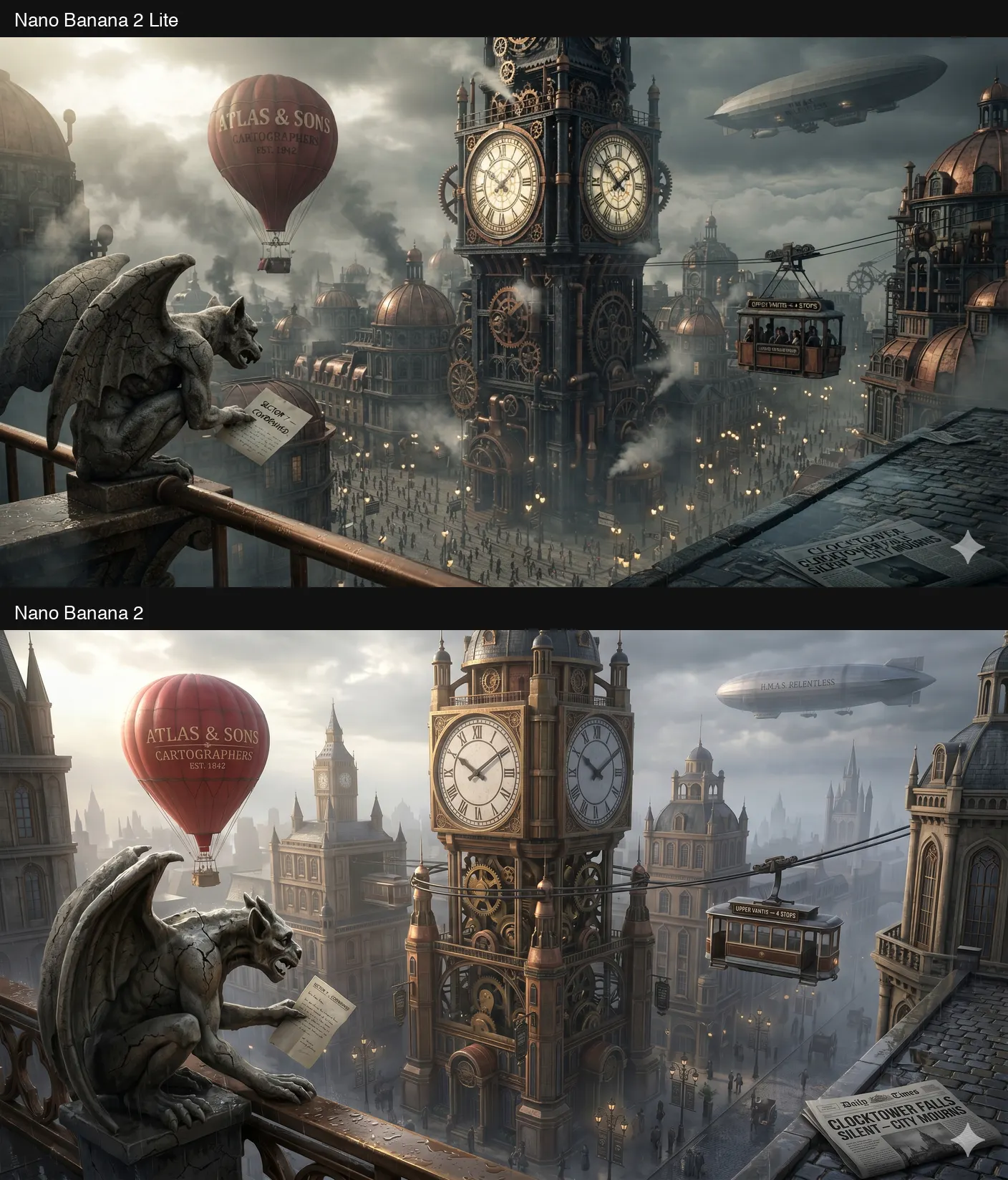
In a surprising twist, the Lite model proved exceptionally capable in text generation. During a complex stress test involving a gritty hardware store scene filled with various signs, posters, and stickers, the Lite model successfully rendered almost every textual element correctly.
Interestingly, while the full Nano Banana 2 model produced a more "atmospheric" and "moody" image, its dark lighting occasionally rendered smaller text illegible. The Lite model’s brighter, more neutral rendering—usually a disadvantage in portrait photography—became a distinct advantage for legibility. For professionals needing signage mockups or infographic elements, the Lite model is arguably superior to its more powerful sibling.

Spatial Awareness
Both models showed high proficiency in spatial reasoning. Whether the scene involved a cluttered medieval alchemist’s desk or a complex streetscape, both models correctly placed objects with accurate occlusion and depth. The differences here were marginal; the Nano Banana 2 provided a slightly better atmospheric gradient, but the Lite version was more than adequate for storyboards, game asset concepts, and general editorial illustration.
Official Responses and Strategic Implications
While Google has remained tight-lipped regarding the specific proprietary architecture behind the "Lite" label, company messaging emphasizes "democratizing high-speed creative tools."
"Our goal," a Google spokesperson noted during the developer briefing, "is to ensure that the cost of iteration is never a barrier to creativity."
The implications for the industry are profound:
- The End of "One-Size-Fits-All" Models: Google is acknowledging that different tasks require different levels of "intelligence." By offering a tier for high-volume, low-complexity tasks, they are effectively pushing the industry toward specialized, model-tiering strategies.
- Platform Switching Costs: For companies already utilizing Google Cloud, the integration of the Gemini API into their existing workflows makes it increasingly difficult for smaller, cheaper competitors like Reve 2.0 to gain traction. The ease of switching between Lite, standard, and Pro models within the same interface is a major competitive moat.
- The "Good Enough" Revolution: For most marketing teams, social media managers, and rapid prototypers, the "photographic" difference between Nano Banana 2 and its Lite version is irrelevant. The cost savings, however, are substantial. We are likely to see a significant portion of commercial AI image production migrate to these "Lite" tiers over the coming fiscal year.
Conclusion: When to Reach for Lite
Nano Banana 2 Lite is not merely a "downgrade"; it is a specialized tool. It is not designed to replace high-end professional artistic output, where every grain of film and nuance of light must be perfect. Instead, it is built for the high-velocity, high-volume needs of modern digital production.
If your workflow involves signage, branded graphics, or multi-element layouts, the Lite model’s superior text rendering and lower cost make it the obvious choice. Conversely, if your project demands cinematic lighting, skin-texture accuracy, or high-fidelity style transfer, the Nano Banana 2 remains the better investment.
Ultimately, Google has succeeded in creating a "Goldilocks" ecosystem. By providing a clear, tiered structure, they allow users to optimize not just for quality, but for the specific demands of the task at hand. As AI image generation continues to evolve, the ability to select the right tool for the right job will become the defining skill of the next generation of creative professionals.