








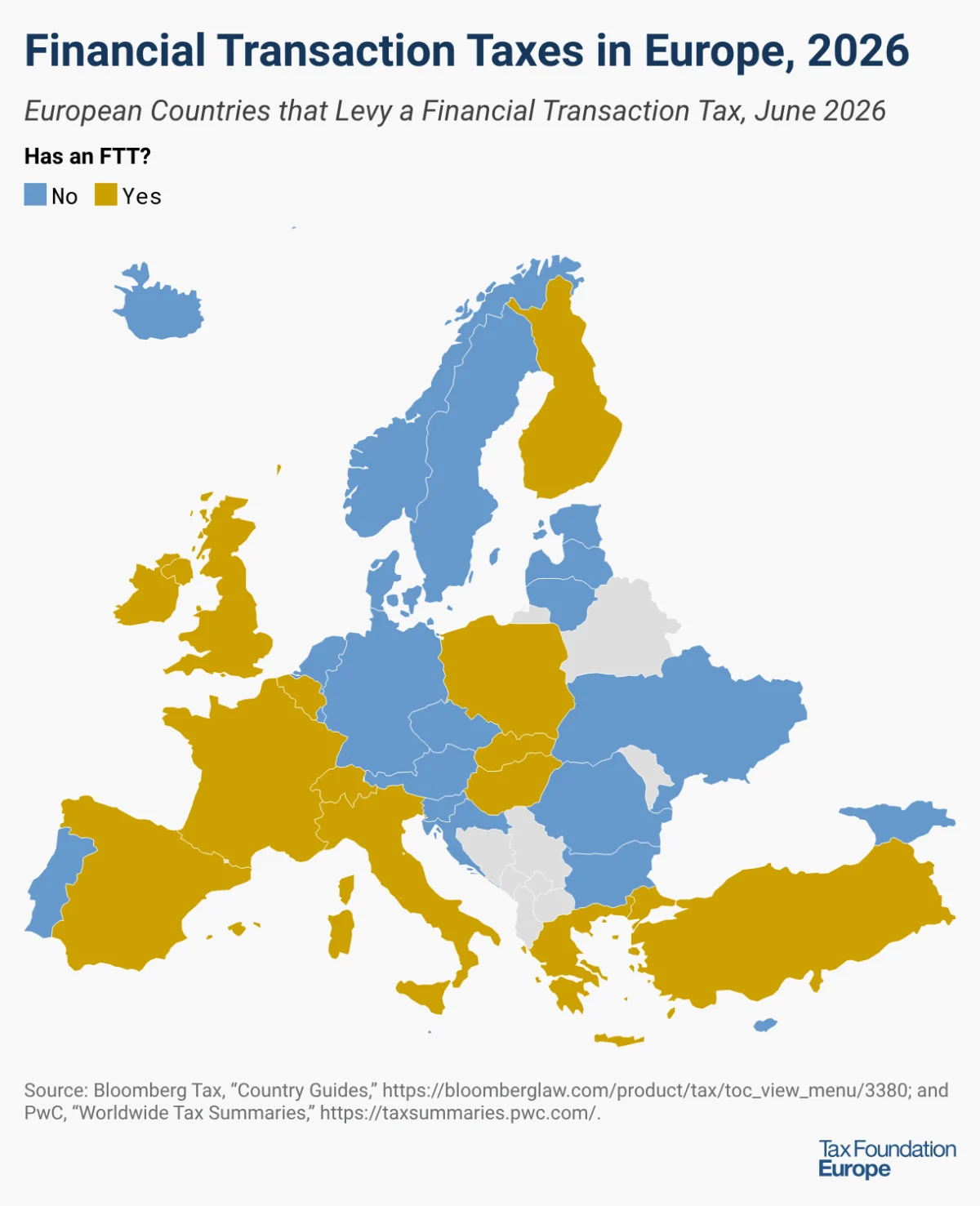
As of June 2026, the European financial landscape remains a complex tapestry of varying tax regimes. While the concept of a harmonized Financial Transaction Tax (FTT)—often dubbed a "Tobin Tax"—has been debated in Brussels for over a decade, a unified approach remains elusive. Instead, the continent is characterized by a patchwork of national levies, each designed with different objectives: from curbing high-frequency trading (HFT) and generating public revenue to dampening speculative volatility.
For investors, corporations, and institutional traders, navigating this environment requires a granular understanding of local statutes, as the cost of capital and transaction friction varies significantly depending on the jurisdiction of the issuer and the nature of the trade.
Main Facts: The "Patchwork" Reality of European Taxation
The European Union and its neighbors do not operate under a singular tax umbrella regarding financial markets. Rather, countries have implemented domestic legislation that reflects their specific economic priorities.
In broad terms, these taxes fall into three primary categories:
- Equity Transaction Taxes: Levies imposed on the transfer of ownership of shares in publicly traded companies. Countries like France, Spain, and Italy focus specifically on large-cap domestic firms.
- Stamp Duties: Traditional levies on the documentation of financial transfers, most notably seen in the United Kingdom and Ireland.
- Broad Financial Activity Taxes: More aggressive, systemic taxes that capture a wide array of payment, securities, and currency exchange transactions, exemplified by the recent approaches in Hungary and Slovakia.
Crucially, the majority of European nations—including economic powerhouses like Germany, the Netherlands, and Sweden—do not currently impose a dedicated FTT on secondary market stock trading, preferring to maintain market liquidity and competitive neutrality.
Chronology: From the Tobin Proposal to the 2026 Reality
The history of the FTT in Europe is rooted in the aftermath of the 2008 Global Financial Crisis. Economists and policymakers sought tools to dampen the "casino-like" behavior of financial markets.
- 2011: The European Commission formally proposed an FTT for the EU, aiming to ensure that the financial sector made a "fair contribution" to the costs of the crisis.
- 2013: A group of 11 EU member states—led by France and Germany—attempted to implement a harmonized FTT through the "enhanced cooperation" procedure. This initiative faced years of internal disagreement over the scope of the tax, particularly regarding its impact on pension funds and market liquidity.
- 2017–2020: Several nations, frustrated by the lack of progress on a collective EU mandate, took unilateral action. France solidified its 0.4% tax on large-cap acquisitions, and Italy introduced sophisticated mechanisms to capture both cash equities and derivatives.
- 2023–2025: The post-pandemic inflationary environment pushed nations like Hungary and Slovakia to expand their revenue bases. These governments moved beyond simple stock taxes, implementing broader levies on bank account debits and currency exchanges to bolster fiscal sustainability.
- June 2026: The current landscape is a definitive "wait-and-see" status. The European Commission has largely relegated the FTT to the background, focusing instead on the Capital Markets Union (CMU), while individual member states continue to adjust their rates to manage domestic debt and fiscal deficits.
Supporting Data: Comparative Tax Burdens
The diversity of tax rates across the continent creates significant arbitrage opportunities and compliance burdens. Below is a breakdown of the current fiscal environment for major players:
The "High-Touch" Jurisdictions
- Malta (2%): Among the highest in Europe, Malta’s stamp duty on marketable securities acts as a significant deterrent to casual trading, though it provides specific carve-outs for non-resident transactions.
- United Kingdom (0.5% – 1.5%): The Stamp Duty Reserve Tax (SDRT) remains a pillar of UK market revenue. The 1.5% surcharge on depositary receipts ensures that the UK captures value even when trading is offloaded to offshore clearance systems.
- Hungary (0.45% – 0.9%): Hungary represents the modern, aggressive model. By taxing not just stock purchases but also cash withdrawals and currency exchanges, the government has integrated financial transactions into its broader tax-collection machinery.
Targeted Equity Taxes
- France (0.4%) & Spain (0.2%): These nations have opted for "surgical" strikes. By limiting the tax to companies with market capitalizations exceeding €1 billion, they seek to protect SMEs and retail market health while taxing large-scale institutional volume.
- Italy (0.04% – 0.4%): Italy utilizes a sophisticated, multi-tiered approach. By taxing the "net daily balance" rather than every individual trade, the Italian tax code is arguably the most economically rational, as it ignores "day-trading noise" to focus on end-of-day positions.
The "Niche" Levies
- Belgium (0.12% – 1.32%): The Tax on Stock Exchange Transactions (TOB) is highly structured. The jump to 1.32% for accumulating funds reflects a policy choice to encourage the distribution of dividends over the reinvestment of capital within funds.
- Finland (1.5%): While appearing high, this rate is deceptive; it applies primarily to unlisted securities, functioning more as a transfer tax on private equity and real estate than a traditional market-liquidity tax.
Official Responses and Strategic Rationale
The divergence in policy is best understood through the lens of national strategy.
Proponents of the FTT (e.g., France, Italy) argue that these taxes are essential for tax justice. They contend that because financial services are often exempt from Value Added Tax (VAT), an FTT is the only way to ensure the financial sector pays its share. Furthermore, proponents highlight that high-frequency trading (HFT) adds no social value and that taxing it helps prevent "flash crashes."
Opponents, including the banking federations in the Netherlands and the Nordics, argue that such taxes simply drive volume to more liquid, tax-free jurisdictions. They point to the "Sweden Experiment" of the 1980s, where a failed FTT caused a massive migration of trading volume to London, resulting in a net loss of tax revenue for the Swedish government.
The European Central Bank (ECB) has historically maintained a neutral-to-skeptical stance, warning that a poorly designed FTT could fragment the European financial market, effectively working against the goals of the Capital Markets Union by increasing the cost of cross-border investment.
Implications: Market Fragmentation and the Cost of Capital
The existence of these disparate taxes has several profound implications for the future of European finance:
1. The Migration of Liquidity
The most immediate effect of localized FTTs is the migration of volume. Large institutional investors often route their trades through clearinghouses in jurisdictions like Luxembourg or the Netherlands, where no such taxes exist, to avoid the domestic levies of France or Spain. This "shadow liquidity" complicates market transparency for regulators.
2. Algorithmic Complexity
For developers of high-frequency trading algorithms, the European landscape is a minefield. An algorithm that is profitable in Germany may be loss-making in Italy due to the 0.04% HFT levy. Consequently, firms must build complex, jurisdiction-specific logic into their trading engines, increasing the cost of technical infrastructure and compliance.
3. Retail Investor Behavior
The taxes are increasingly impacting retail portfolios. In Belgium, the 1.32% tax on certain funds forces investors to choose between tax-efficient ETFs and accumulating funds that might otherwise be superior for long-term wealth compounding. This suggests that tax policy is now actively shaping the investment strategy of the average European household, rather than just the behavior of hedge funds.
4. The Future of the CMU
The long-term goal of a single, efficient European capital market is fundamentally at odds with the current tax reality. If Europe intends to compete with the United States and the emerging markets of Asia for global capital, the current fragmentation creates a "friction penalty." Investors looking for simplicity will continue to favor US markets, where the cost of executing a trade is significantly lower and more uniform.
Conclusion
As of mid-2026, there is no sign of a breakthrough regarding a pan-European Financial Transaction Tax. Instead, the continent seems to have settled into a "coexistence of models." While these taxes provide a reliable stream of revenue for national treasuries, they act as a persistent drag on market integration.
For the foreseeable future, the onus remains on the investor. In an era where a single trade can be subject to a 0.0% levy in one country and a 1.32% levy just across the border, the geography of the trade has become as important as the asset itself. Investors must remain vigilant, as the fiscal landscape of Europe is dynamic, with national governments increasingly willing to adjust these levers to meet the challenges of an evolving global economy.