






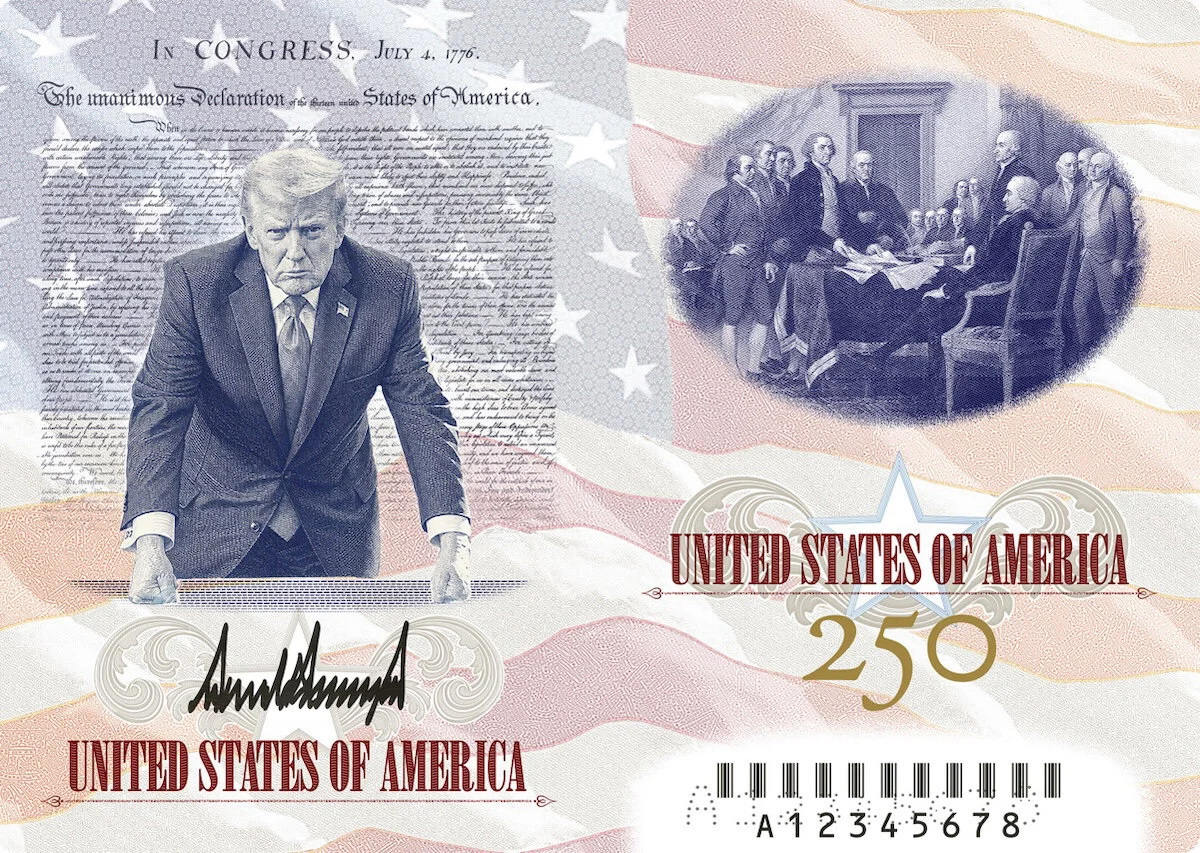
As the United States approaches its semiquincentennial—the 250th anniversary of the signing of the Declaration of Independence in 2026—the federal government has embarked on a series of initiatives to commemorate the nation’s history. Among the most discussed, and perhaps most polarizing, is the introduction of a limited-edition "patriotic passport." Spearheaded by President Donald Trump, the redesigned travel document features imagery that breaks sharply from traditional bureaucratic aesthetics, most notably the inclusion of the President’s own likeness and an enigmatic, unconventional slogan: "Welcome, but be good!"
The design choice has ignited a firestorm of debate, leaving both legal experts and casual observers questioning the intent, appropriateness, and underlying message of a document meant to represent all U.S. citizens abroad.
The Evolution of the Design: A Chronology
The journey toward this updated passport design began several weeks ago when the administration first announced a commemorative series of travel documents intended to celebrate the nation’s 250th anniversary.
Initial Concept
The original proposal, leaked to the public in early June 2026, was characterized by a distinct departure from the muted, historical motifs typically found in government-issued travel documents. The preliminary designs prominently featured President Trump standing in front of the Declaration of Independence. At the time, the design was noted for its use of gold-embossed signatures and a high-contrast layout that leaned heavily into patriotic themes, albeit with a focus on contemporary leadership rather than purely historical figures.
The Refined Reveal
On June 26, 2026, President Trump took to the social media platform Truth Social to provide the public with an updated look at the final design. The revised iteration includes subtle shifts: the gold-leaf signature has been removed, and the depiction of the President has been integrated more fluidly into the backdrop of the Declaration of Independence. However, the most significant change—and the one that has caused the most confusion—is the inclusion of the phrase "Welcome, but be good!" inscribed upon the document.
Decoding the Message: The "Welcome, but be Good!" Conundrum
The core of the controversy lies in the intended audience and the semantic logic of the slogan. In the context of international travel, the primary function of a passport is to serve as a proof of citizenship and identity for the holder. It is a document that asserts the bearer’s rights and protections as a national of the United States.
The Linguistic Mismatch
Critics and observers have pointed out a fundamental contradiction: a passport is not an immigration document. Passports are issued to U.S. citizens, not to those entering the country. Traditionally, "Welcome" messages are reserved for visa documents or entry stamps provided to foreign nationals, where the host country sets conditions for entry.
By printing "Welcome, but be good!" on a document carried by American citizens, the administration creates a psychological and bureaucratic dissonance. If the message is directed at the passport holder, it implies a paternalistic directive to the citizen. If it is directed at foreign border officials or the international community, it deviates from the standard diplomatic protocol of neutrality and official state identification.
The "America First" Perspective
Supporters of the design, such as various political commentators and social media influencers, have interpreted the phrase as a bold assertion of national sovereignty. In this view, the phrase serves as a warning or a "FAFO" (F*** Around and Find Out) sentiment, signaling a shift toward a more aggressive, nationalistic posture on the world stage. For these proponents, the passport is not merely a travel document, but a piece of "patriotic propaganda" that reflects a strong, unyielding government.
Supporting Data and Historical Context
To understand the magnitude of this change, one must look at the history of U.S. passport design. Since the late 18th century, American passports have undergone numerous iterations, generally moving toward higher security features—biometric chips, watermarks, and ultraviolet ink—to prevent fraud.
Security vs. Symbolism
Historically, the U.S. Department of State has maintained a strict adherence to historical and cultural symbols (such as the bald eagle, state seals, or quotes from founding documents) to ensure the document remains globally recognized and politically neutral. The inclusion of a living political leader, let alone a personalized slogan, is unprecedented in modern American history.
Government transparency groups have questioned the costs associated with the design and production of this limited-edition run. While the White House maintains that the "Patriotic Passport" will be available as an opt-in for citizens wishing to commemorate the 250th anniversary, the manufacturing process requires significant retooling of the secure printing facilities managed by the Government Publishing Office (GPO).
Official Responses and Public Reaction
The reaction to the announcement has been bifurcated along deep partisan lines.
- The Administration’s Stance: Representatives for the White House have framed the design as a celebration of American strength and a reminder of the nation’s values. They argue that the slogan is an informal, colloquial way to express that while the U.S. is an open, welcoming nation, it expects its citizens—and those who interact with them—to uphold the high standards of American law and morality.
- Critics and Legal Experts: Legal scholars have expressed concern that the politicization of the passport could lead to complications at foreign borders. If a border agent in a foreign country finds the slogan confusing or provocative, it could, in theory, lead to unnecessary delays or questioning for the traveler. There is also a concern regarding the "official" nature of the government; many argue that a passport should represent the state, not the personal brand of a sitting executive.
- Public Sentiment: On social media, reactions have ranged from intense pride to mockery. Some citizens are eager to obtain what they view as a collector’s item, while others have petitioned to maintain the standard, non-partisan design of the document, fearing that the "Patriotic Passport" undermines the professional standing of the United States in international transit.
Implications: The Future of State-Issued Documentation
The introduction of this passport raises significant questions about the future of state identity. When a government shifts from neutral documentation to messaging that reflects the personal rhetoric of a political leader, it changes the nature of the document itself.
Diplomatic Repercussions
If other nations perceive the U.S. passport as a political tool, it could potentially complicate reciprocal visa agreements. Diplomacy relies on consistency. When a country changes its official documentation to include controversial or ambiguous slogans, it invites scrutiny from foreign intelligence and customs agencies.
The "Commemorative" Precedent
If the 250th anniversary launch is successful, it sets a precedent for future administrations to use government documents as a platform for political messaging. This could lead to a cycle of redesigns every four or eight years, effectively turning a permanent state record into a rotating billboard for the current occupant of the White House.
Conclusion
As the launch date approaches, the "Patriotic Passport" remains a lightning rod for debate. Whether one views the slogan "Welcome, but be good!" as an empowering, uniquely American statement or an incomprehensible, unnecessary political intrusion, the result is the same: the 250th anniversary of the United States will be marked by a document that is as divisive as the current political climate itself.
For the average traveler, the question remains: when you present your passport to a foreign official, you are asking for passage. The addition of a "warning" or a "command" on that document is a social experiment on a global scale—one that will be tested at customs checkpoints around the world starting this summer.