









The digital landscape is saturated with advertisements promising a simple financial panacea: "Refinance your federal student loans today and save thousands in interest." For millions of Americans burdened by student debt, these promises often appear as a beacon of light, offering the prospect of a lower monthly payment and a faster path to debt freedom. However, the reality of student loan refinancing is far more nuanced. While the math behind interest rate reduction is straightforward, the hidden cost—the forfeiture of federal protections—is a permanent decision that carries profound long-term implications.
Refinancing federal student loans involves moving your debt from the Department of Education to a private financial institution. In doing so, you are effectively signing a new contract. While this can result in a lower interest rate, it simultaneously strips away access to the federal safety net, including Income-Driven Repayment (IDR) plans, federal deferment, and critical loan forgiveness programs. To determine if this transition is a prudent financial maneuver or a costly mistake, one must look beyond the advertisements and evaluate the structural differences between federal and private debt.
The Chronology of the Decision: When and Why Borrowers Pivot
The journey of a student loan borrower typically begins with federal loans, which are issued by the government and come with statutory benefits. For many, these benefits are never utilized; for others, they are the only thing keeping them above water during economic downturns.
The decision to refinance usually occurs at a specific intersection of professional stability and financial literacy. Initially, borrowers may find themselves overwhelmed by the sheer volume of their debt. As they gain professional footing—often several years into their career—they begin to notice that their federal interest rates are significantly higher than the rates offered by private lenders in the current market.
However, the "refinancing window" is not universal. It typically opens when a borrower has:
- Achieved stable, high-income employment: Private lenders rely on credit scores and debt-to-income ratios.
- Exhausted or determined the irrelevance of federal programs: The realization that PSLF (Public Service Loan Forgiveness) or IDR plans will not result in net savings.
- Built a robust emergency fund: The loss of federal forbearance means a personal "rainy day" fund must replace government-backed safety nets.
Supporting Data: Calculating the "Breakeven" Point
According to Travis Hornsby, founder of Student Loan Planner, the decision to refinance should be driven by rigorous quantitative analysis rather than marketing slogans. The primary benchmark suggested by experts is a debt-to-income ratio of less than 1.5 to 1. If your total federal debt exceeds this threshold, the cost of losing access to forgiveness programs often outweighs the interest saved by refinancing.

Consider the "1% Rule." If you can refinance at a rate at least 1% lower than your current weighted average federal interest rate, you are moving in the right direction. However, this is only part of the equation. Borrowers must also account for the potential tax-adjusted savings of staying on an IDR plan. For many, the "forgiveness" at the end of a 20- or 25-year term—despite the tax bill that accompanies it—proves more lucrative than the monthly savings provided by a private refinance.
Furthermore, credit scores act as the ultimate gatekeeper. Private lenders typically look for a FICO score of 700 or above. Because a "hard pull" on your credit report occurs during the application process, borrowers must be certain they meet lender criteria before applying, as multiple rejections can damage the very score required to secure a favorable rate.
Official Perspectives and Federal Safeguards
The Department of Education maintains a firm stance on the distinction between federal and private loans. Federal loans are designed as a social contract, offering protections that account for life’s unpredictability. These include:
- Income-Driven Repayment (IDR): Plans that cap payments at a percentage of discretionary income, ensuring that borrowers are not penalized for lower-earning years.
- Public Service Loan Forgiveness (PSLF): A program that incentivizes work in the public and non-profit sectors by forgiving remaining balances after 120 qualifying payments.
- Forbearance and Deferment: Statutory rights that allow for the temporary suspension of payments during periods of unemployment, economic hardship, or medical residency.
When a borrower refinances, they voluntarily relinquish these rights. Official regulatory bodies have historically cautioned that once a federal loan is refinanced into a private one, it is impossible to "reverse" the process. There is no mechanism to convert a private loan back into a federal one, even if the borrower faces catastrophic job loss or financial ruin in the future.
Implications: The Risks of Privatization
The implications of refinancing are irreversible and carry significant long-term risks. When you move to a private lender, you are moving from a flexible, government-backed system to a rigid, contractual one.
The Loss of Flexibility
If you lose your job after refinancing, you are at the mercy of the private lender’s internal policies regarding hardship. While many reputable private lenders offer temporary deferment, it is rarely as generous or as legally protected as the federal government’s offerings.

The Opportunity Cost of Forgiveness
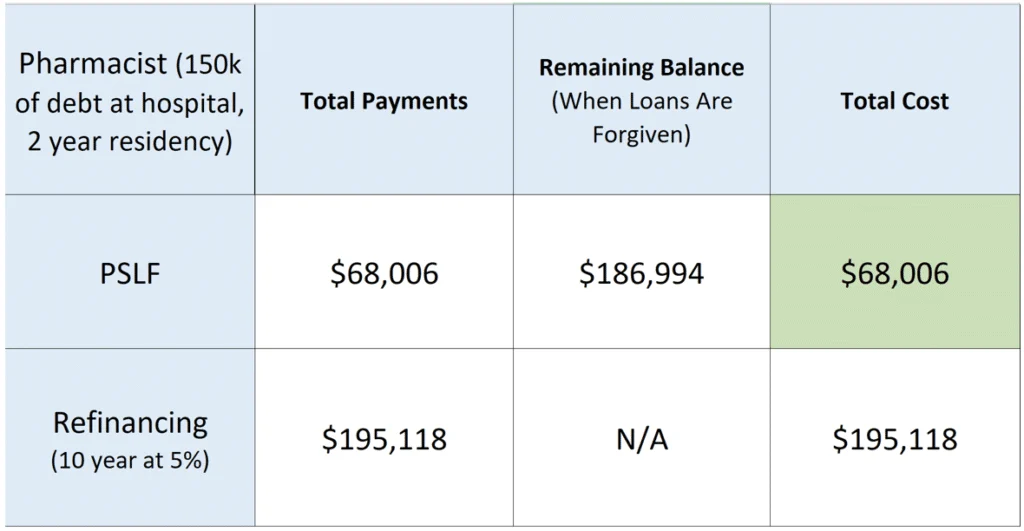
For those in the public sector, the decision to refinance is often a massive financial error. Even if the monthly payment is slightly lower after refinancing, the total cost of the loan over time will be significantly higher because the borrower is no longer eligible to have any portion of their debt forgiven. For a borrower with a large balance, the total lifetime savings of PSLF can exceed $100,000, a figure that no interest rate reduction can match.
The Psychological Shift
There is a qualitative difference in the debt experience as well. Federal loans are often viewed as a "managed" burden, whereas private loans are "enforced" debts. The lack of an IDR safety net means that if you experience a life event—a career change, a health crisis, or a market crash—your private loan obligation remains fixed.
Five Key Indicators That Refinancing is Appropriate
If you are currently evaluating your options, ensure you check these five boxes before signing a new promissory note:
- You are firmly committed to the private sector: You have no intention of pursuing PSLF or working for a non-profit in the future.
- Your employment is secure: You have an industry or role that is resistant to economic volatility.
- Your credit profile is excellent: You qualify for the most competitive rates, ensuring the interest rate drop is significant enough to warrant the loss of protections.
- You can afford the Standard 10-Year Plan: If you are currently struggling to make payments on a standard federal plan, refinancing will not solve your fundamental budget issues; it may only exacerbate them.
- The math supports the move: You have calculated the total cost of the loan with and without refinancing and confirmed that you will save a meaningful amount of money over the life of the loan.
Conclusion: A Strategic Financial Tool, Not a Universal Solution
Refinancing federal student loans is a high-stakes financial move. When executed with precision and careful planning, it can save thousands of dollars and shave years off a repayment timeline. However, when executed impulsively or without understanding the value of federal protections, it can permanently disadvantage a borrower.
The decision is not merely about interest rates; it is about risk management. For the borrower with high income, high credit, and a low likelihood of needing federal support, refinancing is a powerful tool to accelerate wealth building. For the borrower with a precarious income or a career path in public service, the federal system remains an essential shield.
Before moving forward, take the time to run the numbers, consult with financial professionals, and consider the potential "what-ifs." Your student loan debt is a significant part of your financial portfolio; treat the decision to refinance it with the same level of gravity and analytical rigor you would apply to any other major investment. By doing so, you ensure that your path to debt freedom is not only faster but also safer and more sustainable for your future.