








As the European Union economy strives to maintain its footing amid lingering post-pandemic adjustments and subsequent energy price shocks, geopolitical friction in the Middle East has once again injected volatility into global crude oil and natural gas markets. This supply constraint has triggered a fresh wave of surging energy prices, prompting renewed calls from policymakers across the continent for extraordinary fiscal interventions. Among these, the concept of the "windfall profits tax"—a one-time surtax levied on specific companies or entire industries experiencing massive, unexpected gains due to external economic shocks—has staged a notable comeback.
As of 2026, six EU Member States have reignited advocacy for an EU-wide windfall tax mechanism to capture war- and crisis-driven revenues. However, while these taxes are ostensibly designed to cushion consumers against soaring utility bills, economists and financial institutions warn that their structural flaws, market distortions, and long-term economic impacts may far outweigh their short-term fiscal benefits.
Main Facts: The Anatomy of Europe’s Windfall Tax Wave
Windfall profits taxes are fundamentally distinct from standard corporate income taxes. They are designed to target economic rents—profits that accrue not through superior management, innovation, or increased operational efficiency, but rather through exogenous market distortions, such as armed conflicts, geopolitical blockades, or sudden supply deficits.
In the wake of Russia’s 2022 invasion of Ukraine, the European Commission recommended that member states temporarily impose such measures on energy providers. Since then, the policy landscape has fractured. While some governments initially deployed temporary levies on fossil fuel extractors and electricity generators, others have permanently altered their tax codes or shifted the target entirely, training their sights on the banking and financial sectors.
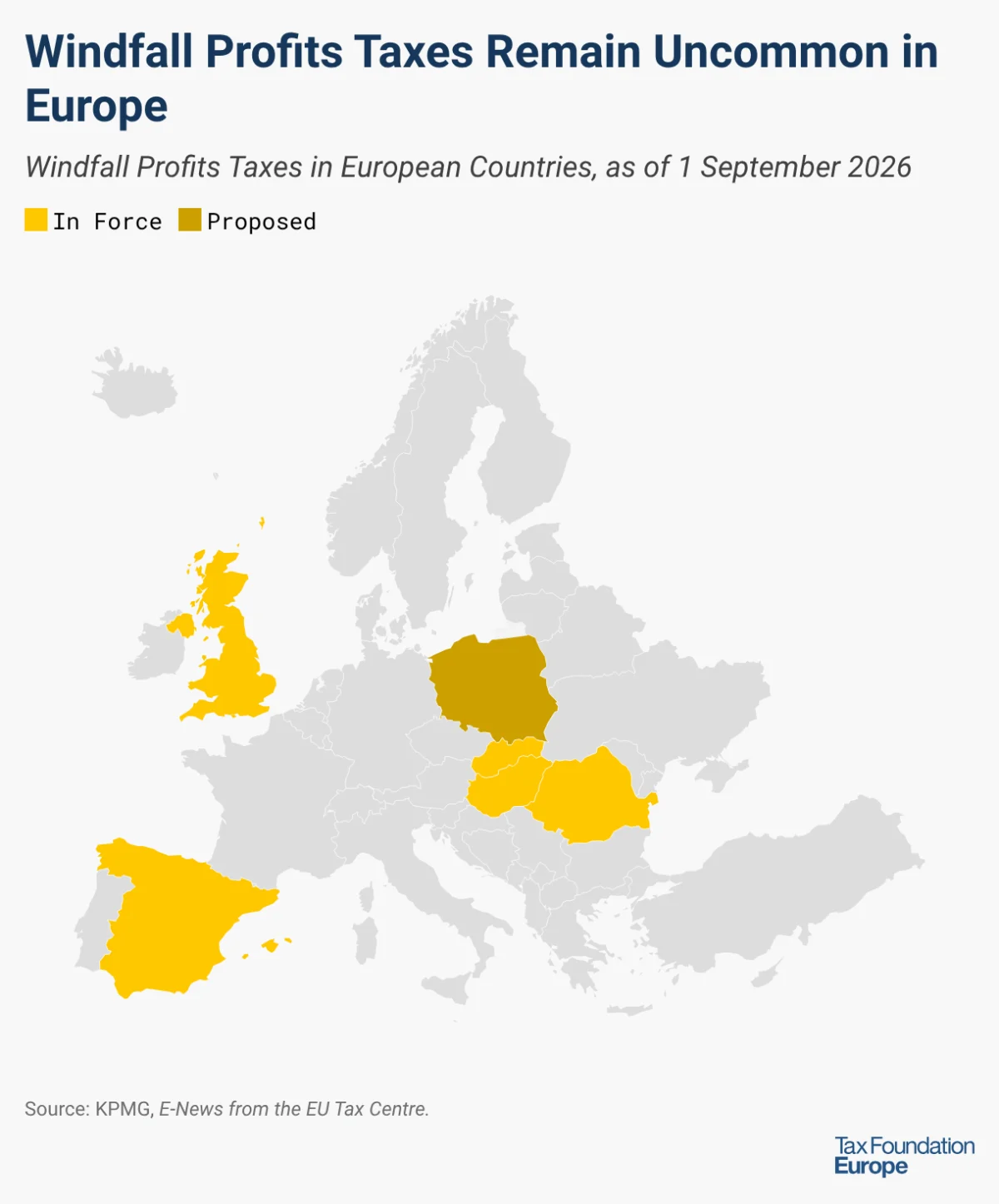
Today, European windfall taxes vary wildly in design, scope, and intensity. Tax rates stretch from a modest 0.5 percent in Romania to a staggering 60 percent proposed in Poland. Furthermore, many of these levies deviate significantly from traditional economic definitions of "excess" profits. Rather than taxing true economic rents, several European countries have taxed incremental profit margins, wholesale electricity prices above arbitrary thresholds, or even total corporate sales. Consequently, tax experts argue that these mechanisms function less like targeted windfall taxes and more like excise taxes or double-taxation schemes, penalizing normal business returns alongside exceptional ones.
Chronology of Events: From Emergency Measure to Permanent Fixture
The modern era of European windfall taxation developed in distinct phases, transitioning from emergency EU-level coordination to fragmented national implementations:
- March 2022: In the immediate wake of the war in Ukraine, the European Commission released its REPowerEU communication, recommending that member states temporarily implement windfall profit taxes on energy providers. Crucially, the Commission stipulated that these measures must be technologically neutral, non-retroactive, and structured so as not to disrupt wholesale electricity pricing or long-term market trends.
- September – October 2022: The Council of the European Union adopted a formal emergency regulation establishing an EU-wide windfall tax—termed a "solidarity contribution"—targeting the fossil fuel sector (oil, gas, coal, and refining). Simultaneously, the EU placed a market revenue cap on infra-marginal electricity generators utilizing renewables, nuclear, and lignite technologies. Outside the EU, the United Kingdom introduced its own Energy Profits Levy targeting domestic oil and gas extraction.
- 2022–2023 Implementation Phase: Over the subsequent two fiscal years, 16 of the EU’s 27 member states applied the EU solidarity contribution, while eight adopted equivalent national measures. Luxembourg, Latvia, and Malta reported having no companies within the scope of the tax. Cyprus opted out entirely, while Croatia applied a general windfall tax across all economic sectors.
- 2024–2025 Shift in Targets: As global energy prices began to stabilize and fossil fuel profits normalized, several governments pivoted. Rather than phasing out the taxes, nations including Hungary, Romania, Slovakia, and Spain expanded the scope of windfall levies to target commercial banks and financial institutions, aiming to capture high profits driven by rising interest rates.
- 2026 and Beyond: Despite the original EU regulatory framework designating these instruments as strictly temporary crisis tools tied to immediate market disruptions, several countries have institutionalized them. Hungary, Slovakia, and Spain maintain active windfall taxes, with some extensions stretching through 2027. The United Kingdom extended its fossil fuel levy through 2030, and Romania permanently codified its bank tax. Meanwhile, new proposals continue to wind through parliaments in Poland and Portugal.
Supporting Data: Revenues Versus Realities
Proponents of European windfall taxes initially justified the measures on macroeconomic grounds: capturing billions from energy giants to directly subsidize vulnerable households.
According to projections by the International Energy Agency (IEA) and the European Council, the EU’s twin policies—the solidarity contribution and the infra-marginal revenue cap—were expected to raise approximately €140 billion collectively. Of that total, roughly €25 billion was projected to stem directly from oil and gas companies via the solidarity contribution. These funds were earmarked to partially offset escalating household utility bills through broad, transparent support mechanisms.
However, a 2025 European Commission implementation report revealed a more complex fiscal reality:
- Yield Discrepancies: For the 2022–2023 fiscal years, total revenues collected from the solidarity contribution reached €26.15 billion—marginally exceeding the initial €25 billion projection.
- Data Gaps and Non-Performers: Out of 27 member states, robust revenue data is available for only 19. While Luxembourg, Latvia, and Malta had no applicable firms, Finland, Lithuania, and Sweden reported zero revenues from the policy, and Cyprus never adopted the framework. Croatia’s cross-sectoral tax design prevented the isolation of specific energy-sector yields.
- The Funding Gap: Most strikingly, the European Commission’s report demonstrated that the total revenue collected from the solidarity contribution accounted for a mere 7 percent of the overall cost of the energy support measures deployed by member states, which totaled an astronomical €340 billion. The vast remainder had to be financed through conventional government borrowing, adding to national debt burdens.
Official Responses and Institutional Pushback
The expansion of windfall taxes—particularly into the banking sector—has triggered severe pushback from central banks, international economic organizations, and industry stakeholders.
The European Central Bank (ECB) has repeatedly intervened with official legal opinions condemning national windfall taxes targeting commercial lenders. The ECB formally objected to banking levies enacted in Spain, as well as prior proposals in Lithuania and Italy. The central bank’s core argument is that arbitrarily draining bank capital restricts financial institutions’ lending capacity precisely when economic resilience is paramount. By reducing capital buffers, windfall taxes weaken banks’ ability to absorb loan defaults during economic downturns, potentially precipitating credit crunches and exacerbating recessions. Furthermore, unpredictable fiscal raids on the financial sector frighten institutional investors, structurally raising the cost of capital and dampening long-term economic growth.
Industry representatives have voiced parallel concerns regarding the energy sector. Research published by the European Parliament indicates that historical applications of windfall taxes consistently depress capital expenditure. In both the United Kingdom and Spain, punitive tax structures have directly threatened domestic capital investment in green energy infrastructure. For instance, planned renewable energy projects in Spain faced immediate cancellations or suspensions until governments rolled back or moderated hostile tax regimes, demonstrating that punitive fiscal policies often undermine the very green transition governments seek to accelerate.
Implications: Market Distortion and the Danger of the "New Normal"
The long-term implications of Europe’s embrace of windfall profits taxes point to a troubling erosion of fiscal predictability and regulatory stability.
- Erosion of the Tax Base: When tax authorities design levies based on arbitrary price thresholds or total sales rather than true economic rents, they introduce profound non-neutrality into the tax code. This penalizes domestic production and discourages firms from investing in high-risk, capital-intensive sectors within European jurisdictions.
- Deterring the Green Transition: Paradoxically, taxes ostensibly levied to manage energy crises frequently strike at the heart of future energy security. By rendering investments in domestic oil, gas, and renewable energy generation financially unviable, windfall taxes stifle the structural supply expansions necessary to prevent future price shocks.
- Institutionalizing Emergency Measures: Perhaps the most significant structural danger is policy creep—the transformation of temporary, emergency crisis instruments into permanent fiscal fixtures. When governments facing structural budget deficits discover that ad-hoc levies provide immediate cash infusions, political incentives often override sound economic principles, turning extraordinary taxes into the "new normal."
Conclusion
As geopolitical tensions continue to buffet European energy and financial markets, policymakers face an ongoing temptation to reach for populist and punitive fiscal tools. However, the empirical record from 2022 through 2026 demonstrates that windfall profits taxes are an inefficient, distortionary, and ultimately inadequate substitute for principled fiscal policy.
Raising a mere 7 percent of total energy support costs while actively discouraging capital investment, damaging banking sector resilience, and undermining green energy transitions highlights the policy’s heavy collateral damage. To foster long-term economic stability and security, European policymakers must learn from past missteps: they should abandon pending windfall tax proposals, repeal existing distortionary levies, and refocus their efforts on stable, predictable, and broad-based tax reforms that encourage growth rather than penalize enterprise.