







Main Facts
Wall Street is bracing itself for a seismic shift in macroeconomic policy as the Federal Open Market Committee (FOMC) prepares to conclude its high-stakes, two-day policy meeting on Wednesday. For the first time since 2023, the U.S. central bank is heavily anticipated to reverse its prolonged stance of holding or easing monetary policy and instead execute an interest rate hike.
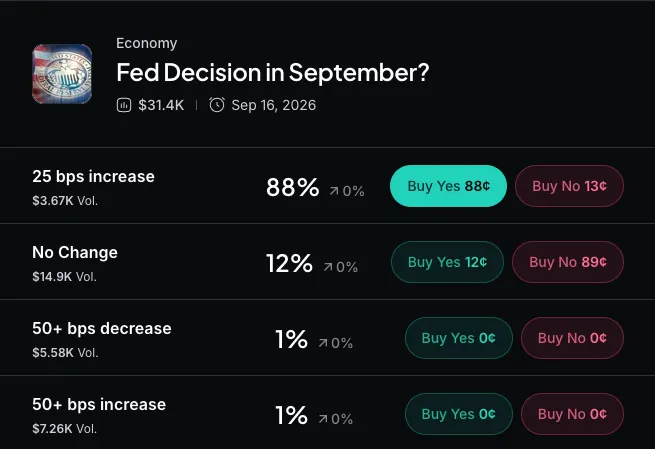
Market expectations have swung dramatically over the past month. According to CME’s FedWatch tool, the implied probability of a quarter-point (25 basis points) interest rate hike has surged to an overwhelming 94.5%, a staggering leap from under 50% just thirty days prior. This sudden reassessment has sent tremors through traditional equities, fixed-income markets, and digital asset ecosystems alike.
The rationale behind this impending shift is anchored in stubborn inflation data that continues to defy the central bank’s target framework. With headline Consumer Price Index (CPI) inflation printing at 3.4% annually in August and core inflation holding firm at 2.5%, price growth remains stubbornly above the Federal Reserve’s coveted 2% objective. Compounding these domestic pricing pressures are geopolitical flashpoints, most notably the ongoing conflict with Iran, which has driven oil prices higher and injected fresh volatility into global supply chains.
This monetary tightening cycle arrives under a uniquely tense political backdrop. Fed Chair Kevin Warsh, handpicked for the central bank’s top post by President Donald Trump in January and sworn into office in May, finds himself on an immediate collision course with the White House. Despite Trump’s vocal public demands—and threats—for lower interest rates to ease the financial burden on American consumers ahead of the November midterms, Warsh and the committee appear poised to prioritize macroeconomic stabilization over executive pressure.
As bond markets reprice aggressively and risk-on assets like Bitcoin and high-beta altcoins experience severe downward pressure, investors are anxiously awaiting Wednesday’s 2:00 p.m. ET rate decision, the updated economic projections ("dot plot"), and Chair Warsh’s subsequent press conference at 2:30 p.m. ET to gauge just how much more tightening the economy may have to endure.
Chronology
To understand how financial markets arrived at this precarious crossroads, it is necessary to examine the rapid chronology of economic indicators, political friction, and policy splits that have defined the summer and early fall of 2026.
- July 2026: The Federal Reserve votes to hold benchmark interest rates steady in the 3.50% to 3.75% range. However, beneath the surface tranquility, deep internal divisions fracture the FOMC. The decision passes by a narrow 9–3 vote, with three hawkish policymakers actively dissenting in favor of an immediate rate hike. This internal split lays the groundwork for the hawkish pivot that would follow.
- Late August 2026: Stronger-than-expected August employment data shatters expectations of a slowing labor market. Job creation outpaces consensus estimates, signaling that the U.S. economy remains too resilient to justify prolonged monetary easing. Simultaneously, persistent oil price spikes driven by Middle Eastern conflict continue to feed inflationary impulses.
- Early September 2026: A sweeping survey published by The Wall Street Journal reveals a radical pivot in sentiment across major financial institutions. Nearly every major Wall Street bank drops its previous forecast of prolonged rate cuts and begins pricing in an imminent September rate hike.
- Mid-September 2026 (The Days Leading to the Decision):
- Political pressure reaches a fever pitch. President Trump, Vice President JD Vance, and Treasury Secretary Scott Bessent publicly lobby for monetary easing, with the president threatening trade retaliation against nations running trade surpluses if borrowing costs are not reduced.
- Fixed-income markets react violently to the looming hike. The benchmark 10-year U.S. Treasury yield spikes to 5.04%—its highest level since July 2007—while short-term two-year yields hit levels not seen since July 2024.
- In the digital asset markets, the long-awaited crypto market structure bill, the Clarity Act, fails its crucial Senate cloture vote. Combined with macro fear, Bitcoin breaks down from its September peak near $82,000, tumbling toward the $75,700 threshold and threatening deeper technical damage.
- Wednesday, September 17 (The Decision Day): The FOMC concludes its two-day meeting. The rate decision and updated dot plot are scheduled for release at 2:00 p.m. ET, followed immediately by Chair Kevin Warsh’s press conference at 2:30 p.m. ET.
Supporting Data
The depth of the market’s repricing can be quantified through a broad array of economic indicators, institutional forecasts, and technical price levels across traditional and digital markets.
Institutional Rate Projections
Wall Street institutions are sharply divided on the terminal trajectory of interest rates following this week’s expected move:
- The Consensus (Barclays, Citigroup, JPMorgan, Morgan Stanley, UBS): Expects Wednesday’s quarter-point hike to be followed by an additional 25 basis points of tightening later in the year, totaling 50 basis points of total tightening in 2026.
- The Hawks (Bank of America, Deutsche Bank, RBC): Forecasting an aggressive 75 basis points of total tightening before the year concludes, signaling fears of entrenched, multi-front inflation.
- The Doves & Outliers (Goldman Sachs, Jefferies, Oxford Economics): Goldman Sachs remains relatively conservative, projecting just this week’s quarter-point increase with no follow-up hikes. Meanwhile, Jefferies and Oxford Economics stand as true outliers, forecasting monetary easing via rate cuts by December 2026 and into 2027, respectively.
Fixed-Income Market Movements
- 10-Year Treasury Yield: Touched 5.04%, marking its highest watermark since July 2007.
- 2-Year Treasury Yield: Reached its highest level since July 2024, reflecting heightened sensitivity to immediate central bank actions.
Cryptocurrency Market Metrics
- Bitcoin (BTC) Price Action: Slipped approximately 3.2% in a single session to trade around $75,700, down significantly from its monthly highs near $82,000.
- Key Technical Support: Analysts point to $73,200 as Bitcoin’s critical "line in the sand." A confirmed daily close below this level risks triggering cascading liquidations down to $71,000 and potentially $66,900, invalidating recent bullish technical structures such as the asset’s recent golden cross.
Official Responses
The impending rate hike has ignited a fierce public debate involving monetary authorities, executive branch officials, and legislative observers.
Federal Reserve Chair Kevin Warsh finds himself at the epicenter of this storm. Appointed by President Trump and sworn in during May with explicit White House expectations of accommodating monetary policy, Warsh has repeatedly emphasized the operational autonomy of the central bank. Despite public warnings and threats from the administration—including President Trump’s explicit demand for lower rates and threats of trade actions against foreign surplus nations—Warsh has maintained that political interference plays no role in FOMC deliberations.
The White House response has been unabashedly critical of the central bank’s direction. Over the past two weeks, President Trump, Vice President JD Vance, and Treasury Secretary Scott Bessent have taken to public platforms to criticize potential monetary tightening. The administration argues that higher borrowing costs will unnecessarily penalize American families and disrupt economic growth just two months ahead of critical midterm elections—an election cycle where voter frustration over persistent inflation and elevated housing and borrowing costs is already palpable.
Ironically, economic analysts point out that a portion of the inflationary pressures driving the Fed to hike rates—such as tariffs and geopolitical trade friction—stems directly from the policy measures championed by the administration itself. This circular policy conflict has left financial markets parsing every word of upcoming official statements to determine whether the central bank will yield to political pressures or double down on its inflation-fighting mandate.
Implications
A rate hike in the current macroeconomic climate carries profound, far-reaching implications for traditional financial systems, global currency valuations, and the burgeoning digital asset economy.
Traditional Markets and Corporate Borrowing
At its core, a Federal Reserve rate hike increases the cost of capital across the entire economy. Higher borrowing costs directly impact corporate debt servicing, mortgage rates, commercial real estate, and consumer revolving credit. As safe-haven government bonds begin offering yields north of 5%—with the 10-year Treasury touching highs not seen in nearly two decades—institutional and retail capital faces a powerful gravitational pull away from risk-on equities and alternative assets.
Furthermore, higher U.S. interest rates naturally bolster the strength of the U.S. dollar against foreign currencies. While a strong dollar helps curb the cost of imported goods, it simultaneously creates severe headwinds for emerging markets holding dollar-denominated debt and compresses profit margins for multinational U.S. corporations operating abroad.
Digital Assets and the Crypto Ecosystem
For the cryptocurrency market, which has historically thrived in low-interest-rate, high-liquidity environments, a hawkish Federal Reserve presents a formidable hurdle. Bitcoin and high-beta altcoins rely heavily on the availability of cheap capital and speculative liquidity to fuel explosive upside cycles.
When risk-free yields on U.S. government debt rise to 5%, the opportunity cost of holding non-yielding digital assets increases exponentially. Coupled with recent regulatory setbacks—such as the Senate’s failure to pass the Clarity Act—the crypto market enters this rate decision in an acutely fragile state.
However, market reactions are rarely uniform. Some macro analysts suggest that if the anticipated quarter-point hike is primarily aimed at anchoring long-term bond yields rather than actively crushing economic growth, the medium-term impact on crypto may already be fully priced in. The ultimate market direction will not necessarily be dictated by the rate hike itself, but by the "dot plot" projections and Chair Warsh’s forward guidance during his post-meeting press conference. If the Fed signals that multiple additional hikes are on the horizon, risk assets could face extended downside pressure; conversely, a dovish hint of a pause could ignite a rapid relief rally across both equities and crypto.