









By: Financial News Desk
Published: September
Main Facts
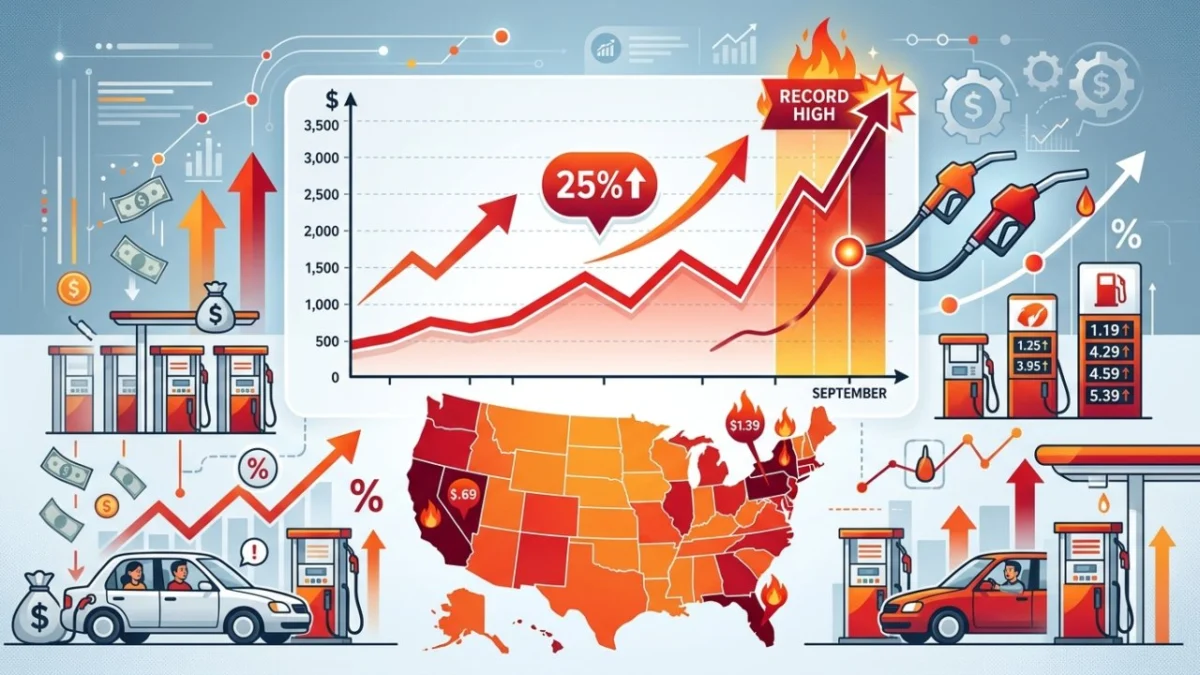
American small business owners are facing a severe economic headwind as fuel prices continue an unexpected and aggressive upward trajectory. According to the latest data released by AAA Gas Prices, the national average for regular gasoline has climbed to $4.48 per gallon. This represents a sharp increase of nearly 5 cents from the previous week and establishes a striking record high for this specific time of the calendar year.
This unseasonal surge is heavily impacting enterprises that rely on transportation, logistics, and mobile services. Unlike typical economic cycles—where fuel prices traditionally taper off as the summer driving season winds down and autumn begins—current market dynamics are pushing costs higher.
The primary catalysts behind this persistent pump pain include ongoing geopolitical and supply-chain volatility in the Strait of Hormuz, alongside robust, elevated pricing for crude oil. Consequently, the national monthly average for September has settled at $4.30 per gallon, easily overshadowing last year’s previous record of $3.83 for the same period.
For the millions of small-to-medium-sized enterprises (SMEs) that form the backbone of the American economy, this dynamic threatens to compress profit margins. Fleet operators, delivery services, contractors, and local service providers are now forced to absorb—or pass along—steep operational cost increases at a time when consumer spending habits are already under scrutiny.
Chronology of Market Events
To understand how the national average reached $4.48 per gallon, industry analysts look at a sequence of recent supply, demand, and trading milestones that have shaped the energy landscape over the past several weeks:
- Late Summer Shift: As autumn approached, energy analysts anticipated the traditional seasonal demand drop. Instead, gasoline demand stubbornly increased, setting the stage for unseasonal price growth.
- Mid-Month Crude Surge: West Texas Intermediate (WTI) crude oil futures experienced a notable upward movement, closing a critical trading session at $92.16 per barrel—a single-day jump of $1.64. This directly impacted wholesale gasoline pricing structures.
- EIA Inventory Report Release: The Energy Information Administration (EIA) released data indicating a tightening market. Domestic gasoline demand ticked upward from 8.79 million barrels per day to 8.84 million barrels per day.
- Production and Supply Contraction: Concurrently, domestic gasoline production saw a slight contraction, dropping from 9.64 million barrels to 9.59 million barrels. This dual pressure of rising demand and falling production drove total domestic gasoline supplies down from 207.7 million barrels to 206 million barrels.
- AAA Weekly Index Update: The compounding effect of these metrics culminated in AAA’s weekly reporting, confirming the national average had breached $4.48 per gallon, driven by sustained volatility in international shipping lanes like the Strait of Hormuz.
Supporting Data and Regional Disparities
A macro-level look at national averages tells only part of the story. The burden of fuel inflation varies dramatically depending on a business’s geographic footprint.
National Supply and Demand Metrics
- National Regular Gasoline Average: $4.48 per gallon (up nearly 5 cents week-over-week).
- September Average (To Date): $4.30 per gallon (compared to $3.83 last year).
- WTI Crude Oil Benchmark: $92.16 per barrel (up $1.64 in the last trading session).
- Gasoline Demand: Increased from 8.79 million to 8.84 million barrels per day.
- Gasoline Production: Decreased from 9.64 million to 9.59 million barrels per day.
- Total Domestic Gasoline Supply: Dropped from 207.7 million to 206 million barrels.
Regional Cost Variations
Geographic location plays a pivotal role in how severely a small business feels the pinch. State-level energy markets reveal stark contrasts across the United States:
- California: Continues to lead the nation with the highest average price, standing at a staggering $6.23 per gallon. Businesses operating fleets in the Golden State face severe margin compression.
- Hawaii: Follows closely behind as the second most expensive market, with an average of $5.57 per gallon.
- Texas: Maintains the most affordable fuel environment in the nation, boasting an average of $3.95 per gallon, providing a relative cushion for local enterprises.
These vast geographic discrepancies require multi-state and regional businesses to adopt localized operational strategies rather than relying on blanket corporate budgeting.
Official Responses and Expert Perspectives
As economic pressure mounts, industry authorities and energy market observers are urging business owners to proactively manage their financial forecasts.
"Small businesses might need to prepare for an additional budgetary burden," noted a representative from AAA during a recent briefing on energy trends. He emphasized that as gasoline prices continue their upward climb without the expected seasonal relief, proactive adjustments in financial forecasting will be crucial for survival and stability.
Financial advisors echo this sentiment, pointing out that businesses that fail to factor fuel volatility into their quarterly and annual budgets risk sudden cash flow crunches. The unpredictability of crude oil markets—tied heavily to overseas geopolitical tensions—means that business owners must build financial buffers to absorb potential shocks through the remainder of the fiscal year.
Implications for Small Businesses
The ripple effects of $4.48-per-gallon gasoline extend far beyond the gas pump, touching nearly every facet of small business operations, logistics, and consumer relations.
1. Margin Compression and Pricing Strategies
For enterprises dependent on vehicle fleets—such as plumbing services, catering companies, mobile pet groomers, and local couriers—fuel is a direct, non-negotiable cost of goods sold. As these expenses mount, profit margins shrink. Business owners are forced to weigh difficult decisions: absorb the costs and accept lower profitability, or pass the burden onto consumers through fuel surcharges or price hikes. However, raising prices in an inflation-sensitive market carries the risk of alienating price-conscious customers.
2. Shifts in Consumer Behavior and Local Foot Traffic
Rising transportation costs do not just affect business vehicles; they also change how consumers move. As everyday commuting and leisure driving become more expensive, local foot traffic patterns may shift. Consumers may consolidate their shopping trips, favoring local convenience over distant retail centers, or pivot further toward e-commerce. Businesses with physical storefronts must find creative ways to attract local shoppers, while delivery-centric enterprises may discover new avenues to capture market share by offering reliable, efficient home-delivery solutions.
3. The Long-Term Viability of Electric Vehicles (EVs)
In response to perpetual fossil fuel volatility, a growing number of small business owners are casting an eye toward alternative energy sources. Electric vehicle charging costs have remained relatively stable, hovering around an average of 42 cents per kilowatt-hour at public charging stations nationwide.
While transitioning a fleet to electric vehicles offers a clear pathway to long-term operational savings, the initial barriers to entry remain formidable. The capital expenditure required to purchase commercial EVs and install dedicated on-site charging infrastructure can strain small business balance sheets. Consequently, business owners are forced to weigh short-term capital constraints against long-term fuel hedging strategies.
4. Leveraging Modern Travel and Expense Tools
To mitigate immediate impacts, businesses are increasingly turning to logistical technology. Resources like the AAA TripTik Travel Planner and similar routing applications are becoming essential tools for fleet managers. These platforms provide real-time tracking of both traditional gasoline and electric charging prices along specific delivery routes, allowing companies to optimize travel paths and minimize unnecessary fuel consumption.
Conclusion
The convergence of rising crude oil prices, tightening domestic gasoline supplies, and unseasonal demand spikes has created a challenging environment for American small businesses. With the national average holding firm at $4.48 per gallon—and states like California seeing averages soar above $6.23—enterprise leaders cannot afford to treat fuel costs as a static line item.
Navigating this climate demands agility, rigorous financial forecasting, and a willingness to evaluate alternative logistics models or energy sources. By staying informed through resources like AAA Gas Prices and leveraging advanced route-planning technologies, small businesses can better weather the storm, protect their profit margins, and position themselves for long-term resilience.