








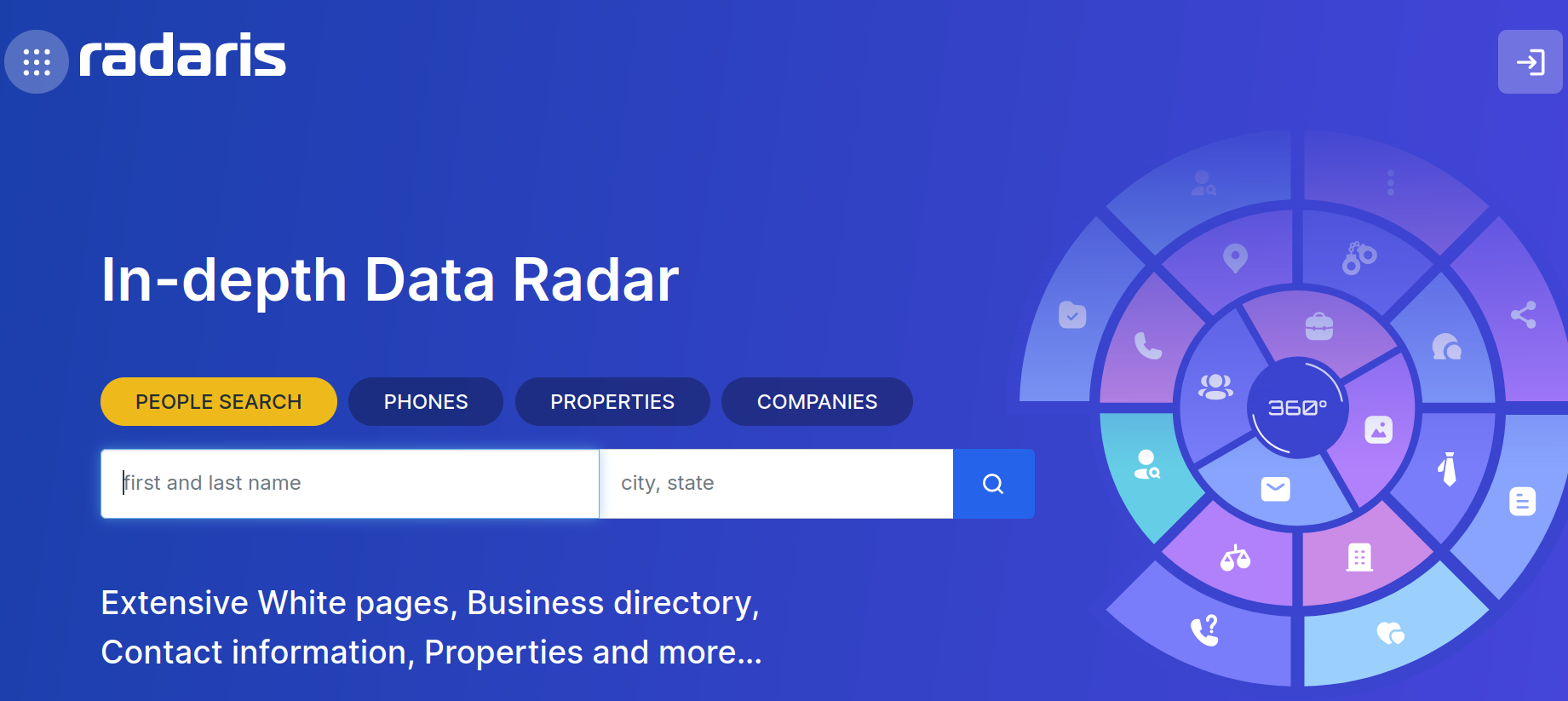
The era of "data broker impunity" in the United States may be approaching a reckoning. For years, the people-search giant Radaris.com operated with a perceived sense of untouchability, ignoring removal requests and shielding its operations behind a complex web of shell companies and international jurisdictions. That era of shadow-play has hit a legal wall. In a significant victory for consumer privacy advocates, a New Jersey court has ordered the transfer of the Radaris.com domain—along with more than a dozen associated properties—to the plaintiffs, Atlas Data Privacy Corp.
This unprecedented judicial action is the result of years of litigation centered on "Daniel’s Law," a New Jersey statute designed to protect law enforcement officers, judges, and their families by mandating the removal of their personal information from commercial data brokers. The case has not only exposed the mechanics of a massive, multi-million dollar data-mining operation but has also laid bare the "cat-and-mouse" strategies that brokers use to evade accountability in the digital age.
A Chronology of Evasion: The Radaris Playbook
The legal battle between Atlas Data Privacy Corp and the Radaris family of companies began in earnest in February 2024. Atlas, a firm focused on enforcing data privacy statutes, targeted Radaris for systemic non-compliance with Daniel’s Law. Under the law, companies are liable for $1,000 in fines for every instance where they fail to remove the personal data of protected individuals.
However, the litigation was immediately met with a sophisticated strategy of obstruction. Radaris’s legal counsel repeatedly employed procedural delays, questioning the service of process and challenging the jurisdictional reach of the court.
The "Island-Hopping" Strategy
According to Matt Adkisson, CEO of Atlas, the defendants operated what he calls an "island-hopping" phase. As pressure mounted, the company’s terms of service and corporate registrations would shift rapidly across jurisdictions like the Marshall Islands, the British Virgin Islands, and the Seychelles.
“It felt like a shell game,” Adkisson explained. “Defense lawyers would tell the court that certain entities merely operated the domains and were the proper parties to sue. But by the time a judgment neared, those entities would be discarded and new ones would appear.” In one notable instance, when the defense claimed a Marshall Islands-based company managed Radaris, an investigator hired by Atlas discovered the entity had not even been legally incorporated at the time of the claim.
The Myth of "Gary Norden"
The obfuscation extended to the company’s very leadership. In March 2024, KrebsOnSecurity published an investigation identifying the true architects of Radaris as Igor and Dmitry Lubarsky, Russian-born brothers based in Massachusetts. Despite the brothers’ attempt to threaten the outlet with defamation litigation, subsequent reporting revealed that the duo had been operating behind a fictitious CEO persona named "Gary Norden." The Radaris legal team eventually admitted that the CEO was a fabrication, a discovery that further undermined the company’s credibility in the eyes of the court.
Supporting Data: The Anatomy of an Empire
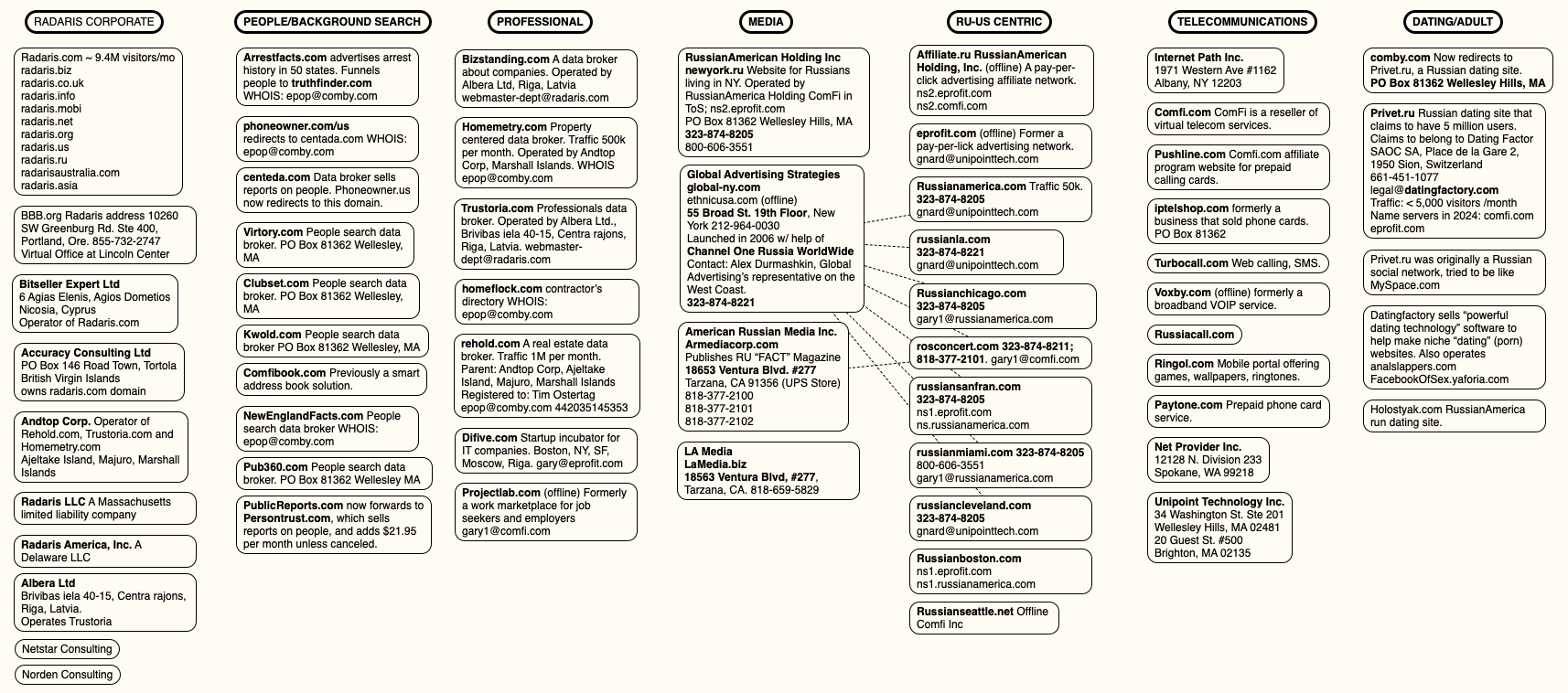
The litigation has provided a rare, granular look into the financial and operational structure of the people-search industry. Through the discovery of more than 10,000 emails and internal documents, Atlas mapped out a centralized engine behind dozens of disparate-looking websites.
The Centralized Web
The records confirm that entities such as Radaris America, Inc., Bitseller Expert Limited, Veripages Inc., and Nuform Solutions Inc. were, in reality, a single operation. These companies shared:
- Common Financial Infrastructure: Unified banking and payment processing channels.
- Administrative Cohesion: Managed by the same small group of Boston-area individuals using shared email domains (e.g., centerex.com, realmo.com).
- Revenue Streams: Radaris.com alone was estimated to generate roughly $42,000 in monthly revenue, while sister site Veripages.com pulled in approximately $45,000.
These sites relied heavily on partnerships with advertising firms like the Lifetime Value Company. Perhaps most ironically, the emails revealed that the Radaris family earned up to $25,000 monthly from a partnership with Onerep, a service that claims to help individuals remove their data from the very sites the Lubarsky brothers were managing. This "selling the cure to the disease" business model has become a hallmark of the data-mining ecosystem.
Official Responses and Legal Maneuvers
The current state of the Radaris domain is one of forced silence. The site now serves as a digital billboard for the court-ordered transfer, linking to transparency reports and legal documentation. However, the defense is not conceding defeat.
Victor Worms, an attorney representing the interests tied to the domain, maintains that the transfer is legally flawed. "We have made a motion to vacate that default judgment on the grounds that it is void since a non-entity has no legal capacity to sue or be sued," Worms stated. The defense argues that the court’s seizure of the domain amounts to a constitutional violation, specifically citing due process concerns.
Despite these protests, the August 2026 judgment stands as a testament to the court’s exhaustion with the defendants’ procedural games. As Raj Parikh of PEM Law noted, the strategy of "winning by attrition" worked for a decade, but the severity of the threat posed to law enforcement families necessitated a more robust legal response.
Implications for the Future of Privacy
The downfall of Radaris in this case is a localized victory, but the broader war over data privacy is currently facing a constitutional bottleneck.
The Constitutional Challenge
Daniel’s Law is currently under fire from approximately 150 data broker firms. These companies have successfully moved many of these cases into federal court, arguing that the statute is overly broad and infringes upon First Amendment rights regarding the publication of public records. With federal courts in states like West Virginia already ruling similar laws "facially unconstitutional," the issue is widely expected to reach the U.S. Supreme Court.
The "Public Record" Exemption
Privacy expert Justin Sherman points out a fundamental flaw in current legislation: the "public record" loophole. Most state laws, including Daniel’s Law, exempt data derived from marriage certificates, court documents, property filings, and motor vehicle registries. In an age where these records are digitized and scraped by AI, the distinction between "public" and "private" has effectively vanished.
"We don’t need more wake-up calls," Sherman argues. "We’ve had eight million wake-up calls already." He highlights that the lack of comprehensive federal privacy legislation—compounded by aggressive lobbying from big tech, AI proponents, and data brokers—leaves the average American vulnerable to identity theft and surveillance.
The case of Radaris serves as a chilling case study. Even when a company is unmasked, when its fake CEOs are exposed, and when its shell games are mapped out, the legal hurdles to actually stopping the data flow remain immense. For now, the Radaris domain transfer is a significant scalp for privacy advocates, but until Congress acts to define privacy in the 21st century, the industry of selling personal information will likely continue to thrive, shifting its infrastructure from one jurisdiction to the next, just beyond the reach of the law.