







Buying a home is one of the most significant financial milestones in a person’s life. For many, the path to homeownership is not a straight line; it is often paved with unexpected life events, from corporate restructuring and medical emergencies to simple administrative oversights. When applying for a mortgage, these "life events" often manifest as red flags on a credit report or bank statement.
While a less-than-perfect credit history might seem like a barrier to entry, it is not an automatic disqualification. Mortgage lenders and underwriters understand that financial data is often stripped of its context. To bridge the gap between raw data and reality, lenders frequently request a Letter of Explanation (LOE). This document acts as your opportunity to provide the necessary narrative context to your financial history, helping underwriters assess risk with a complete, humanized picture of your situation.
The Role of the Underwriter and the Necessity of the LOE
To understand why a letter of explanation is required, one must first understand the role of the mortgage underwriter. Their primary responsibility is to assess the level of risk a borrower poses to the lender. They are tasked with verifying that you have the financial stability to repay the loan over a long-term period.
When an underwriter reviews a file, they look for consistency. If they spot an anomaly—such as a large, unexplained cash deposit in your checking account or a 30-day late payment from two years ago—their duty is to investigate. An LOE is not an invitation to make excuses; it is a request for documentation and clarification. By providing a professional, concise, and factual explanation, you assist the underwriter in completing the "paper trail" required for regulatory compliance and risk mitigation.

Common Triggers for an LOE Request
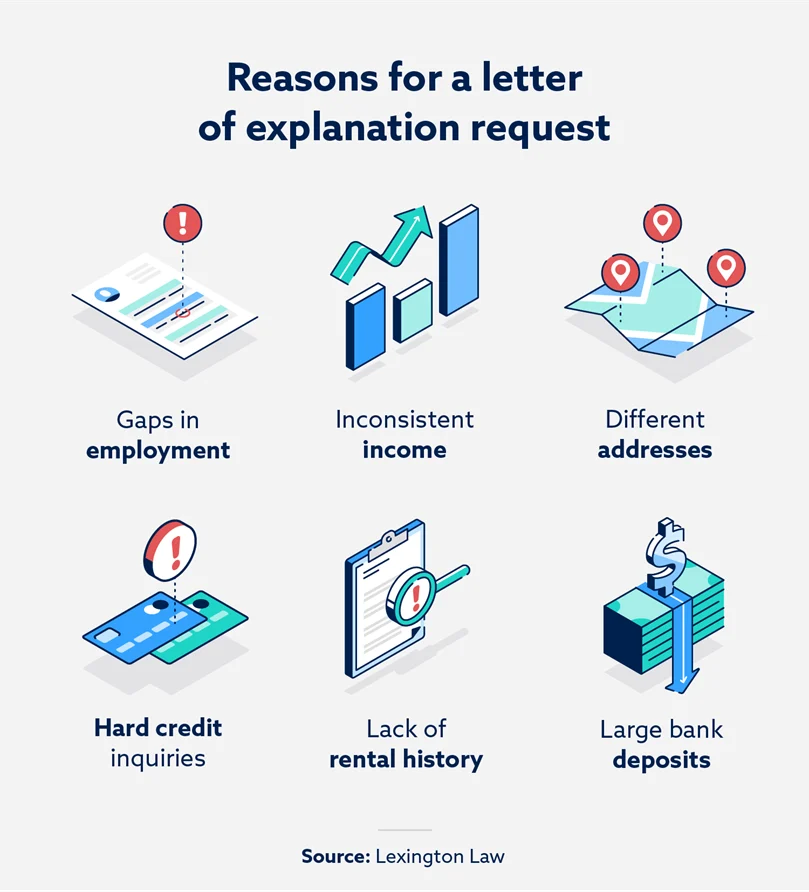
Underwriters are trained to spot deviations from standard financial behavior. While every lender has its own internal policies, the following scenarios are the most frequent triggers for an LOE:
- Significant Gaps in Employment: A prolonged period of unemployment can signal instability to a lender. You will need to explain the circumstances and demonstrate your current steady employment status.
- Large, Unusual Bank Deposits: If there is a sudden influx of cash that isn’t clearly identified as payroll, lenders need to verify that it isn’t an undisclosed loan or a "gift" that hasn’t been properly documented.
- Late Payments or Delinquencies: A single late payment on a credit card or utility bill can lower a credit score. Explaining that this was an isolated incident (e.g., a bank billing error) can help mitigate the impact.
- Recent Inquiries: A flurry of new credit inquiries can signal that you are over-leveraging yourself.
- Discrepancies in Personal Information: Variations in how your name or address is listed across different reports can raise security flags that must be reconciled.
A Five-Step Framework for Crafting Your Letter
Writing a letter of explanation requires a shift in mindset: it is an exercise in technical writing, not creative storytelling. The goal is to provide enough detail to satisfy an underwriter’s checklist without providing extraneous, emotional details that do not impact your creditworthiness.
1. Formatting and Professional Presentation
Whether you are sending a physical document or a digital file via a secure portal, the formatting must be impeccable. Use a standard business letter block format.
- Header: Include your full legal name, current address, the date, and the lender’s contact information.
- The "RE" Line: This is crucial. Always include your specific loan application number. Without it, your letter risks being lost in a stack of files.
- Digital Submission: If emailing, the subject line should be clear and descriptive: Letter of Explanation – [Your Name] – Loan #[Number].
2. Clarity and Factual Precision
Start your letter by explicitly stating why you are writing. For example: "I am providing this letter to clarify the $2,500 deposit made into my savings account on January 15th." Use the Date–Entity–Amount format. Keep the language neutral. Avoid phrases like "I was really struggling," and instead use "My income was temporarily interrupted due to a corporate restructuring."

3. The Resolution Statement
The most important part of the letter is the "resolution." Lenders care less about the past and more about the future. You must explain how you have mitigated the risk that led to the original issue. If the issue was a late payment, explain that you have since set up automatic payments. If it was an employment gap, highlight your current, steady tenure.
4. Professional Closing
End your letter by offering to provide further documentation. This demonstrates transparency and cooperation. Sign your name exactly as it appears on your mortgage application, including any middle initials or suffixes.
5. The "List of Enclosures"
Never expect an underwriter to take your word at face value. If you mention a bank statement, an offer letter, or a divorce decree, attach it. Create a "List of Enclosures" at the bottom of your letter, labeling each attachment (e.g., "Attachment A: Proof of Severance Payment"). This organized approach saves the underwriter time and significantly increases the likelihood of a favorable review.
Strategic Considerations: Credit Repair vs. Explanation
It is vital to distinguish between an LOE and credit repair. An LOE is a short-term tool used to clear a specific hurdle in your current mortgage application. It does not delete negative items from your credit report.

If your credit report contains significant, long-term errors—such as fraudulent accounts, identity theft remnants, or incorrect late payment marks—you should pursue formal credit repair. By challenging these inaccuracies directly with the credit bureaus, you can improve your credit score for the long term. Many borrowers find that working with credit professionals helps them ensure their financial file is accurate before they apply for a loan, thereby reducing the need for an exhaustive series of LOE requests during the underwriting phase.
Frequently Asked Questions
Does an LOE guarantee loan approval?
No. An LOE is not a "magic bullet" that guarantees approval. However, it is an essential component of the process. Failing to provide one, or providing a poorly written one, can lead to unnecessary delays or even the denial of your application.
Is a request for an LOE a sign of trouble?
On the contrary, it is usually a positive sign. It indicates that the underwriter is actively working on your file and is looking for a way to justify your approval. It means you are still in the running, and they simply need to clear up the "paperwork" of your financial story.
What if my letter is rejected?
If your explanation is deemed insufficient, the underwriter will typically reach out to explain why. It usually means the documentation provided didn’t match the story or the risk remains too high. At this point, you should consult with your loan officer to determine if there is additional evidence you can provide.

How much detail is too much?
Stick to the facts. Underwriters are busy; they appreciate brevity. If you are explaining a medical expense, you do not need to provide a detailed history of the illness—only the dates of the expense and confirmation that it has been resolved or is being managed.
Conclusion: The Path Forward
The mortgage process is designed to be rigorous, and while an LOE request may feel like an inconvenience, it is simply part of the due diligence required to secure a significant loan. By approaching the task with professionalism, maintaining a strict adherence to facts, and ensuring that all claims are backed by solid, documented evidence, you can turn potential red flags into a straightforward, cleared path toward your new home.
Remember: the goal of the underwriter is to approve your loan while minimizing risk. By providing a clear, logical, and well-documented narrative, you are making their job easier—and in the process, you are taking a major step toward closing on your home.