








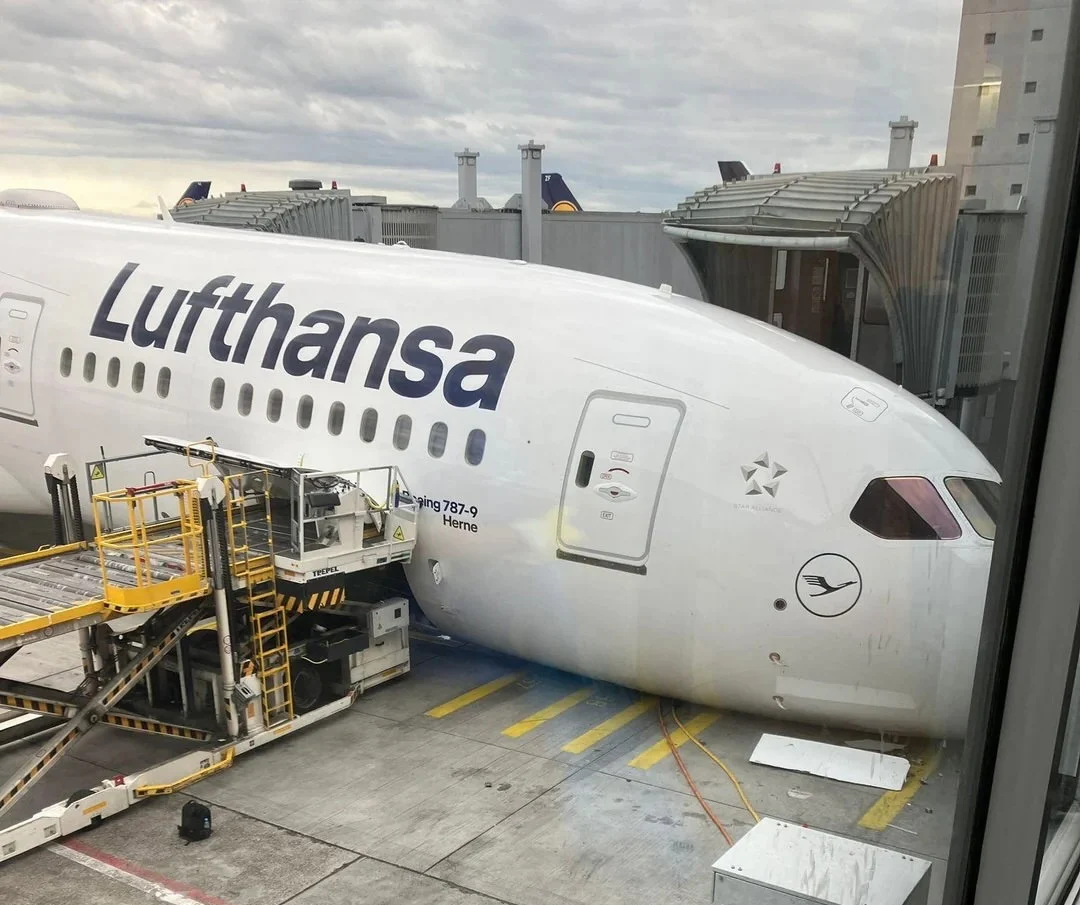
The aviation industry thrives on a foundation of rigorous protocol, where checklists and safety pins serve as the final barrier between routine maintenance and catastrophic failure. However, a startling incident at Frankfurt Airport (FRA) on June 4, 2026, has brought these safety systems under intense public and regulatory scrutiny. A brand-new Lufthansa Boeing 787-9 Dreamliner suffered a sudden, violent nose gear collapse while parked at its gate, leading to significant structural damage to the aircraft and injuring 23 people.
The incident, which occurred in broad daylight, was captured on CCTV, revealing the terrifying moment the aircraft’s nose buckled, causing the fuselage to drop abruptly. An interim report released by the German Federal Bureau of Aircraft Accident Investigation (BFU) has now confirmed what many industry experts suspected: the collapse was the direct result of a fundamental failure in human protocol during ground maintenance.
The Incident: A Routine Day Turned Chaotic
The aircraft involved, registration D-ABPQ, was a state-of-the-art Boeing 787-9 featuring Lufthansa’s highly touted "Allegris" cabin interior. Having only entered service on February 13, 2026, the aircraft was a crown jewel of the airline’s long-haul fleet, having operated for less than four months.
On the morning of June 4, the Dreamliner arrived at Frankfurt following an overnight flight from Austin, Texas (AUS). The flight landed without incident, and the aircraft was scheduled to undergo a quick turnaround before departing for Los Angeles (LAX) as flight LH450. However, the flight never departed.
As the aircraft sat at the gate, ground crews were performing routine activities, including the connection of Unit Load Devices (ULDs) for cargo loading and the positioning of jet bridges. Suddenly, the nose landing gear retracted, forcing the forward section of the aircraft to collapse onto the tarmac. The impact caused the landing gear panel to shear off and sent a shockwave through the boarding area.
Chronology of the Failure
The BFU’s investigation provides a detailed timeline that highlights the critical lapse in safety procedures:
- June 3, 2026 (Evening): Maintenance technicians logged an error message related to the aircraft’s landing gear system. This triggered a requirement for troubleshooting and diagnostic testing.
- June 4, 2026 (Morning): Upon arrival from Austin, the aircraft was handed over to the maintenance team at Frankfurt to conduct the necessary landing gear tests.
- The Critical Window: To perform landing gear retraction tests safely while the aircraft is on the ground, a "downlock pin" must be inserted into the nose gear mechanism. This physical pin acts as a mechanical fail-safe, physically preventing the gear from retracting even if the hydraulic system or electronic controls are triggered.
- The Omission: The investigation confirmed that the maintenance team failed to insert the downlock pin. Instead of being secured in the nose gear assembly, the pin was later discovered resting in its standard storage box, completely unused.
- The Collapse: As technicians initiated the landing gear testing sequence, the lack of the mechanical lock allowed the gear to retract, causing the aircraft to collapse instantly.
Human Factors and Safety Implications
The human toll of this incident was significant. While initial reports focused on the damage to the multi-million-dollar aircraft, the BFU confirmed two serious injuries and 21 minor injuries among personnel in the vicinity of the aircraft. Given the proximity of ground staff to the nose gear when it collapsed, investigators noted that the outcome could have easily been fatal.
The BFU’s findings raise uncomfortable questions about maintenance culture and the efficacy of safety checklists. The "Swiss Cheese Model" of accident causation—where multiple layers of defense must fail for an accident to occur—was clearly breached here. Why was the pin not installed? Why did the diagnostic protocol not require a "positive confirmation" of the pin’s installation before testing began?
The report highlights a disturbing trend in aviation maintenance. This incident bears a striking resemblance to a June 2021 incident involving a British Airways Boeing 787-8, where a similar gear collapse occurred. In that instance, the issue was related to the incorrect insertion of a pin, whereas the Lufthansa incident involved the complete omission of the safety device.
Comparing Technical Failures
The aviation community has long been aware of the specific vulnerabilities of the Boeing 787 nose gear configuration. Following the 2021 British Airways incident, Boeing issued service bulletins and guidance regarding the proper use of landing gear pins.
The fact that a major carrier like Lufthansa—known for its meticulous adherence to German engineering standards and regulatory oversight—fell victim to such a basic error suggests that even the most experienced organizations are susceptible to "normalization of deviance." This occurs when procedures become so routine that steps are skipped, and the danger of doing so is underestimated because "nothing happened the last time."
Official Responses and Industry Impact
Lufthansa has issued a statement expressing its commitment to cooperating fully with the BFU and the German aviation authorities. The airline has stated that it is conducting its own internal review to determine how such a fundamental breakdown in the maintenance chain of command occurred.
"The safety of our passengers and ground staff is our absolute priority," a Lufthansa spokesperson noted in a press release following the publication of the interim report. "We are reviewing our internal maintenance training and supervision protocols to ensure that such a lapse in procedure is never repeated."
Industry analysts suggest that the impact of this incident will extend beyond Lufthansa. The BFU is expected to make formal recommendations to the European Union Aviation Safety Agency (EASA) regarding updated maintenance requirements for the Boeing 787. These might include mandatory physical interlocks or electronic sensors that prevent landing gear testing unless a safety pin is detected in the "locked" position.
The Long Road to Recovery
The aircraft, D-ABPQ, remains out of service. Assessing the structural integrity of a composite-bodied aircraft like the 787 after a nose gear collapse is a complex and expensive endeavor. The sudden impact would have sent significant stress forces through the fuselage, particularly around the nose wheel well and the forward cargo area.
For Lufthansa, the timing could not be worse. Occurring at the start of the peak summer travel season, the loss of a brand-new, high-capacity Dreamliner creates a ripple effect in their scheduling, forcing the airline to adjust capacity on long-haul routes at a time when demand is at its highest.
Conclusion: A Lesson in Vigilance
The Lufthansa Boeing 787 collapse serves as a sobering reminder that technology, no matter how advanced, cannot compensate for the human element. The Dreamliner is a marvel of aeronautical engineering, designed with redundant systems and cutting-edge safety features. Yet, those systems were rendered useless by a simple, manual error.
As the BFU continues its investigation, the focus will likely shift toward organizational safety management systems (SMS). How does a maintenance team, presumably comprised of highly trained professionals, reach a point where a safety pin is left in a storage box during a high-stakes test?
The final report from the BFU will be a critical document for the aviation industry. It will not only detail the technical failures of the day but will hopefully provide a blueprint for how airlines can better protect their staff and their assets from the most dangerous threat in aviation: the assumption that a routine job carries no risk. For now, the global aviation community watches closely, hoping that the lessons learned from this incident in Frankfurt will lead to more robust, fail-safe procedures that ensure the integrity of the aircraft before it ever leaves the gate.