







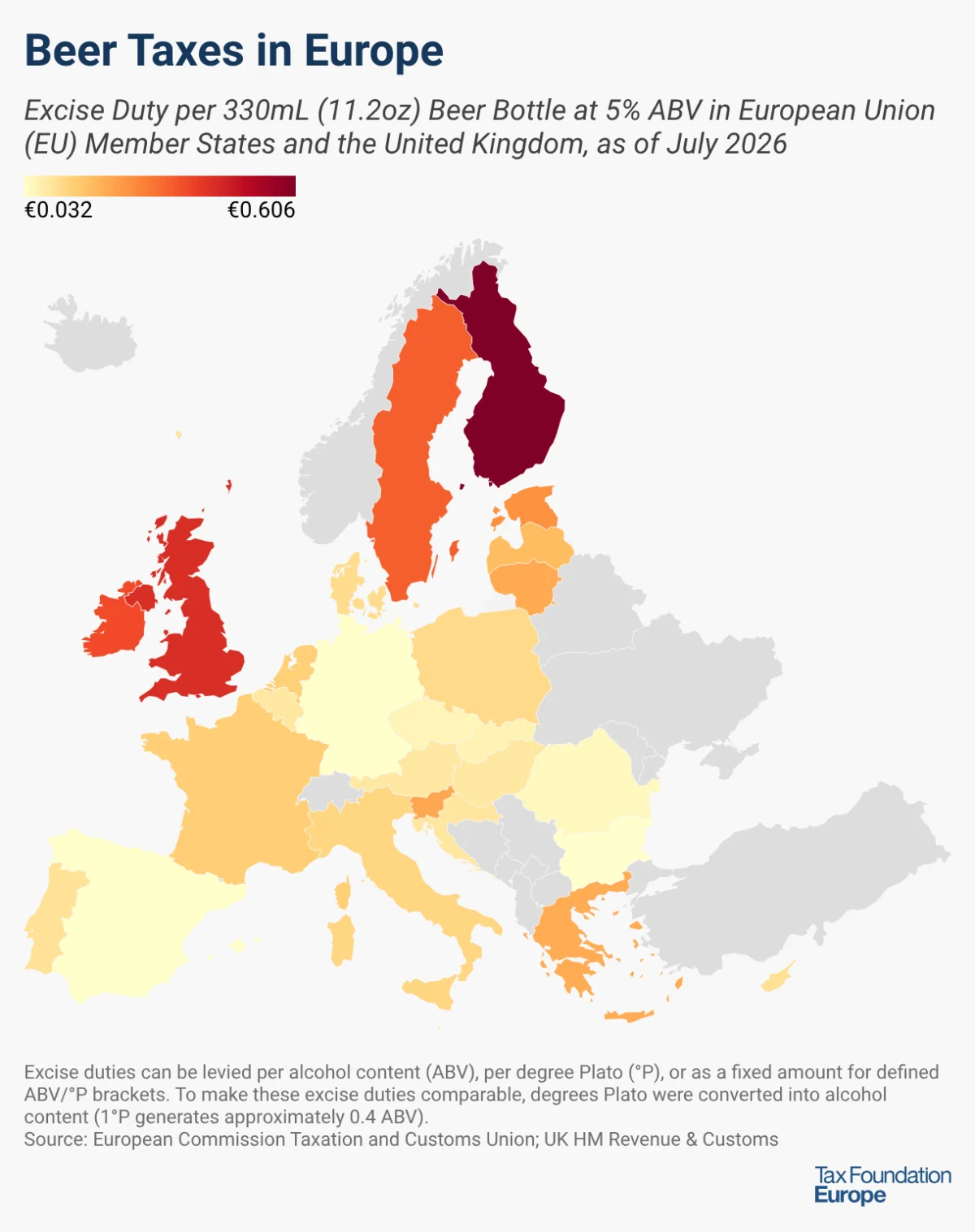
BRUSSELS — As the European Union and its neighbors look toward significant regulatory shifts slated for 2026, the continent’s age-old system of alcohol taxation is facing a profound reckoning. Policymakers, economists, and industry leaders are grappling with a market that has fundamentally outgrown the rigid legal and fiscal categories designed decades ago.
At the heart of the debate is a simple fiscal instrument with complex societal goals: the excise tax. Long utilized by governments to curb public health harms and secure steady streams of revenue from widely consumed goods, excise taxes on alcohol remain a blunt instrument. As we approach 2026, the friction between traditional tax classifications and modern drinking habits is exposing deep inefficiencies across the European market, igniting a broader conversation about modernization, tax fairness, and administrative streamlining.
Main Facts
The fundamental architecture of alcohol taxation in Europe is built on a tripartite division: beer, wine, and distilled spirits. Each category has historically been subjected to vastly different fiscal pressures based on cultural norms, agricultural lobbies, and public health objectives.
Governments levy excise taxes on beer primarily for two reasons: to discourage excessive consumption that leads to societal and healthcare burdens, and to generate reliable tax revenue. However, the application of these taxes varies wildly across the European Union, reflecting a patchwork of national priorities rather than a unified single-market approach.
When compared to other alcoholic beverages, beer occupies a middle tier in the European tax ecosystem:
- Beer vs. Wine: Across the continent, beer is generally taxed more heavily than wine. In several EU member states, wine enjoys a zero-rate excise tax, a policy deeply rooted in the cultural and agricultural traditions of Southern European wine-producing powerhouses.
- Beer vs. Spirits: Conversely, beer is taxed much lighter than distilled spirits, which carry the heaviest fiscal burdens due to their high alcohol-by-volume (ABV) concentrations.
However, these clear categorical lines are increasingly outdated. The explosion of the craft beverage market, the blurring of lines between fermented and distilled products, and the rise of hybrid beverages have rendered traditional tax structures increasingly obsolete. While European beer taxation is already frequently indexed to alcohol content—assessed either by percentage of alcohol or by degrees Plato—other categories, such as wine and certain spirit-based coolers, are not subjected to the same granular assessment.
Chronology
To understand how Europe arrived at the current crossroads of alcohol policy, it is necessary to examine the evolution of taxation frameworks and the pressures leading up to the anticipated 2026 changes:
- Late 20th Century (Harmonization Efforts): The European Economic Community and later the EU made initial attempts to harmonize excise duties on alcohol to prevent cross-border shopping distortions and trade barriers within the single market. Directives were established establishing minimum rates, but wide national discretion remained.
- The Craft Beer Revolution (2010s): The global craft brewing movement exploded, introducing thousands of new independent brewers. These businesses diversified the market with extreme variations in flavor, ingredients, and alcohol content, challenging the traditional industrial definitions of "beer."
- The Rise of Ready-to-Drink (RTD) Beverages (Late 2010s–Early 2020s): The market flooded with ready-to-drink cocktails and hard seltzers. Many of these products utilize distilled spirits as a base, but once diluted with mixers, their final ABV closely mirrors that of a standard beer or cider, creating classification nightmares for tax authorities.
- The United Kingdom’s Duty Overhaul (2023): Demonstrating a bold alternative model, the UK implemented a sweeping overhaul of its alcohol duty system, moving toward a progressive structure based strictly on alcohol strength across nearly all categories. This reform served as a major case study for European policymakers.
- The 2024–2025 Transition Period: As member states prepare for significant fiscal adjustments and strategic reviews heading into 2026, industry stakeholders have ramped up lobbying efforts. They are pushing either for protective categorical classifications or for comprehensive tax modernization based on ABV.
- Horizon 2026 (Significant Policy Shifts): Set against the backdrop of broader EU digital and administrative integration, 2026 marks a targeted milestone for various national tax adjustments, compliance updates, and potential framework reviews regarding how cross-border and novel alcohol products are treated fiscally.
Supporting Data
The economic reality of European alcohol taxation is characterized by stark disparities, administrative friction, and shifting consumer trends.
The Categorical Divide
Tax burdens across Europe are notoriously asymmetrical. According to data compiled by the Tax Foundation, the tax treatment of alcohol in Europe varies more widely across product categories than almost anywhere else in the developed world.
- Zero-Rate Wine: Countries such as France, Italy, and several other wine-producing nations maintain nominal or zero excise duties on still wine, framing it as an agricultural food product rather than a recreational intoxicant.
- The Beer Gradient: Beer taxation is typically calculated either per hectolitre/degree Plato or per hectolitre/percentage of alcohol. This means that a standard 5% ABV lager pays significantly less in absolute tax than a 9% Imperial Stout, even within the same jurisdiction. However, the base rates differ exponentially when crossing national borders; consumers in Northern and Nordic countries often face beer taxes many times higher than those in Central or Eastern Europe.
Product Innovation and the ABV Blur
The proliferation of hybrid products has severely strained existing tax codes. Consider the following segments:
- Malt Liquors and Strong Lagers: By definition, these are beers brewed with extra adjuncts and malt to achieve a higher alcohol content (often 6% to 9%+), straddling the line between standard beers and heavy liquors in terms of intoxicating potential.
- Spirit-Based RTDs: A hard seltzer or canned cocktail created with a vodka base might have an ABV of 4.5%—identical to a mainstream commercial beer. Yet, under traditional European tax classifications, if the alcohol originates from a distilled spirit rather than fermentation, it may face a punitive spirits-category duty rate, regardless of its final, consumer-ready strength.
These discrepancies create massive compliance costs for manufacturers, who must navigate a labyrinth of differing national rules, labeling requirements, and bonded warehouse protocols just to sell pan-European products.
Official Responses
As the debate over tax modernization intensifies, stakeholders across the public and private sectors have staked out clear positions regarding the future of European alcohol policy.
Public Health Advocates
Public health organizations generally support high and restrictive excise taxes on alcohol, citing robust empirical data linking price increases to reduced consumption, lower rates of chronic disease, and decreased societal harms such as domestic abuse and traffic accidents.
- “Excise taxes remain our most effective preventative tool against alcohol-related harm,” noted a spokesperson for a prominent European public health coalition. “While we acknowledge the administrative complexities raised by industry groups, any tax reform must not result in an overall reduction of the effective tax burden on high-strength products. Public health must supersede administrative convenience.”
The Brewing and Craft Industry
The brewing sector, particularly independent craft breweries, has expressed mounting frustration with archaic tax structures that fail to account for market innovation. Small brewers argue that rigid bureaucratic definitions often lock them out of cross-border expansion.
- “When a small brewer creates an innovative, low-alcohol sour beer or an experimental high-gravity ale, they shouldn’t have to hire a team of international tax lawyers just to understand how their product will be classified in a neighboring member state,” said a representative from a pan-European brewing federation. “A modernized, transparent system based strictly on absolute alcohol content would level the playing field.”
Fiscal Authorities and Tax Administrators
National tax authorities are increasingly caught between the desire to maximize revenue and the reality of rising enforcement costs. Traditional audits struggle to keep pace with rapid product development.
- “As the product landscape continues to evolve, our current categorical systems are becoming increasingly complex, inefficient, and costly to administer and comply with,” acknowledged a senior fiscal policy advisor in Brussels. “Moving toward a system that rationalizes duties based on true alcohol content is analytically appealing, but untangling decades of entrenched agricultural subsidies and national tax carve-outs—especially regarding wine—remains a monumental political hurdle.”
Implications
The push toward potential tax modernization and the impending adjustments of 2026 carry profound implications for consumers, producers, and the broader European economy.
1. Administrative Efficiency vs. Political Reality
The core theoretical solution to the current tax tangle is straightforward: discard clunky, outdated categorical systems in favor of a neutral tax levied strictly on absolute alcohol content (per unit of pure alcohol, or hectolitre/degree Plato). Such a reform would equalize the treatment of different types of alcohol, eliminate market distortions, and dramatically reduce compliance costs.
However, implementing this across the EU faces fierce political resistance. Southern European wine-producing nations fiercely guard their zero-rate or low-rate wine policies, viewing any attempt to tax wine on par with spirits or strong beer as an existential threat to their agricultural heritage and rural economies. Consequently, while a uniform ABV-based tax may work brilliantly on paper, achieving consensus among 27 sovereign member states remains highly improbable in the near term.
2. Market Adaptation and Product Formulation
If tax structures increasingly shift toward rewarding lower-alcohol products through proportional taxation, beverage manufacturers will have a powerful financial incentive to reformulate. We are already witnessing a massive boom in the "no-and-low" (NoLo) alcohol sector. Brands are aggressively investing in non-alcoholic beers, low-ABV wines, and spirit alternatives. A transparent, strength-based tax regime would accelerate this trend, rewarding producers who innovate in lower-alcohol segments with lower tax liabilities.
3. Consumer Impact and Cross-Border Trade
For the everyday consumer, changes in alcohol taxation directly dictate retail pricing. If governments streamline their duties, consumers could see more rational pricing models where products with identical alcohol content bear comparable tax loads, regardless of whether they are derived from malt, grapes, or grain. Conversely, continued fragmentation will ensure that cross-border shopping and excise duty arbitrage remain lucrative for consumers living near high-tax national borders.
Outlook
As Europe moves closer to 2026, the alcohol tax landscape stands as a microcosm of the broader struggle between modern economic integration and entrenched national sovereignty. Whether through comprehensive legislative overhauls or incremental national adjustments, the pressure to modernize is undeniable. Until policymakers find the political courage to harmonize duties around the reality of absolute alcohol content, Europe’s brewers, vintners, and distillers will continue navigating a labyrinth of red tape—proving that while the motivations for taxation may be simple, the execution remains a heady brew indeed.