








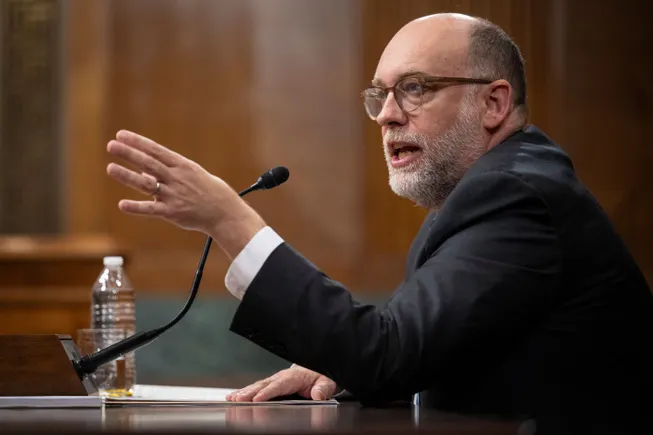
WASHINGTON D.C. — In a series of high-stakes congressional hearings this week, Russ Vought, the Acting Director of the Consumer Financial Protection Bureau (CFPB) and current Director of the Office of Management and Budget (OMB), laid out a provocative and scorched-earth vision for the future of federal consumer protection. Appearing before both the House Financial Services Committee and the Senate Banking Committee, Vought defended his aggressive efforts to dismantle the agency from within, characterizing the bureau as a "weaponized" entity that had historically overstepped its legal bounds.
The testimony comes at a pivotal moment for the American financial landscape. Since taking the helm in February 2025, Vought has moved with unprecedented speed to rescale, defund, and redirect the CFPB—an agency born out of the 2008 financial crisis to protect consumers from predatory lending. His mission, as he described it to lawmakers, is to replace "heavy-handed Washington control" with a leaner, "accountable" model that prioritizes market competition over regulatory enforcement.
Main Facts: A Mandate for Deconstruction
The core of Vought’s testimony centered on the ideological shift currently underway at the CFPB. Since his appointment, the agency has moved away from its traditional role as a proactive "cop on the beat" for financial markets. Vought argued that the bureau had become a "rogue" agency under previous administrations, operating without sufficient oversight from Congress due to its unique funding structure through the Federal Reserve rather than the traditional appropriations process.
Key developments highlighted during the hearings include:
- Aggressive Workforce Reductions: Vought confirmed that the agency’s headcount has been slashed to 1,071 employees, with ongoing efforts to lay off hundreds more. This is part of a broader strategy coordinated with the Department of Government Efficiency (DOGE) to reduce the federal footprint.
- Regulatory Rescission: The bureau has rescinded 67 pieces of previous guidance, effectively removing the "rules of the road" that banks and lenders had followed for years. Vought framed this as a move to eliminate "novel legal theories" that lacked statutory backing.
- Enforcement Rollbacks: High-profile lawsuits and enforcement actions, including those against major financial institutions like Capital One, have been dropped or settled for significantly reduced amounts.
- Erasure of Institutional Memory: In a move that drew sharp criticism from transparency advocates, the CFPB has deleted vast archives of press releases, speeches, and historical data that predated the current administration’s second term.
Vought’s ultimate goal, which he first signaled in October 2024, was to "shutter the bureau" entirely within a matter of months. While the agency remains functional for now, its operational capacity has been intentionally "downscaled to the maximum extent possible."
Chronology: The Rapid Transformation of 2025
The timeline of Vought’s tenure reflects a "blitzkrieg" approach to administrative reform.
October 2024: As Director of the OMB, Vought publicly expresses his desire to see the CFPB shuttered within two to three months, citing it as an unconstitutional and unnecessary layer of bureaucracy.
February 2025: Vought is appointed Acting Director of the CFPB. He immediately begins a comprehensive review of all active enforcement actions and internal guidance. He declares the agency "out of control" and "weaponized" against the American economy.
March – May 2025: The CFPB begins the mass rescission of guidance documents. Simultaneously, the agency initiates a plan to lay off hundreds of workers, a move challenged by the National Treasury Employees Union (NTEU). During this period, the agency also begins purging its website of historical records.
June 2025: The administration reverses a major order against Navy Federal Credit Union. While the credit union pays a $15 million civil penalty, Vought cancels the requirement for $80.6 million in consumer redress, signaling a shift away from making "victims" whole if the legal theory is deemed "novel."
July 2025: Vought appears before Congress for the first time as Acting Director. He announces he will remain in the post until August 1, 2025, pending the confirmation of Brian Johnson, a former CFPB deputy director and Capital One executive, who has been nominated to take the permanent lead.
Supporting Data: The Multi-Billion Dollar Impact
The policy shifts under Vought’s leadership are not merely academic; they carry significant financial weight. A report issued by Senate Banking Committee Democrats on Thursday provides a stark contrast to Vought’s narrative of "fiscal responsibility."
According to the report, the "attack" on the CFPB has cost American consumers an estimated $26.5 billion in lost protections and increased fees. The data breaks down as follows:
- Fee Rescissions: Approximately $19 billion in 2025 and $7.5 billion in the first half of 2026 are attributed to the rescission of credit card late fee and overdraft fee rules. These rules, implemented by the previous administration, were designed to cap "junk fees" that hit low-income consumers the hardest.
- Lost Redress: Since its founding in 2011, the CFPB has returned more than $21 billion to consumers. Under Vought’s leadership, the pace of these returns has slowed to a trickle. The cancellation of the $80.6 million Navy Federal redress is cited as a primary example of "material and measurable" harm to military service members.
- Operational Costs: While Vought argues that cutting the agency’s 1,071-person staff saves taxpayer money, critics argue that the loss of oversight leads to a more volatile financial market, the costs of which are eventually borne by the public.
Furthermore, the report notes that the CFPB’s shift toward "state-led enforcement" often leaves gaps in states with weaker consumer protection laws, creating a "patchwork" regulatory environment that could actually increase compliance costs for national banks.
Official Responses: A House and Senate Divided
The reaction to Vought’s testimony fell strictly along party lines, highlighting the deep ideological divide regarding the role of government in the private sector.
The Republican Perspective: "Competition Over Control"
Republicans, led by Senator Tim Scott (R-SC) and Senator Pete Ricketts (R-NE), lauded Vought for his "courage" in reigning in an agency they view as an "added layer of bureaucracy."
"The best way to protect consumers is through competition, choice, and clear rules, not through heavy-handed Washington control that leaves consumers with fewer and fewer options," Senator Scott stated.
Senator Ricketts argued that the CFPB’s functions were redundant, asserting that other regulators were already "responsible for doing this." Republicans praised the move away from a "sue and settle" mindset, which they argue extorts settlements from businesses through the threat of endless litigation.
The Democratic Perspective: "Weaponizing the Bureaucracy"
Democrats, conversely, were scathing in their assessment. Representative Maxine Waters (D-CA), the ranking member of the House Financial Services Committee, issued a stern warning to Vought regarding his communications and the potential for future investigations.
"You should preserve all of your emails, text messages, and other forms of communication… while your work may be done… let me be clear, we are not done with you," Waters said, hinting at potential subpoenas should the political tide shift.
Sens. Mark Warner (D-VA) and Lisa Blunt Rochester (D-DE) specifically targeted Vought’s comments regarding Community Development Financial Institutions (CDFIs). Vought had dismissed many of these lenders as "incredibly woke," a comment Warner characterized as a dismissal of vital financial lifelines for underserved communities.
Implications: The Future of Consumer Protection
The "Vought Era" at the CFPB, though brief in tenure, marks a fundamental restructuring of federal power. The implications of his actions will likely resonate for years:
1. The Shift to State Enforcement:
By signaling that the CFPB will "fill in the gaps" rather than lead, Vought is effectively handing the reins of consumer protection to state Attorneys General. This may lead to a surge in litigation from blue states like New York and California, while consumers in red states may find themselves with significantly fewer protections against predatory lending.
2. The "Brian Johnson" Transition:
With Brian Johnson’s nomination hearing set for July 23, the industry is watching to see if a permanent director will continue Vought’s "shuttering" strategy or move toward a more traditional, albeit conservative, regulatory stance. Johnson’s background at Capital One suggests a pro-industry tilt, but his experience as a former deputy director may lead to a more stabilized, less "trauma-focused" management style.
3. Judicial and Legislative Challenges:
Vought’s assertion that the CFPB’s funding through the Federal Reserve is its "main defect" touches on a constitutional debate that may eventually return to the Supreme Court. If the agency is moved under the congressional appropriations process, its budget—and its ability to function—will become a permanent pawn in annual budget battles.
4. The Cultural War in Finance:
Vought’s comments on "woke" lenders and his desire to put federal workers "in trauma" reflect a broader administration-wide effort to purge ideological opponents from the civil service. This creates a high level of institutional instability that may make it difficult for the agency to recruit top-tier legal and financial talent in the future.
As Russ Vought prepares to exit the CFPB on August 1, he leaves behind an agency that is a shadow of its former self. Whether this leads to the "strong economy" and "innovation" he promises, or a return to the "Wild West" lending practices that preceded the 2008 crisis, remains the central question for the American consumer.