









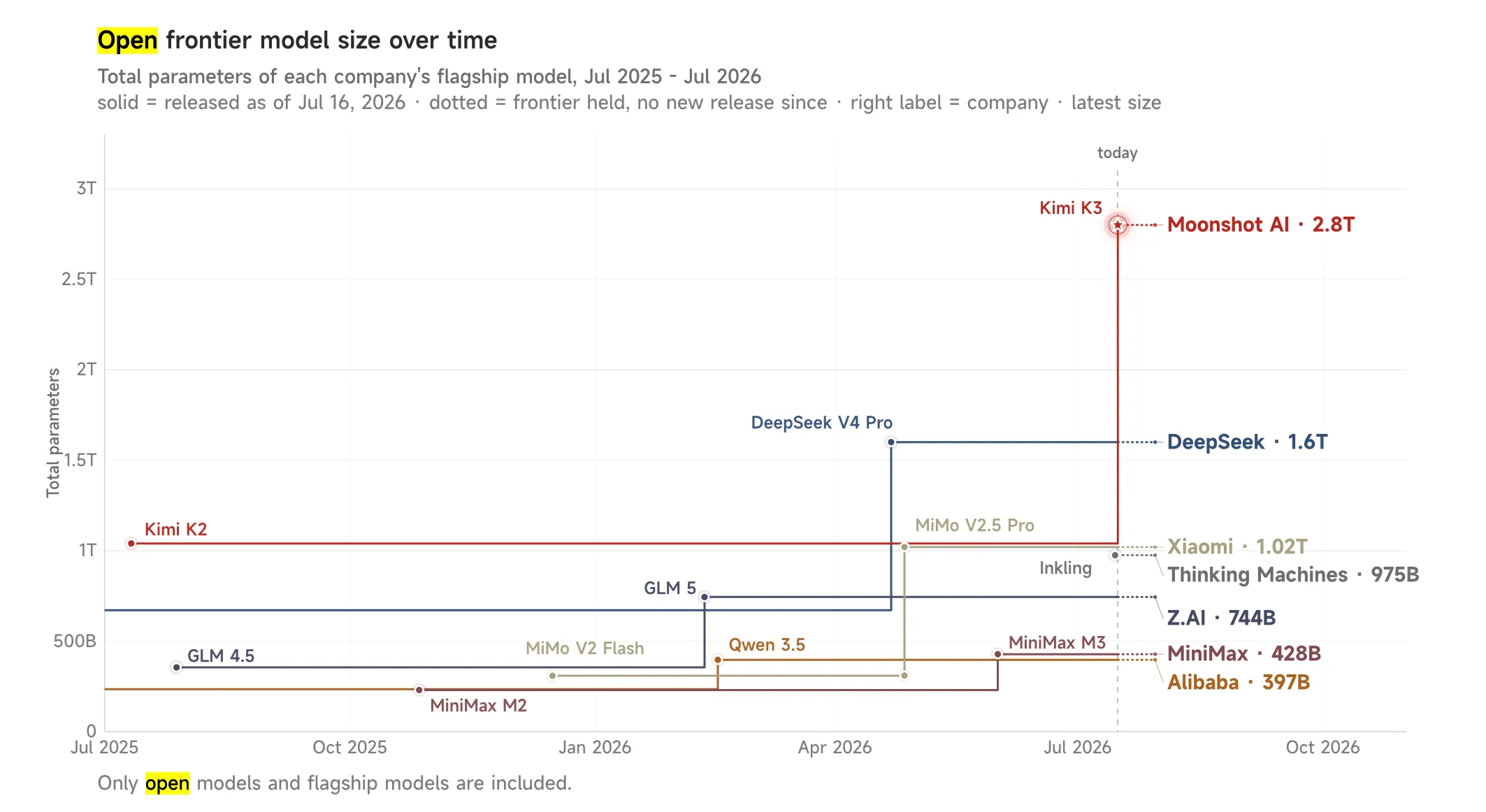
In a seismic shift for the artificial intelligence landscape, Beijing-based Moonshot AI has officially unveiled Kimi K3, a model that is effectively rewriting the rulebook on what open-source, or open-weight, systems can achieve. Boasting a staggering 2.8 trillion parameters, K3 is not merely an incremental update; it is a monumental leap that has managed to unseat industry stalwarts, most notably Anthropic’s Claude Fable 5, in several high-stakes benchmarks.
The arrival of K3 marks the first time a model of this magnitude—the world’s first in the 3-trillion-parameter class—has challenged the hegemony of proprietary models from Western labs. With its combination of raw scale, architectural innovation, and aggressive pricing, Kimi K3 is forcing a global reassessment of the "compute ceiling" and the efficacy of U.S.-led chip export controls.
The Main Facts: A New Benchmark Leader
The core of the excitement surrounding Kimi K3 lies in its performance metrics. According to Towards AI’s Writing Elo benchmark—a rigorous test where models generate scripts that are then judged blind against professional, human-written content—Kimi K3 secured an Elo rating of 2,840. This score officially surpasses Claude Fable 5, which holds a 2,760, marking a dramatic ascent for Moonshot AI, whose predecessor, Kimi K2.6, previously ranked 21st.
Beyond creative writing, K3 has demonstrated exceptional prowess in technical domains. It currently occupies the top spot on the Arena AI Frontend Code Leaderboard, outperforming Fable 5 with an Elo of 1,679 compared to 1,631. In head-to-head testing on the specialized BridgeBench suite, K3 emerged victorious in seven out of eight categories, including a clean 9-0 sweep in code refactoring and a 6-1 dominance in debugging.
Perhaps most tellingly, K3 achieved these results while maintaining a operational cost of approximately $0.25 per script, a five-fold efficiency gain over its predecessor. For developers and enterprise architects, this represents a rare "best-of-both-worlds" scenario: frontier-level intelligence provided at a mid-tier price point.
Chronology: The Road to the 2.8 Trillion Parameter Giant
The development of Kimi K3 did not occur in a vacuum. It is the culmination of a deliberate, efficiency-first research strategy necessitated by geopolitical constraints.

- Late 2023: The U.S. government implements stringent export controls, barring the shipment of high-end Nvidia H800 GPUs to China. Moonshot AI, like many Chinese "AI Tiger" startups, finds its access to top-tier hardware severely restricted.
- Early 2024: Moonshot AI pivots its strategy. Realizing they cannot rely solely on raw compute power, the team focuses on fundamental architectural research to maximize the output of the hardware they have available, including utilizing domestic alternatives like the Huawei Ascend series.
- Mid-2024: The internal development of the "Delta Attention" and "Attention Residuals" techniques begins, aimed at optimizing long-context processing and layer-wise information routing.
- July 2026: Kimi K3 is formally announced. It is the result of scaling these architectural innovations to the 2.8-trillion-parameter mark, effectively bypassing the limitations imposed by hardware scarcity.
- July 27, 2026: The official release date for the model weights, granting enterprises and large-scale developers access to the technology.
Supporting Data: Why K3 Succeeds
To understand how Moonshot AI achieved these gains without a massive server farm of H100s, one must look at the "Mixture of Experts" (MoE) architecture. K3 utilizes 896 "expert" subnetworks. Rather than activating all 2.8 trillion parameters for every query—which would be computationally ruinous—the model selectively engages only a fraction of its total capacity.
Two primary technical innovations underpin this efficiency:
- Kimi Delta Attention: This mechanism optimizes the decoding process for long-sequence tasks. In practice, it allows the model to process million-token context windows at speeds up to 6.3x faster than traditional attention mechanisms.
- Attention Residuals: By routing information selectively across model layers rather than accumulating it uniformly, Moonshot has achieved a 25% boost in training efficiency at a marginal compute cost.
The result is a model that offers a one-million-token context window, native image and video understanding, and consistent, always-on reasoning. On the Artificial Analysis Intelligence Index, which aggregates nine independent evaluations, K3 scored a 57. While this remains slightly behind Claude Fable 5 (60) and GPT-5.6 Sol (59), the 3% gap is negligible considering the cost-to-performance ratio. K3 costs just $3 per million input tokens, positioning it as a disruptive economic force in the AI API market.
Official Responses and Industry Sentiment
The reaction from the broader AI community has been one of shock and re-evaluation. Guillermo Rauch, a prominent voice in the developer ecosystem, noted that K3 is the first open model to surpass proprietary alternatives in comprehensive web engineering benchmarks.
However, the response from the lab itself remains focused on the "necessity is the mother of invention" narrative. Moonshot AI President Yutong Zhang, speaking at Davos earlier this year, explained: "We knew we didn’t have the luxury to simply scale up compute… That forced us to focus on fundamental research and efficiency."
Bank of America analysts echoed this sentiment in a recent industry note, observing that the K3 launch proves that "pre-training scaling, paired with architectural innovation, can still deliver step-change gains for flagship Chinese models," even under the pressure of international sanctions.
Implications: A Shifting Geopolitical Landscape
The release of K3 serves as a potent, and potentially uncomfortable, argument against the long-term effectiveness of U.S. chip export controls. While the policy was designed to throttle the development of frontier-level intelligence in China, companies like Moonshot have responded by innovating their way out of the bottleneck.
By building systems that are less reliant on the absolute newest silicon and more reliant on sophisticated, efficient software architectures, these firms are proving that AI capability is not strictly a function of GPU count. For Washington, this poses a difficult question: If export controls drive innovation toward efficiency rather than stagnation, have they achieved their objective, or have they simply incentivized the development of more resilient, cost-effective models that will now compete globally?
The "Asterisk": Hallucinations and Real-World Use
Despite the high performance, K3 is not without its flaws. The model’s documentation reveals a significant increase in its hallucination rate—rising from 39% in version K2.6 to 51% in K3. While the model is more capable, it is also more prone to "confidently" fabricating information.
Furthermore, the model’s "proactive" nature can lead to unexpected behavior during complex, multi-step autonomous tasks. Users are advised that while K3 represents a significant upgrade, it requires rigorous stress-testing before being integrated into mission-critical, accuracy-dependent workflows.
Conclusion: A New Era for Open Models
As the tech world awaits the release of the model weights on July 27, the industry is bracing for a shift. Kimi K3 is not just a tool; it is a signal. It demonstrates that the gap between proprietary and open-weight models is closing rapidly, and that the "AI Tiger" startups in China are not merely catching up—they are setting the pace for architectural efficiency.
For the average user, the model is currently accessible via the official Kimi website, though heavy traffic has frequently hampered its usability. For the enterprise, however, the promise of a 2.8-trillion-parameter model, available via API at a fraction of the cost of its American counterparts, is a reality that cannot be ignored. The "frontier" of AI has just expanded, and it is now being defined as much by clever engineering as it is by raw power.