







By PYMNTS | July 21, 2026
In the modern logistics landscape, the “last mile” has long been recognized as the most expensive, complex, and inefficient segment of the global supply chain. While global shipping networks have reached a state of near-perfect digital synchronization, the physical act of moving a package from a delivery van to a customer’s front door remains a labor-intensive, human-centric bottleneck.
As of mid-2026, industry estimates indicate that last-mile delivery accounts for more than 50% of total supply chain costs. U.S. carriers are burning through approximately $90 billion annually to bridge the final gap between the curb and the porch. While the road journey is largely optimized, the “last 50 feet”—the uneven, obstacle-laden terrain of driveways, stairs, and porches—remains the industry’s final frontier. Today, a new generation of robotics companies and tech giants are betting billions that the solution lies not in better vans or more efficient routes, but in four-legged, stair-climbing autonomous agents.
The Core Challenge: Why the Porch Remains Unconquered
The logistics industry has effectively solved the macro-level logistics puzzle. Automated warehouses, AI-driven route optimization, and high-speed sorting facilities have turned the transit phase into a commodity. However, the micro-level logistics of the “porch gap” persist.
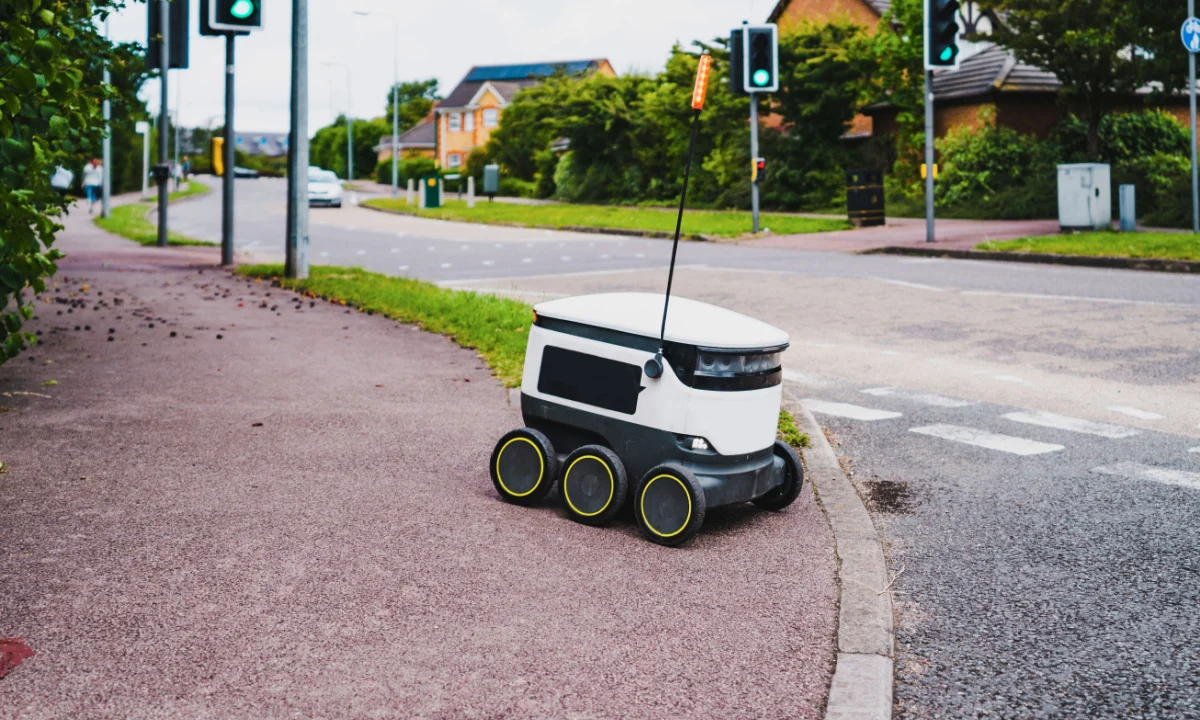
Historically, delivery automation has hit a physical wall. Sidewalk robots, such as those deployed by Serve Robotics, have proven that autonomous vehicles can operate safely and reliably on flat, paved surfaces. Yet, these robots are fundamentally limited by geometry: they cannot navigate stairs, steep inclines, or complex porch layouts. Consequently, they are relegated to urban centers with specific infrastructure, leaving the vast majority of suburban and residential deliveries to human drivers.
“So much of logistics is already automated, but we believe that the final frontier of logistics automation is that last 50 feet,” explains Marco da Silva, vice president and general manager for Spot at Boston Dynamics. For the industry, the goal is clear: transition from "curb-to-curb" delivery to "van-to-doorstep" delivery, removing the need for a human to leave the driver’s seat.
A Chronology of the Last-Mile Evolution
The trajectory of autonomous delivery has shifted from high-concept experimentation to aggressive, real-world deployment over the last several years.
- 2022: Amazon shuttered its “Scout” delivery robot program, a wheeled sidewalk vehicle that struggled to scale and lacked the physical versatility required for complex residential environments. This served as a sobering lesson for the industry: navigation is not enough; physical dexterity is mandatory.
- 2025: Serve Robotics achieved a landmark milestone, reaching a fleet size of 2,000 autonomous sidewalk robots across major U.S. cities, including Los Angeles, Dallas, and Chicago. Through partnerships with Uber Eats and DoorDash, Serve proved that autonomous delivery is commercially viable at scale—provided the terrain is flat.
- Late 2025: DoorDash introduced the “Dot” robot in Arizona. While it showcased improved navigation and doorframe clearance, it remained tethered to ground-level delivery, reinforcing the “staircase dilemma.”
- March 2026: In a pivotal move, Amazon acquired Rivr, a Zurich-based robotics startup. This acquisition signaled Amazon’s pivot toward legged-locomotion technology, integrating Rivr’s stair-climbing capabilities into its internal R&D roadmap.
- Mid-2026: Boston Dynamics intensified its pilot programs for Spot, focusing on a “delivery assistant” model where the robot acts as an extension of the human driver, handling the final 50-foot journey to improve driver efficiency and reduce physical fatigue.
Supporting Data: The Economics of Automation
The business case for these robots rests on a delicate balance between unit cost and delivery volume. Boston Dynamics’ Spot, for instance, carries a price tag of roughly $75,000. For a retail or logistics firm to justify this capital expenditure, the robot must reliably handle a high volume of packages—Boston Dynamics’ current pilot target is 200 packages per day, five days a week.
The scale of the opportunity is equally massive. Serve Robotics has successfully demonstrated that Level 4 autonomy (operation without a human safety driver) can achieve a 99.8% completion rate on sidewalks. However, the data for porch-based robots is still in its infancy. Unlike sidewalk bots that operate on a predictable grid, porch robots must contend with:
- Dynamic Obstacles: Toys, debris, and pets.
- Structural Variability: Varying stair heights, gravel, ice, and uneven pavers.
- Precision Requirements: The ability to place a fragile item, such as a carton of eggs, without damage.
As Nvidia CEO Jensen Huang noted at CES in January 2026, we are currently in the “ChatGPT moment for robotics.” The current thesis is that the winners of this race will be determined by data. The more a robot navigates the real world, the better its “Physical AI” models become. Every successful delivery is a data point that trains the next generation of movement algorithms.
The Strategic Battle: Amazon vs. The Specialists
The current market is bifurcated between specialized robotics firms and massive retail conglomerates.
Boston Dynamics represents the hardware-first approach. Their Spot robot utilizes four-legged locomotion, providing unmatched agility on highly unstructured terrain. By opting for legs over wheels, they prioritize mobility over raw speed. As Paige Miller, Spot’s product manager, notes, “Companies have tried drones, but they haven’t been able to get to the porch, and so packages were being left in the middle of the yard. We’ve also seen the struggles of various wheeled robots.”
Amazon, through its acquisition of Rivr, is pursuing a hybrid philosophy. Rivr’s robots utilize a combination of wheels and legs, aiming to marry the speed of wheeled transport with the dexterity of legged movement. This suggests that Amazon is looking to optimize for the entire last-mile journey, from the van to the door, rather than just the final flight of stairs. By leveraging its Industrial Innovation Fund—which had previously invested in Rivr—Amazon is effectively hedging its bets to ensure it does not lose its dominance in logistics to a third-party robotics provider.
Implications for the Future of Labor and Logistics
The automation of the last 50 feet carries profound implications for the future of work and urban infrastructure.
- Redefining the Delivery Driver: The objective of these robots is not necessarily to replace the driver entirely, but to redefine their role. By delegating the heavy lifting and the final 50-foot walk to a robot, the driver can remain in the vehicle, managing the robot’s progress, optimizing the route in real-time, and focusing on complex tasks that require human judgment.
- Infrastructure Adaptation: As these robots become common, cities may need to adapt. We are already seeing “robot-friendly” architecture in new residential developments. In the future, the design of porches, stairways, and curb-cuts will likely be influenced by the physical constraints of the robots that service them.
- The Cost-Volume Threshold: The ultimate success of these technologies hinges on the “hardware cost vs. delivery volume” equation. If a $75,000 robot can save a company $2 per delivery by reducing labor time, the return on investment is clear. However, if the maintenance, charging, and software overheads exceed those savings, the transition will remain stalled in the pilot phase.
Conclusion
The race to conquer the last 50 feet is the final frontier in a decades-long pursuit of logistics perfection. While sidewalk robots have mastered the flat, and human drivers have mastered the complex, the next few years will determine whether a robot can successfully navigate the chaos of the average American porch at scale.
For now, the industry is in a data-collection phase. The robot that can reliably climb a set of stairs, identify the correct door, place a package with precision, and operate for thousands of cycles without a maintenance failure has yet to be fully realized. However, with Amazon, Boston Dynamics, and a growing ecosystem of AI-driven startups pouring capital into the space, the "porch gap" is closing faster than ever before. The question is no longer if the porch will be automated, but which architecture—legged, wheeled, or hybrid—will win the right to deliver the future.