









Main Facts
As of January 2026, the federal provision shielding forgiven student loan balances from taxation has officially expired, bringing back what financial planners call the student loan "tax bomb."
Under current regulations governing income-driven repayment (IDR) plans in the private sector, any remaining balance forgiven after 20, 25, or 30 years of qualifying payments is treated by the Internal Revenue Service (IRS) as taxable ordinary income. Borrowers who cross the finish line of their repayment terms will receive a Form 1099-C from their loan servicer, treating the forgiven balance as if it were a massive, one-time cash bonus earned in a single calendar year.
While Public Service Loan Forgiveness (PSLF) remains entirely tax-free, private-sector IDR forgiveness no longer enjoys this protection. For high-debt professionals—such as physicians, dentists, attorneys, and veterinarians
—forgiven balances frequently range from $100,000 to over $400,000. Under ordinary income tax brackets, this translates into five- or six-figure federal and state tax liabilities coming due all at once.
Despite the panic this induces, two primary safety valves exist:
- The Insolvency Exclusion: Borrowers whose total liabilities exceed their total assets at the exact moment of forgiveness can use IRS Form 982 to shelter some or all of the forgiven sum from taxation.
- The Anticipation of Future Legislation: Financial experts predict that as thousands of borrowers begin receiving surprise tax bills, mounting public pressure may eventually force Congress to permanently repeal the tax.
Chronology: How We Got Here
To understand how the tax bomb returned to the forefront of personal finance, it is necessary to examine the legislative timeline governing student loan relief over the past decade.
- Pre-2021: Under traditional tax code guidelines, the cancellation or forgiveness of debt—including federal student loans—was classified as taxable income. Borrowers on IDR plans faced the tax bomb upon completing their 20- to 25-year terms.
- March 2021: Congress passed the American Rescue Plan Act, which included a landmark provision making all student loan forgiveness tax-free through December 31, 2025. Because this bill was enacted via budget reconciliation to bypass a Senate filibuster, the tax-free provision was legally required to be temporary.
- 2024: Following the federal elections, a new political alignment took control of the White House and Congress. Because the temporary provision carried an automatic expiration date, lawmakers did not need to pass new legislation to revive the tax bomb; they simply allowed the sunset clause to take effect.
- Throughout 2025: Borrowers who reached their final payment milestones during this calendar year were protected under the dying provisions of the American Rescue Plan. Even administrative processing delays by the U.S. Department of Education that spilled into late 2025 generally retained their tax-free status.
- January 2026: The expiration date arrived. Forgiveness granted under private-sector IDR plans officially became taxable income once again.
- Early 2027 (Anticipated): The first large wave of post-expiration IDR forgiveness milestones will prompt servicers to issue 1099-C forms. Tax preparers and accountants will face an unprecedented influx of clients grappling with unexpected, massive tax bills, setting the stage for potential political fallout and renewed legislative lobbying.
Supporting Data and Financial Realities
The mechanics of the tax bomb reveal a profound mismatch between modern professional wealth accumulation and IRS definitions of liquidity.
The Scale of the Bill
Consider a borrower with $350,000 in underlying student loans who spent 25 years making income-driven payments. Upon forgiveness, the servicer reports $350,000 of canceled debt to the IRS via Form 1099-C. If that borrower falls into the top federal tax bracket, alongside state income taxes, the resulting bill can easily eclipse $120,000 to $150,000.
The Insolvency Dilemma
The IRS provides an escape hatch through the insolvency exclusion. If a taxpayer is insolvent—meaning their total liabilities exceed the fair market value of all assets—at the time the debt is canceled, they are not required to pay taxes on the forgiven amount, up to the exact dollar amount of their insolvency.
However, professionals with advanced degrees frequently do not qualify for insolvency by the time they reach their 40s, 50s, or 60s. A dentist who has spent decades building a dental practice, purchasing a family home, and steadily funding a 401(k) retirement plan will often possess a net worth well above zero. On paper, they are solvent. Consequently, IRS Form 982 offers them no relief.
The Illiquidity Problem
Even among high-earning professionals, liquid cash reserves rarely match the scale of a six-figure tax assessment. Net worth is almost universally tied up in three primary illiquid asset classes:
- Real Estate: Primary residential equity cannot be easily tapped to pay a sudden tax liability without incurring refinancing costs or selling the home.
- Retirement Accounts: Withdrawing funds from a 401(k) or traditional IRA before age 59½ triggers ordinary income taxes plus a harsh 10% early withdrawal penalty.
- Private Businesses: Owning a medical or professional practice means capital is tied up in equipment, real estate, and accounts receivable, not sitting in a checking account.
Faced with a sudden tax bill and no liquid cash, borrowers are forced into uncomfortable compromises—such as liquidating long-term investments, taking out high-interest personal loans, or negotiating restrictive installment agreements with the IRS.
Official Responses and Expert Perspectives
Financial advisors, tax specialists, and policy analysts have offered varying assessments of the crisis, balancing cautious optimism regarding future legislative intervention against the necessity of immediate contingency planning.
The Legislative Outlook
Many policy analysts believe the tax bomb will ultimately meet a permanent legislative end. The reasoning is straightforward: when tens of thousands of middle- and upper-middle-class professionals—including teachers, nurses, and small-business medical practitioners—receive five-figure tax bills for money they never physically possessed, public backlash is swift and bipartisan.
Financial planners frequently advise clients to adopt a "wait-and-see" mindset regarding long-term policy shifts, noting that political pressure in 2027 or 2028 could prompt retroactive or prospective tax relief similar to the American Rescue Plan.
The Proactive Preparation Strategy
Despite the probability of future legislative fixes, trusted advisory firms strongly discourage passive inaction. Financial planners recommend establishing a dedicated, post-tax brokerage account specifically earmarked as a "tax bomb reserve."
By systematically contributing a manageable monthly sum into a taxable brokerage account over the course of a 20- or 25-year repayment plan, borrowers accomplish two vital goals:
- Guaranteed Liquidity: Unlike retirement accounts, a standard brokerage account allows penalty-free withdrawals at any age, providing immediate cash to satisfy an IRS assessment without disrupting a primary residence or business.
- A Win-Win Financial Outcome: If the tax bomb is ultimately repealed by Congress—a scenario many experts consider likely—the borrower is left with a substantial pool of accumulated wealth that can be drawn upon for early retirement, long before traditional retirement accounts become accessible at age 59½.
Implications for Borrowers
The reinstatement of the student loan tax bomb fundamentally alters the calculus of long-term debt management for millions of Americans navigating private-sector IDR plans.
1. A Shift in Repayment Strategy
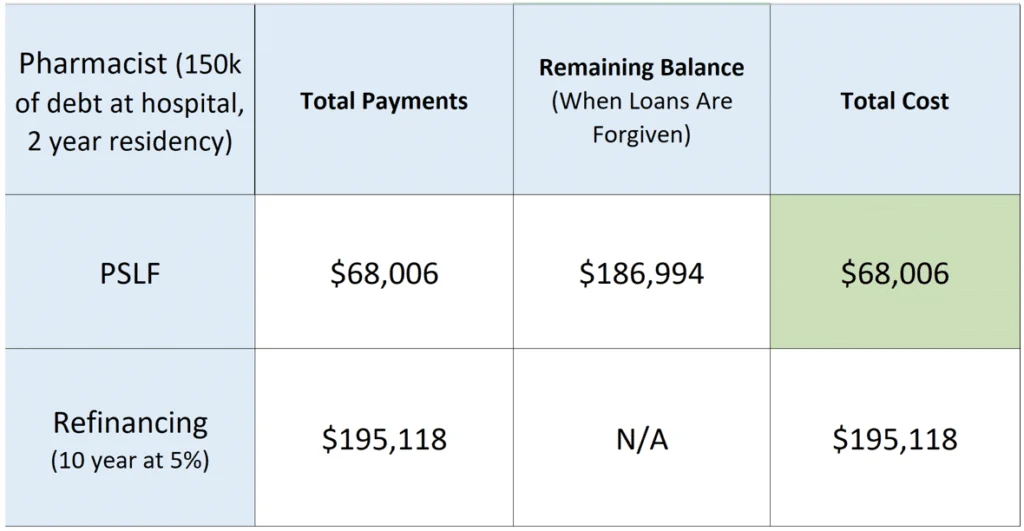
Borrowers must carefully weigh the total lifecycle cost of staying on an income-driven repayment plan versus alternative paths, such as aggressive refinancing or pursuing Public Service Loan Forgiveness (PSLF). Because PSLF remains permanently exempt from taxation, public-sector workers retain a distinct financial advantage over private-sector peers facing potential tax liabilities.
2. The Necessity of Holistic Financial Planning
Relying solely on loan calculators is no longer sufficient. Student loan strategy must now be integrated directly with tax planning, estate planning, and asset allocation. Working alongside specialized tax professionals who understand IRS Form 982 and insolvency calculations is essential for minimizing exposure.
3. Psychological and Emotional Well-Being
The looming threat of an arbitrary, multi-thousand-dollar tax penalty can create chronic financial anxiety. Experts emphasize that while the threat is real, it is entirely manageable with disciplined, early-stage saving habits. By treating the potential tax bomb as an operational expense and building a parallel investment vehicle, borrowers can neutralize the threat entirely—transforming a potential financial crisis into an enforced wealth-building engine.