








By Leland McFarland
Published in Small Business Trends
Artificial intelligence has rapidly transitioned from a futuristic novelty into the operational backbone of modern commerce. For small and medium-sized businesses (SMBs), AI tools offer unprecedented leverage—automating administrative tasks, accelerating customer service, drafting marketing materials, and allowing lean teams to punch well above their weight class.
Yet, this technological leap has birthed an invisible and potentially catastrophic blind spot: Shadow AI.
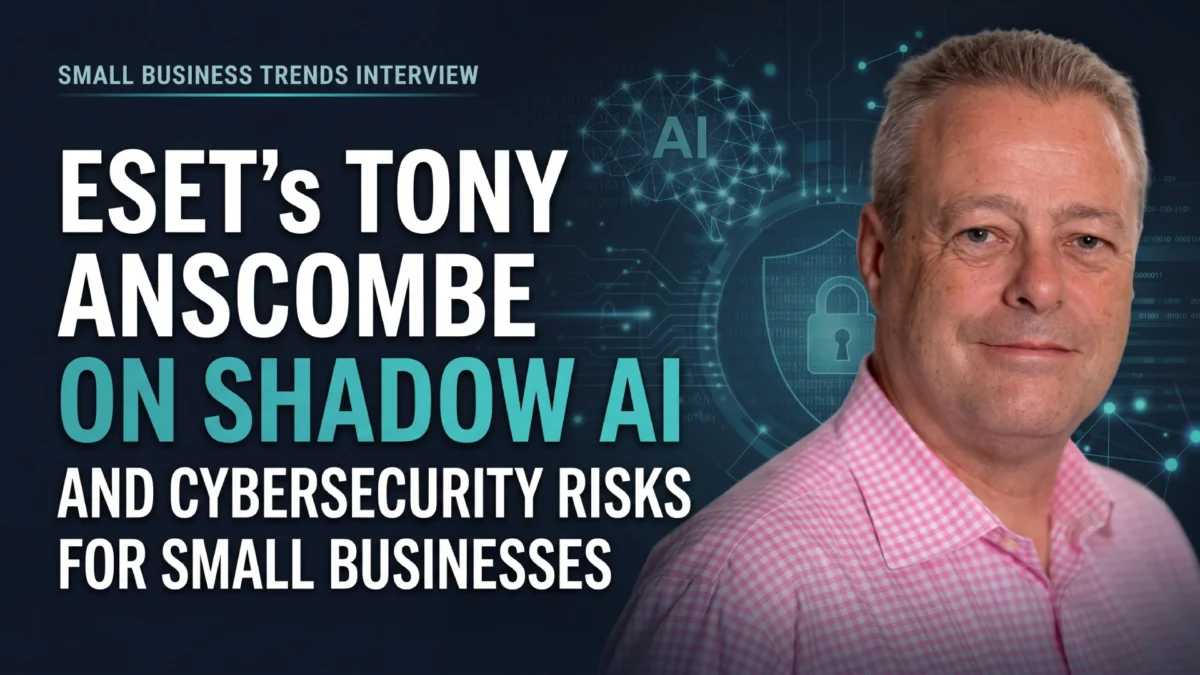
As employees increasingly turn to generative AI and language models to lighten their workloads, many companies are discovering that convenience comes tethered to severe cybersecurity vulnerabilities. To unpack these escalating risks, practical guardrails, and the evolving threat landscape, I recently sat down with Tony Anscombe, Chief Security Evangelist at ESET.
The Main Facts: The Rise of Shadow AI and SMB Vulnerabilities
The conversation with Anscombe shed light on a fundamental disconnect in the modern workplace. According to recent ESET small business cyber readiness surveys, 81% of U.S. SMB respondents are aggressively integrating AI into their operations. Concurrently, 75% acknowledge that this integration introduces novel risks.
At the heart of these risks is Shadow AI—the unapproved, unmonitored use of artificial intelligence applications by employees. Whether staff members are pasting sensitive client lists into public chatbots or deploying unauthorized browser plugins, these actions expose enterprises to data leakage, compliance violations, and intellectual property theft.
Crucially, smaller businesses often lack dedicated IT departments or Chief Information Security Officers (CISOs). When the business owner is also the IT manager, the challenge of tracking every piece of software or chat interface operating across employee devices becomes exponentially harder.
Chronology of a Paradigm Shift: Parallels to the Remote Work Era
To understand how Shadow AI permeated the enterprise, Anscombe drew a historical parallel to the chaotic early days of the COVID-19 pandemic.
-
The Early Pandemic Precedent: When work-from-home mandates abruptly went into effect, employees rapidly adopted unvetted file-sharing platforms and conferencing systems to maintain continuity. Enterprises were forced into a reactive stance, scrambling to establish guardrails after the tools were already deeply
entrenched.
- The Current AI Inflection Point: Companies find themselves at an identical juncture today. Without explicit company-wide policies designating approved AI platforms and security guardrails, employees naturally default to whatever tools are easiest to access—often on personal devices via Bring Your Own Device (BYOD) protocols.
- The Scale of the Threat: As AI capabilities expand from simple text generation to autonomous execution, the potential damage shifts from accidental data leaks to active, machine-driven compromise.
Supporting Data: Quantifying the AI Security Gap
The discussion underscored several critical data points derived from ESET’s ongoing cyber intelligence research:
- The Confidence Paradox: A staggering 87% of U.S. businesses surveyed expressed strong confidence in their cybersecurity resilience. However, 54% simultaneously admitted to experiencing at least one cyber incident over the previous year. Anscombe attributes this paradox to a shift in baseline expectations: while incidents have become an accepted norm, businesses feel confident in their recovery mechanisms unless hit by a catastrophic event.
- Complexity Over Budget: When asked what barriers prevent better cybersecurity posture, 29% of respondents cited complexity and integration challenges, outstripping the 19% who pointed to budget limitations. Modern security requires real-time analysis, which is difficult for resource-constrained firms to manage internally.
- The Danger of Malicious AI Skills: In a recent ESET scan of approximately 900,000 publicly listed AI skills and extensions over a four-month period, researchers identified roughly 3,000 malicious or heavily compromised tools (amounting to roughly 0.3%). While the percentage appears small, downloading a single weaponized skill can allow threat actors to execute credential theft, self-obfuscate, or download secondary malware payloads directly into a business network.
Official Insights and Expert Guidance: A Conversation with Tony Anscombe
Defining the Threat and Preventing Data Leaks
Leland McFarland: What is shadow AI, and why should small business owners care?
Tony Anscombe: “It’s using something without the company’s approval… You don’t really know where the data is going, you don’t know what’s providing the answers, and employees will go and do it.”
Anscombe noted that everyday tasks—such as summarizing an email, analyzing a spreadsheet, or drafting a client proposal—frequently involve uploading sensitive data to publicly trained Large Language Models (LLMs). Once uploaded, that data can become part of the model’s permanent training corpus.
For small businesses, this creates immediate hazards:
- Financial Data: Uploading sales projections or revenue trends to public models exposes proprietary commercial metrics.
- Contracts and Intellectual Property: Pasting legal agreements or proprietary manufacturing recipes into a chatbot strips away the organization’s unique competitive advantages.
- Customer Information: Mishandling personally identifiable information (PII) triggers severe legal and compliance penalties under data privacy regulations.
Establishing Practical Guardrails
Rather than imposing heavy-handed, counterproductive bans, Anscombe advises business owners to implement straightforward, practical frameworks:
- Draft a One-Page Policy: Create a concise document clearly outlining approved versus prohibited tools, rules regarding data cut-and-pasting, and a mandatory fact-verification step for any AI-generated output directed at clients.
- Invest in Paid Business Tiers: Transitioning from free consumer AI tools to paid enterprise subscriptions allows organizations to explicitly exclude their operational data from training public models, thereby preserving intellectual property rights.
- Treat AI Agents Like Employees: When deploying autonomous AI agents that connect to file systems or operational workflows, business owners must practice strict "siloing." An agent should only be granted access to the specific datasets required for its assigned task—much like you would segment permissions for human personnel. Furthermore, high-stakes actions like financial transfers, bulk database modifications, or pricing updates should always require human authorization.
Remediation When Things Go Wrong
If an employee admits to uploading confidential files to an unapproved application, swift action is imperative. Anscombe recommends securing the account immediately, downloading and saving a copy of the chat history, wiping the platform’s session data, and submitting a formal deletion request to the AI provider, citing the inclusion of sensitive corporate or personal information.
Implications for Small Businesses: Moving Forward
The primary takeaway from our discussion is clear: securing AI adoption does not require an enterprise-sized budget; it requires intentionality and visibility.
1. Conduct an Internal Audit
Before purchasing complex security overlays, business owners must map their current landscape. An internal audit identifying who is using what tools provides the foundational knowledge necessary to address vulnerabilities.
2. Recognize the Limits of Consumer Products
Small business owners should avoid utilizing consumer-grade security software. Business-grade solutions are specifically packaged to handle modern requirements, including vulnerability patch management, multi-factor authentication (MFA), and data encryption.
3. Embrace Managed Detection and Response (MDR)
Given the complexity of modern threat vectors and the reality that most small businesses cannot afford a 24/7 internal security team, Anscombe strongly recommends outsourcing endpoint protection to Managed Detection and Response (MDR) providers. Having professional security analysts monitoring systems during off-hours ensures that malicious code or active breaches are intercepted before turning catastrophic.
Conclusion
As artificial intelligence continues to reshape the commercial landscape, small businesses that weave security directly into their adoption strategies will thrive. By establishing clear policies, vetting third-party tools, and treating AI agents with the same rigorous access controls as human employees, business owners can safely harness productivity gains while safeguarding their most vital asset: trust.
For further guidance on AI risk management, business owners can consult the comprehensive frameworks provided by ESET, the educational resources at WeLiveSecurity, and the National Institute of Standards and Technology (NIST) AI Risk Management Framework.
More in: ESET