








In an era where the modern internet is built upon a precarious "house of cards" of third-party dependencies, a major security breach has once again exposed the fragility of the digital supply chain. Over a 24-hour window, at least 178 top-tier web destinations—including household names like the BBC, CNN, Equifax, Ledger, and Zoom—unwittingly served malicious payloads to their unsuspecting visitors.
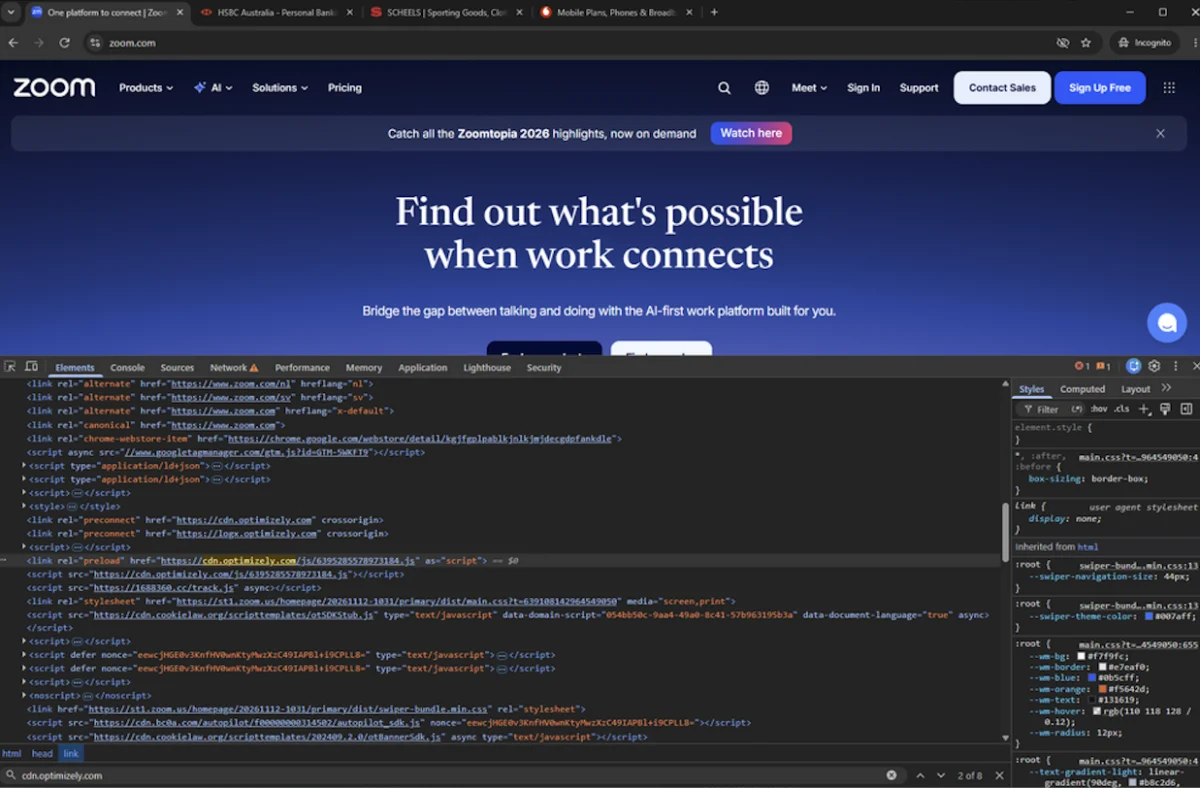
The vector for this widespread infection was a security vulnerability within the platform of Optimizely, a ubiquitous software suite used by major corporations to manage A/B testing, user experience customization, and feature deployment. The incident serves as a stark reminder that in the modern web ecosystem, a company’s security is only as strong as its weakest third-party vendor.
Chronology of the Incident: November 16, 2026
The breach, which was first brought to light by security researchers at Report URI, unfolded with alarming speed and precision on November 16, 2026.
- Early Morning (Initial Injection): Threat actors identified and exploited a vulnerability within the Optimizely Experimentation platform. This allowed them to inject unauthorized, malicious JavaScript code directly into the customer projects hosted on Optimizely’s infrastructure.
- Active Exploitation: Once the code was injected, it was served to every user who visited the affected sites. Researcher Scott Helme noted that the malicious payload was remarkably dynamic; the attackers rebuilt and modified the malware kit 26 times throughout the day to evade detection and expand its capabilities.
- The Payload: The malicious script was designed for maximum impact. It was engineered to harvest payment card data, intercept browser cookies, and capture screenshots. Furthermore, it possessed a sophisticated "man-in-the-browser" capability that could dynamically swap cryptocurrency wallet addresses on payment pages, redirecting funds directly to the attackers.
- Mobile Exploitation: Beyond standard data theft, the payload included custom-built exploit kits known as "DarkSword" and "Coruna." These tools targeted specific, known vulnerabilities in older Apple iOS devices, chaining together multiple security holes to achieve "zero-click" remote code execution, granting the attackers complete control over the users’ mobile hardware.
- Containment: By the following day, Optimizely had identified the root cause and implemented a series of containment measures. These included blocking the vulnerable code paths, revoking compromised tokens, and purging the malicious scripts from client projects.
The Anatomy of a Supply Chain Attack
To understand the scale of this disaster, one must understand how modern websites function. According to the 2025 Web Almanac by the HTTP Archive, the median website homepage loads at least 22 distinct JavaScript files. These files are often pulled from third-party servers, allowing site operators to outsource complex functionality like analytics, tracking, and A/B testing.
However, as Zach Edwards, a researcher at Infoblox and co-founder of the tracking-analysis service DecryptAds, points out, this convenience comes at a severe security cost.
"Optimizely is typically embedded as close to the top of the page as possible to ensure it renders immediately for A/B testing," Edwards explained. "Because this code is designed to fire on-load to prevent page flickering, it often bypasses user consent dialogs entirely. The supply chain attack didn’t require the victim to click on anything; the mere act of loading the webpage was enough to trigger the malicious payload."
This highlights a fundamental shift in cyber warfare. Attackers no longer need to breach the firewalls of a major organization like CNN or the BBC. Instead, they target the "middlemen"—the third-party software providers that these organizations trust implicitly. By compromising one central vendor, the attackers gained access to 178 premium digital properties simultaneously.
Data and Vulnerability Analysis
The impact of the breach was significantly magnified by the industry-wide failure to implement robust Content Security Policies (CSPs). A CSP is a security layer that allows site administrators to restrict the domains from which a browser is allowed to load resources. If a site had a strictly configured CSP, the browser would have blocked the malicious script from reaching out to the attacker’s command-and-control server.
The data provided by Report URI is damning:
- 68 of the 178 affected sites had no CSP in place whatsoever, offering no protection against the unauthorized injection of third-party scripts.
- 50 sites had a CSP, but it was configured so permissively that it still allowed the malicious payload and the subsequent data exfiltration to occur.
- Only 24 sites (15%) had a CSP robust enough to fully block the malicious activity.
Scott Helme, who monitors the security posture of the top one million websites via his service crawler.ninja, suggests that the overall adoption of effective CSPs among top-tier sites remains stubbornly low, hovering around 10%. "Organizations are running all this code, but they don’t know what it’s doing," Helme remarked. "This was inevitable. Once an attacker gets to the point of running code on your site, the only remaining question is how much damage they can do. With the integration of AI-driven coding, writing these malicious scripts has become trivial."

Official Responses and Remediation
Optimizely has moved to manage the fallout through transparency and rapid patching. In an official statement and a detailed post-incident report released on November 18, the company acknowledged the breach of its "Experimentation" platform.
"We acted swiftly to contain the incident and have fully remediated the identified vulnerability," the company stated. "These measures included blocking access to the vulnerable path, deploying a fix, removing the injected code from affected projects, ending active sessions, revoking tokens, and resetting access for affected user accounts. We have also implemented additional protections to prevent malicious code from being delivered in Cloudflare."
While the company claims to be working with third-party security experts to conduct a comprehensive investigation, the incident has left a lingering question regarding the liability of SaaS (Software as a Service) providers when their platforms are turned into conduits for crime.
Broader Implications for the Digital Economy
The Optimizely breach is not an isolated event; it is a symptom of a systemic "trust" issue in the digital economy. The reliance on third-party JavaScript has created an environment where the web is inherently insecure by design.
1. The Death of Implicit Trust
For years, developers have treated third-party libraries as "safe" once they are integrated. This incident mandates a move toward a "Zero Trust" model for web scripts. Companies must move beyond simply vetting vendors during the procurement process and begin continuously monitoring the behavior of the scripts running on their sites.
2. The Role of CSPs
The findings demonstrate that Content Security Policies are no longer optional "best practices"; they are critical infrastructure. The industry must move away from permissive policies designed for ease of marketing and toward restrictive, granular policies that explicitly define allowed behavior.
3. The Burden on the End-User
While organizations are responsible for their own security, the average internet user remains vulnerable. Historically, security advice focused on installing antivirus software, but in 2026, the browser has become the primary battleground.
As noted by experts, modern ad-blocking and script-blocking software—such as uBlock Origin or similar privacy-focused extensions—function as the "firewall of the modern age." By blocking unnecessary third-party requests, these tools provide an essential layer of defense against supply chain attacks that the average user cannot defend against on their own.
Conclusion
The attack on Optimizely, which resulted in the theft of an estimated $7,500 in cryptocurrency and an untold volume of sensitive payment data, should serve as a wake-up call for the entire tech industry. We are currently living in the "Wild West" of the JavaScript era, where convenience is consistently prioritized over security.
Unless major web properties begin to audit their dependencies with the same intensity that they guard their internal databases, these supply chain attacks will only grow in scale and frequency. The lesson of November 2026 is clear: when it comes to the modern web, "trusted" JavaScript is a term that should be viewed with extreme skepticism. Organizations that continue to ignore the implementation of rigorous security controls are not just risking their data—they are risking the security of every single visitor who lands on their homepage.