








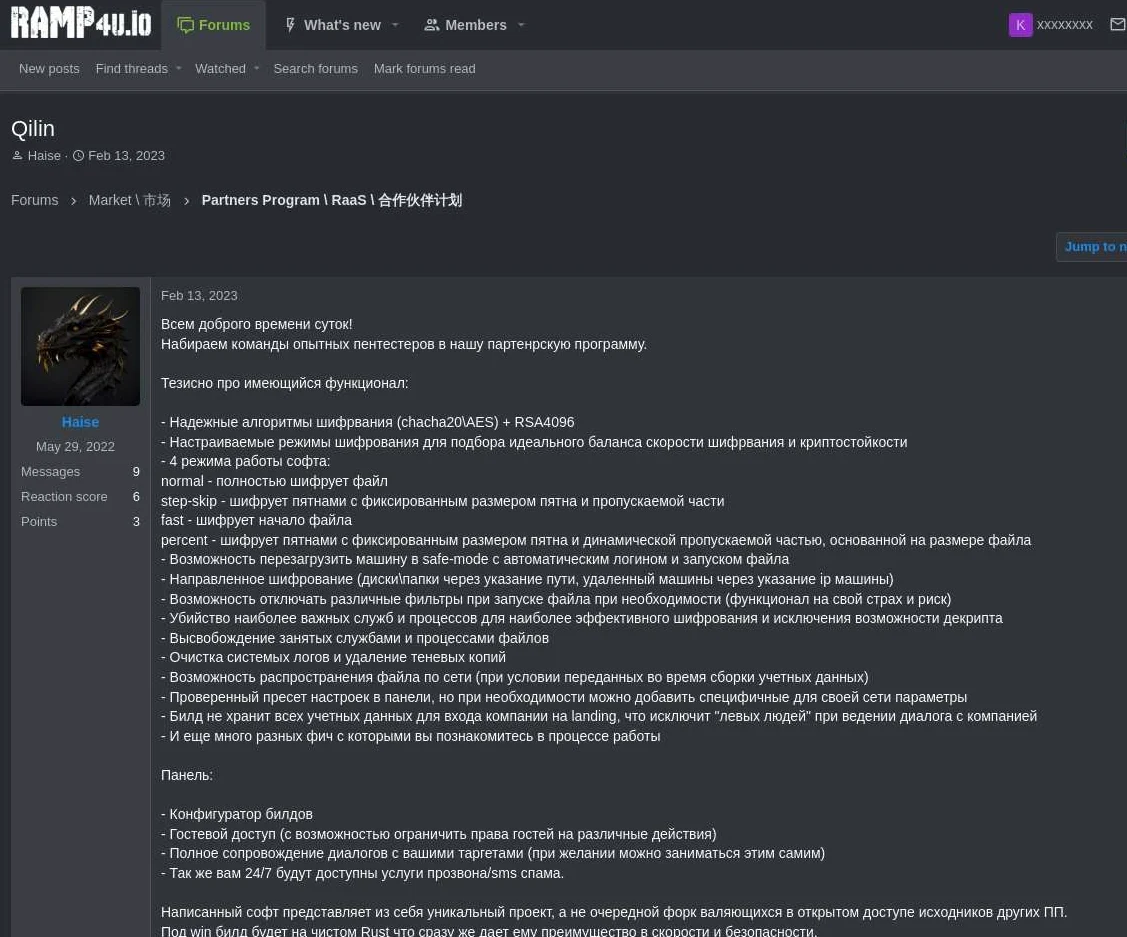
In the shadowy ecosystem of global cybercrime, few entities have demonstrated the operational scale and aggressive efficiency of the ransomware group known as Qilin. According to the latest quarterly threat intelligence report from the NCC Group, Qilin has firmly established itself as the world’s most industrious Ransomware-as-a-Service (RaaS) operation, claiming a staggering 365 victim organizations in just the last three months.
However, beneath the veneer of sophisticated encryption protocols and double-extortion tactics lies a trail of human error. Despite the perceived anonymity afforded by the dark web, the administrator of Qilin—a figure operating under the pseudonym "Haise"—has left a digital footprint spanning over a decade. A comprehensive forensic investigation, bolstered by AI-driven identity resolution and data from recent state-level breaches, has effectively de-anonymized the architect behind this criminal empire: a 36-year-old resident of St. Petersburg, Russia, named Aleksey Mikhailovich Yakovtsev.
The Rise of Qilin: A Blueprint for Digital Extortion
Qilin entered the cybercrime landscape in September 2022, rapidly distinguishing itself through a highly lucrative and collaborative business model. Unlike many of its peers, which restrict their affiliate networks to Russian-speaking actors, Qilin has aggressively recruited English-speaking hackers, creating a global pipeline for their malicious software.
Their operations rely on the "double extortion" model: affiliates infiltrate corporate networks, exfiltrate sensitive data, and then deploy ransomware to encrypt the victim’s systems. The threat is twofold—pay the ransom to restore access, or face the public release of confidential files. To incentivize this, Qilin offers its affiliates a minimum of 80 percent of all extorted funds. This generous split, combined with strategic partnerships with notorious groups like Scattered Spider and RansomHub, has allowed Qilin to dominate the threat landscape with unprecedented speed.
Chronology of a Criminal Identity
The de-anonymization of Haise is a masterclass in how historical data, when synthesized by modern intelligence tools, can dismantle the strongest "opsec" (operational security) walls. The process was not an overnight discovery, but a meticulous reconstruction of a digital life.
2018–2020: The Formative Years
Long before the moniker "Haise" became a household name in the cybersecurity community, the individual behind the screen operated under the handle "Rjun." Between 2018 and 2019, Rjun was a fledgling participant in Russian cybercrime forums, focusing on relatively low-level activities such as credit card fraud and small-scale arbitrage.
By 2020, Rjun’s ambitions—and capabilities—had expanded. He became a fixture on established forums like Exploit and XSS. It was during this period that he began using the Telegram handle "Alexbigboss44." Flashpoint, a cyber intelligence platform, noted that during this phase, the user focused on the acquisition of Facebook logs and Google Ads accounts to facilitate large-scale advertising fraud and gambling schemes. He had shifted from a novice fraudster to a broker, managing a complex network of traffickers and compromised data conduits.

2022: The Birth of "Haise" and the RAMP Connection
In June 2022, as the Qilin project took shape, the user now known as Haise sought a more exclusive venue to advertise his services. He applied for membership to RAMP (Ransomware Anonymous Market Place), a prestigious and highly guarded Russian forum.
Intelligence gathered by Intel 471, which indexed private messages from the RAMP forum before its seizure by the FBI in January 2026, shows the RAMP administrator approving Haise’s application. Crucially, the records link Haise directly to the Telegram username "Alexbigboss44," providing the missing link between the Qilin kingpin and the earlier identity of Rjun.
2023–2026: The Digital Paper Trail
The final phase of the identification process relied on the consolidation of leaked databases. The email address [email protected], used by Rjun to register on multiple criminal forums, served as the master key. When cross-referenced with breach data from gosuslugi.ru—the official Russian state services portal—researchers found that the address was linked to a specific identity: Aleksey Mikhailovich Yakovtsev, born August 18, 1990.
Supporting Data: The Convergence of Evidence
The evidence against Yakovtsev is multi-layered, moving beyond simple handle associations to verifiable physical and biographical data.
Stylometry and Behavioral Analysis
The AI-based platform IntelHawk played a critical role in confirming the identity. By analyzing "stylometry"—the distinct linguistic patterns, syntax, and vocabulary choices used by a writer—IntelHawk confirmed that the posts made by Rjun, Alexbigboss44, and Haise were authored by the same individual. The progression from an amateur arbitrageur to a professional ransomware operator follows a logical, documented career path in the cybercriminal underground.
The Role of Compromised State Data
The breach of the gosuslugi.ru platform in 2025 was a watershed moment for threat intelligence. It exposed the personal details of 20 million Russian citizens, including Yakovtsev. This data confirmed his age, full name, and residential region. Furthermore, records from Rosobrnadzor, the Russian education watchdog, validated that Yakovtsev was educated in Murmansk and possesses a master’s degree in computing and information systems—a background that aligns perfectly with the technical sophistication required to manage a global ransomware operation.
The Family Connection
Perhaps the most damning evidence comes from the phone number associated with the Telegram ID used by Haise (+79602347275). While the number was registered to Yakovtsev’s biological sister, forensic investigators found that Yakovtsev frequently used his sister’s contact information and email addresses to register for services, a common but dangerous practice that ultimately bridged the gap between his criminal activity and his private life.

Travel and Lifestyle Patterns
Flight records obtained from breached Russian travel agencies provide a window into Yakovtsev’s physical movements. The records show him traveling frequently between St. Petersburg and Murmansk in his younger years, and more recently, between St. Petersburg and Sochi. These movements corroborate the digital geography associated with his logins and account activity.
Official Responses and the Challenge of Jurisdiction
Attempts to reach Mr. Yakovtsev for comment via his associated phone numbers and email addresses have yielded no response. Given the geopolitical climate, the prospect of his arrest remains complex. While his identity is now public knowledge, he resides within the borders of the Russian Federation, a country that has historically been reluctant to extradite cybercriminals, particularly those whose activities primarily target Western entities.
Security firms and law enforcement agencies are currently reviewing the findings. The case of Qilin serves as a stark reminder that even the most "professional" cybercriminal syndicates are vulnerable to the inherent fallibility of human behavior.
Implications for the Future of Ransomware
The unmasking of the Qilin administrator has profound implications for the RaaS model.
- The Fragility of Anonymity: This case proves that there is no such thing as "absolute" anonymity. Every digital alias, when held for a long enough period, risks being tied to a physical reality through metadata, stylometry, and leaked secondary databases.
- The "Insider" Threat to RaaS: Qilin’s success was built on recruiting external affiliates. However, the same platform that allowed for such growth—Telegram and private forums—is also a playground for intelligence agencies and security researchers. By engaging in the very forums they use to recruit, administrators often leave the breadcrumbs that lead to their own undoing.
- The Shift in Intelligence: The use of AI-based platforms like IntelHawk represents a new era in cybersecurity. It is no longer just about monitoring malware; it is about profiling the individuals behind it. The ability to aggregate thousands of disparate data points—from old forum posts to airline records—is becoming the new standard in threat intelligence.
As the cyber-threat landscape continues to evolve, the "Haise" case will likely be cited as a seminal moment in the war on ransomware. It highlights a critical truth: while these groups may hide behind layers of encryption and international borders, they are still fundamentally driven by human beings—beings who, despite their brilliance in code, are prone to the simple, fatal mistake of leaving their past behind in the public record.